

Tom Moore got the call just before Christmas in 2021. The head of the University of Durham’s Archaeology department, Mr. Moore was well-known in history circles in Yorkshire, in northeast England. It was why he had received the urgent message, from a man who claimed to have stumbled on something big.
“I think it’s Iron Age,” said the caller, Peter Heads, an amateur metal detectorist. And then, no one said a word.
Now, after more than three years of painstaking excavation, conducted in near-total secrecy, Mr. Moore and his colleagues say that it could be one of the most significant archaeological finds in northern England — and could change historians’ understanding of the Iron Age, around 2,000 years ago.
“Quite simply, this is one of the most important and exciting Iron Age period discoveries made in the U.K.,” Duncan Wilson, the chief executive of the government agency Historic England, said in a statement this week. “It sheds new light on Iron Age life in the north and Britain, but it also demonstrates connections with Europe.”
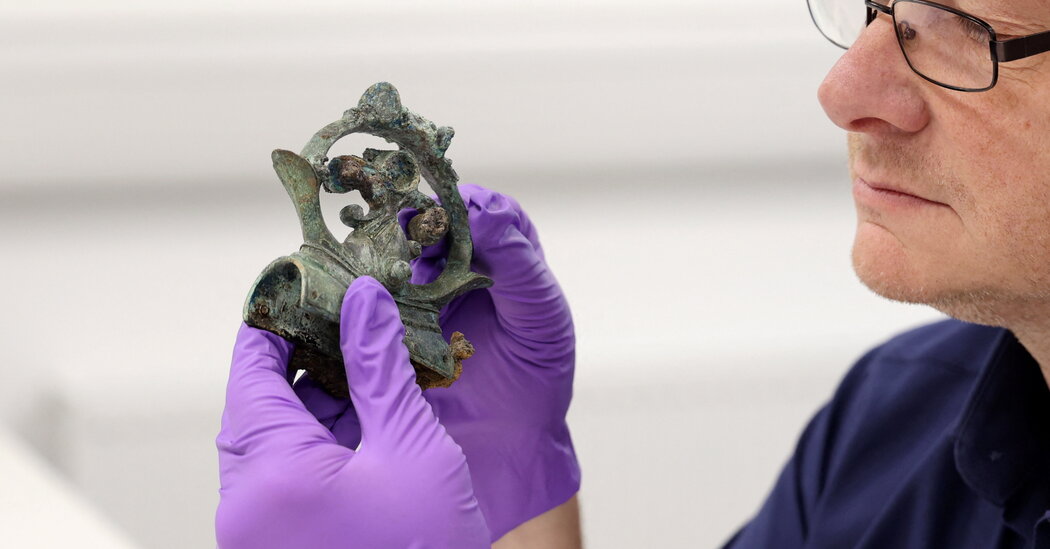
Since Mr. Heads’s finding in 2021, a team of archaeologists working at the site has collected a total of more than 800 objects, most dating to the Iron Age. Among them are cauldrons, a wine-mixing bowl, coral-coated horse harnesses and ceremonial spears.
They also include 28 iron wheels, presumably from a chariot or wagon — the kinds of transportation mechanisms never before believed to have existed in such size and scope among the elite of Britain’s Iron Age.
Experts said that the collection of artifacts — dubbed the Melsonby hoard, for the North Yorkshire town where it was found — stands as an example of how Britain’s complicated treasure laws can work to safeguard potential finds. British law defines anything older than 300 years and consisting of at least 10 percent precious metal as “treasure,” and thus the property of the British crown.
After Mr. Heads stumbled on a few pieces of ancient metal, his decision to immediately notify local historians allowed them to quickly protect the site and begin moving the discovery through the legal process.
“It was all done very quietly,” said Professor Moore, who led the excavation.
He said that the secrecy was partly to ensure that other, less conscientious detectorists did not try to access the site, and partly so the area could be preserved until the artifacts could be evaluated by British authorities. They eventually assessed the find to be worth around 254,000 pounds (about $329,000).
“It was a very responsible metal detectorist who alerted the archaeologists when he found some of the objects,” Mr. Wilson said in an interview. “It was a very good example.”
Not everyone shows as much familiarity with the laws as Mr. Heads. Britain’s rules governing metal detecting require dutiful adherence to reporting requirements, with potential legal consequences for failing to do so.
People can use metal detectors on private land with the landowner’s permission, but if they discover something that might be considered treasure, they are required to report it. If the item is determined to be treasure, it becomes the property of the government, which manages its potential acquisition by museums. Proceeds from any sale are split between the detectorists and the landowner.
Mr. Heads stumbled on the Melsonby hoard while detecting on the property of a friendly landowner. After digging a few holes and recognizing the potential value of the find, he contacted Mr. Moore, whom he knew from working in the area.
“I said to him, ‘Don’t dig it out,’” recalled Mr. Moore. “‘Stop, and I’ll bring a team.’”
Officials are working to get the hoard to the Yorkshire Museum, which is running a crowdfunding effort to purchase the collection.
“This is a Yorkshire story. This is a history of the place, of the people who organized North Yorkshire,” said Adam Parker, the museum’s curator of archaeology. “We think it’s very important for it to be retained in the north.”
For Mr. Parker, Mr. Moore and their colleagues, to finally be able to talk publicly about the Melsonby find is a relief. The discovery was kept quiet for years as the items progressed through the treasures assessment process, keeping them from discussing the matter with other experts.
“We’re really excited now,” Mr. Moore said. “We can kind of start the research process.”