

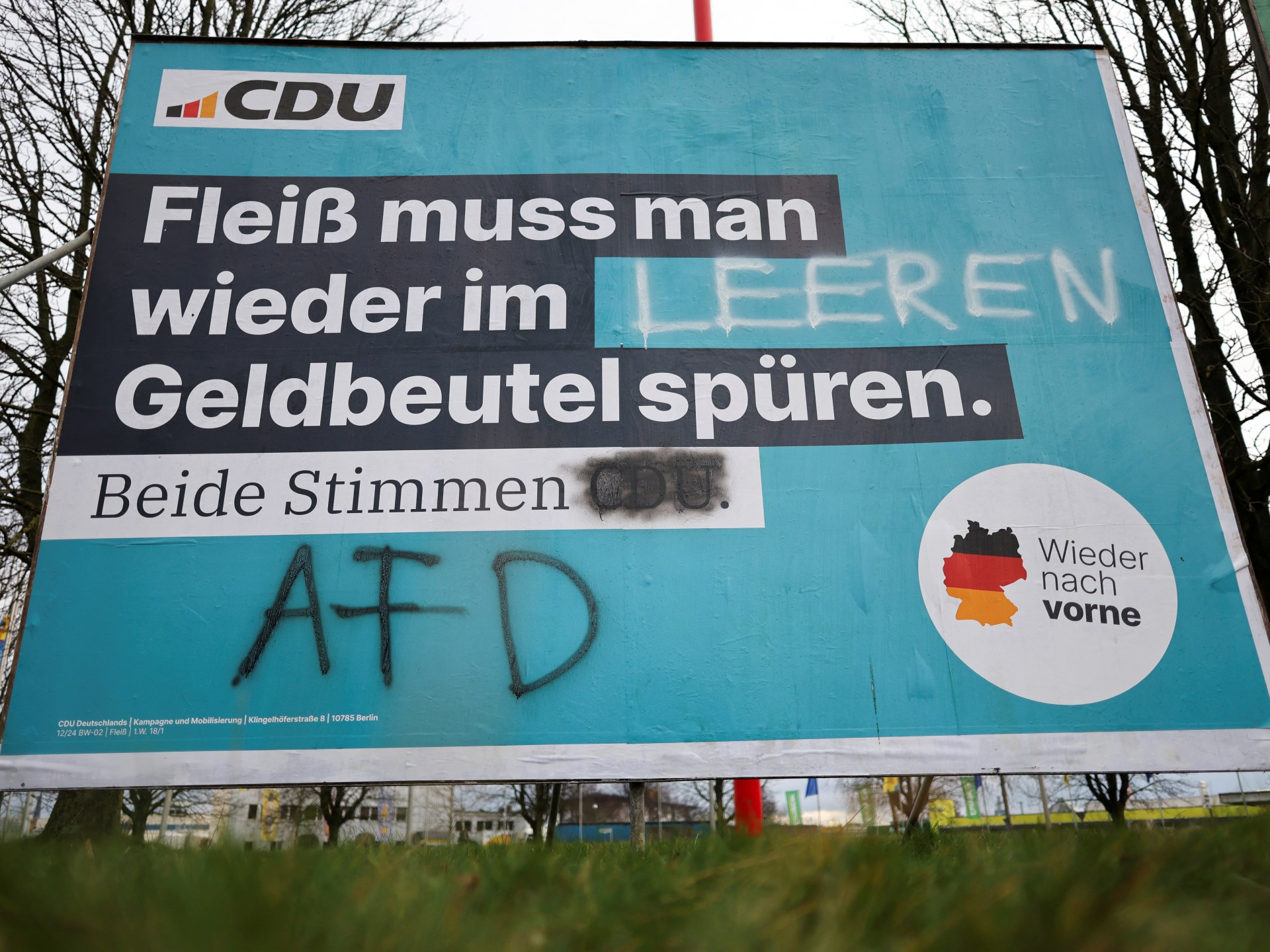
Germans would be hard-pressed to find a time when their political landscape was as fragmented as it is days ahead of Sunday’s federal election.
For the first time since World War II, Germany’s two traditional political locomotives are set to garner less than half the national vote.
The ruling centre-left Social Democratic Party (SPD), expecting to tumble out of a four-year term in office – their shortest since the war – are polling at an embarrassing 16 percent, a post-war low.
The once-dominant, centre-right Christian Democratic Union (CDU), in power for 51 of the past 75 years, is in the lead, but with a diminished majority of about 30 percent, a few points below its weakest win to date in 2017, and a far cry from its Cold War election victories.
The rise of smaller parties
The ruling Social Democrats called the election after losing a coalition partner last autumn and a confidence vote in parliament last December.
But the timing of Germany’s political upheaval could hardly be worse.
As the administration of US President Donald Trump offers Russia concessions in return for a speedy end to the Ukraine war, many in Europe are calling for a redesign of the continent’s security architecture, requiring strong governments to make momentous decisions on defence and foreign policy.
More than half the German vote will go to smaller parties on the left and right. The lion’s share – about 20 percent – is to go to the far-right Alternative for Germany (AfD), a party that promises to banish the euro and bring back the Deutschmark, reverse the transition to clean energy, throw out immigrants, and possibly take Germany out of the European Union altogether.
“People are saying, it’s kind of the last chance for liberal democratic parties, and they are saying, make sure the next government is a functional government that produces results,” German retired diplomat Christian Schlaga told Al Jazeera.
“The next government will have to prove they can do it, especially on immigration,” Schlaga said. “If they fail, like the last government, then people will say this is a basis to elect the AfD.”
The CDU and SPD decline
In their heyday, the 1960s and 1970s, the CDU and SPD together took about 90 percent of the popular vote, leaving little room for anyone else.
That began to change in the late 1990s, as the German political landscape became more pluralistic. The left-wing Greens were founded in 1993, The Left (Die Linke) in 2007, and the AfD in 2013. All have eaten away at the CDU-SPD voter base.
“If [the CDU] score below 30 percent, it’s a defeat for the CDU,” Jens Bastian, an economist at the German Institute for International and Security Affairs, told Al Jazeera, adding that the situation is even more dire for the SPD.
“We have only one party left that consider 30 percent a success… for the SPD, it’s a success if you get close to 20.”
Why is immigration on the ballet?
Immigration has rapidly become the number one issue during the election campaign, partly due to a series of deadly attacks perpetrated by foreign nationals in the past few months.
A Saudi national killed six people and injured 200 when he ploughed a rented SUV into pedestrians at a Christmas market in the town of Magdeburg last December.
Last month, on January 22, a mentally ill Afghan man wielding a knife killed a two-year-old boy and the 41-year-old man who was trying to protect him in a park in Aschaffenburg, near Frankfurt.
Last week, on February 13, another Afghan asylum seeker killed a 37-year-old woman and her two-year-old daughter when he ploughed a car into a trade union protest march in Munich.
These and earlier attacks have inflamed German indignation against immigrants who are ineligible to stay in Germany but haven’t been deported, or who have not integrated with German society and values.
The AfD is openly calling for large numbers of immigrants to be deported, including legal residents and even citizens, much as the Trump administration has said it will do in the US.
CDU leader Friedrich Merz has called for a strengthening of border controls, increasing police powers to arrest people and slowing or stopping family reunification for migrants already in the country legally.
The SPD and Greens have refused to work with Merz on this agenda, saying it plays into the hands of the far right.
What about the economy and unemployment?
Germans also perceive their infrastructure to be crumbling after years of underinvestment, particularly railways and bridges, but are wary of relaxing their constitutional requirement for a balanced budget, fearing it will lead to uncontrolled spending.
Some observers believe German society is unprepared for the difficult economic decisions ahead.
“Unions demand an eight percent increase in salaries and three more days of holiday in a country where workers already have six weeks off a year,” said Schlaga. “This does not reflect the realities of the day and people don’t accept that.”
Chancellor Olaf Scholz, of SPD, has said he is in favour of relaxing fiscal rules to spend more on stimulating the economy and on defence, but Merz has shown a reluctance to borrow more or to raise taxes.
The Ukraine war has raised energy costs and caused inflation in Germany as everywhere else in Europe, but it has hurt the manufacturing and industrial German economic base particularly badly.
The German economy is expected to contract by 0.5 percent in 2025, said the German Chamber of Commerce and Industry, marking its third annual shrinkage in a row, its longest postwar recession. “This is a turning point and emphasises the acute need for action,” said Helena Melnikov, the chamber’s managing director.
That has had knock-on effects. The VDP banking association this month estimated property prices had fallen by 5.4 percent last year, rounding a four-year ebb.
A recent survey showed that 70 percent of Germans were worried about the cost of living, and a similar margin feared a further downturn.
Although unemployment is low at 3.2 percent, new jobs stagnated in December, the latest federal figures revealed, and German industrial production fell by 2.4 percent in December compared to November, four times more than forecast.
“Politicians are not telling the truth about the number of challenges ahead,” said Schlaga. “Scholz is reassuring voters that their socioeconomic status won’t change. Merz is telling people we won’t have to significantly raise the debt brake, and yet we will somehow deal with all the expenditures.”
What is the likely outcome?
Germany has a parliamentary system, meaning that a party or coalition of parties comes to power by holding a majority of the Bundestag’s 630 seats.
No party is forecast to have enough votes to win a majority of 616 seats and rule on its own, so a coalition is likely to be necessary.
Chancellor-presumptive Merz has said he wants to have the choice of working with any one of three strong runners-up. He would prefer to avoid a tripartite coalition, which some people blame for the fall of the Social Democrats, who in 2021 banded together with the Free Democrats and Greens.