
Close Menu
    Trending
    • Canada evaluating ‘all options’ after fresh US tariffs threat
    • US judge blocks Trump bid to strip work permits from immigrants | Courts News
    • Northwestern’s new Ryan Field tour leads to incredible Chip Kelly photo
    • A High School Dropout Tackled Online Returns — Now Makes $500M
    • How a Futurama plotline led to a totally new math proof
    • Journey Guitarist Slams Bruce Springsteen as ‘Annoying, Bitter Old Man’ for Turning Concerts into Anti-Trump Political Rallies * The Gateway Pundit * by Cassandra MacDonald
    • ‘Health Issue’ Halts Harry Styles’ Brazil Concert
    • Murdered ex-UK minister Widdecombe was struck on head with hammer 21 times, court told
    Benjamin Franklin Institute
    Tuesday, July 21
    • Home
    • Politics
    • Business
    • Science
    • Technology
    • Arts & Entertainment
    • International
    Benjamin Franklin Institute
    Home»Technology»Exploring Innovative Number Formats for AI Efficiency
    Technology

    Exploring Innovative Number Formats for AI Efficiency

    Team_Benjamin Franklin InstituteBy Team_Benjamin Franklin InstituteFebruary 23, 2026No Comments4 Mins Read
    Share Facebook Twitter Pinterest Copy Link LinkedIn Tumblr Email VKontakte Telegram
    Share
    Facebook Twitter Pinterest Email Copy Link

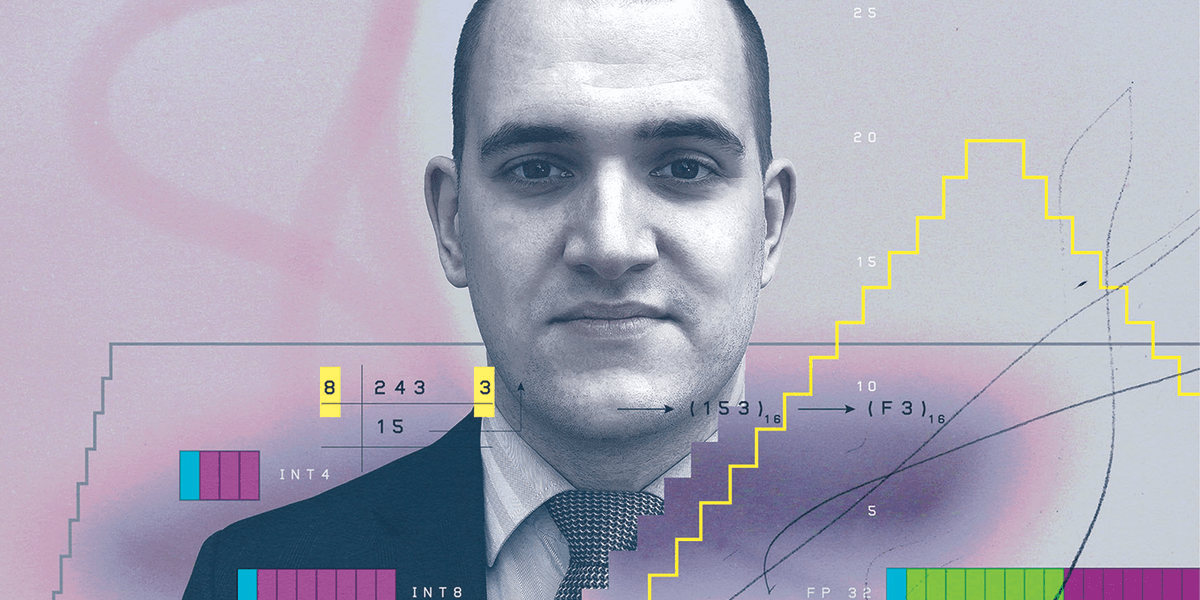
    AI has driven an explosion of new number formats—the ways in which numbers are represented digitally. Engineers are looking at every possible way to save computation time and energy, including shortening the number of bits used to represent data. But what works for AI doesn’t necessarily work for scientific computing, be it for computational physics, biology, fluid dynamics, or engineering simulations. IEEE Spectrum spoke with Laslo Hunhold, who recently joined Barcelona-based Openchip as an AI engineer, about his efforts to develop a bespoke number format for scientific computing.

    LASLO HUNHOLD

    Laslo Hunhold is a senior AI accelerator engineer at Barcelona-based startup Openchip. He recently completed a Ph.D. in computer science from the University of Cologne, in Germany.

    What makes number formats interesting to you?

    Laslo Hunhold: I don’t know another example of a field that so few are interested in but has such a high impact. If you make a number format that’s 10 percent more [energy] efficient, it can translate to all applications being 10 percent more efficient, and you can save a lot of energy.

    Why are there so many new number formats?

    Hunhold: For decades, computer users had it really easy. They could just buy new systems every few years, and they would have performance benefits for free. But this hasn’t been the case for the last 10 years. In computers, you have a certain number of bits used to represent a single number, and for years the default was 64 bits. And for AI, companies noticed that they don’t need 64 bits for each number. So they had a strong incentive to go down to 16, 8, or even 2 bits [to save energy]. The problem is, the dominating standard for representing numbers in 64 bits is not well designed for lower bit counts. So in the AI field, they came up with new formats which are more tailored toward AI.

    Why does AI need different number formats than scientific computing?

    Hunhold: Scientific computing needs high dynamic range: You need very large numbers, or very small numbers, and very high accuracy in both cases. The 64-bit standard has an excessive dynamic range, and it is many more bits than you need most of the time. It’s different with AI. The numbers usually follow a specific distribution, and you don’t need as much accuracy.

    What makes a number format “good”?

    Hunhold: You have infinite numbers but only finite bit representations. So you need to decide how you assign numbers. The most important part is to represent numbers that you’re actually going to use. Because if you represent a number that you don’t use, you’ve wasted a representation. The simplest thing to look at is the dynamic range. The next is distribution: How do you assign your bits to certain values? Do you have a uniform distribution, or something else? There are infinite possibilities.

    What motivated you to introduce the takum number format?

    Hunhold: Takums are based on posits. In posits, the numbers that get used more frequently can be represented with more density. But posits don’t work for scientific computing, and this is a huge issue. They have a high density for [numbers close to one], which is great for AI, but the density falls off sharply once you look at larger or smaller values. People have been proposing dozens of number formats in the last few years, but takums are the only number format that’s actually tailored for scientific computing. I found the dynamic range of values you use in scientific computations, if you look at all the fields, and designed takums such that when you take away bits, you don’t reduce that dynamic range

    This article appears in the March 2026 print issue as “Laslo Hunhold.”

    From Your Site Articles

    Related Articles Around the Web


    Source link

    Share. Facebook Twitter Pinterest LinkedIn Tumblr Email Telegram Copy Link

    Related Posts

    Technology

    AI minister role boosted but tech department axed in Burnham shake-up

    July 21, 2026
    Technology

    How LEDs Are Making Light Pollution Worse

    July 21, 2026
    Technology

    IEEE Program Helps Girls In India See a Future In STEM

    July 21, 2026
    Technology

    Manufacturing: How trainees combine tech and age-old skills

    July 21, 2026
    Technology

    Thousands of websites taken down for illegal World Cup streams

    July 20, 2026
    Technology

    Ofcom unable to take further legal action against suicide forum

    July 20, 2026
    Editors Picks

    Inside Julie and Todd Chrisley’s Marriage One Year After Prison

    July 10, 2026

    Top ministers quit after Peru’s president postpones F-16 fighter jet deal | Government News

    April 23, 2026

    Trump to pardon former Puerto Rico Governor Wanda Vazquez after plea deal | Donald Trump News

    January 16, 2026

    4 tips to help you maintain a healthy credit rating

    November 30, 2025

    Rob Gronkowski’s Girlfriend Is Campaigning For His ‘DWTS’ Debut

    February 10, 2026
    About Us
    About Us

    Welcome to Benjamin Franklin Institute, your premier destination for insightful, engaging, and diverse Political News and Opinions.

    The Benjamin Franklin Institute supports free speech, the U.S. Constitution and political candidates and organizations that promote and protect both of these important features of the American Experiment.

    We are passionate about delivering high-quality, accurate, and engaging content that resonates with our readers. Sign up for our text alerts and email newsletter to stay informed.

    Latest Posts

    Canada evaluating ‘all options’ after fresh US tariffs threat

    July 21, 2026

    US judge blocks Trump bid to strip work permits from immigrants | Courts News

    July 21, 2026

    Northwestern’s new Ryan Field tour leads to incredible Chip Kelly photo

    July 21, 2026

    Subscribe for Updates

    Stay informed by signing up for our free news alerts.

    Paid for by the Benjamin Franklin Institute. Not authorized by any candidate or candidate’s committee.
    • Privacy Policy
    • About us
    • Contact us

    Type above and press Enter to search. Press Esc to cancel.