

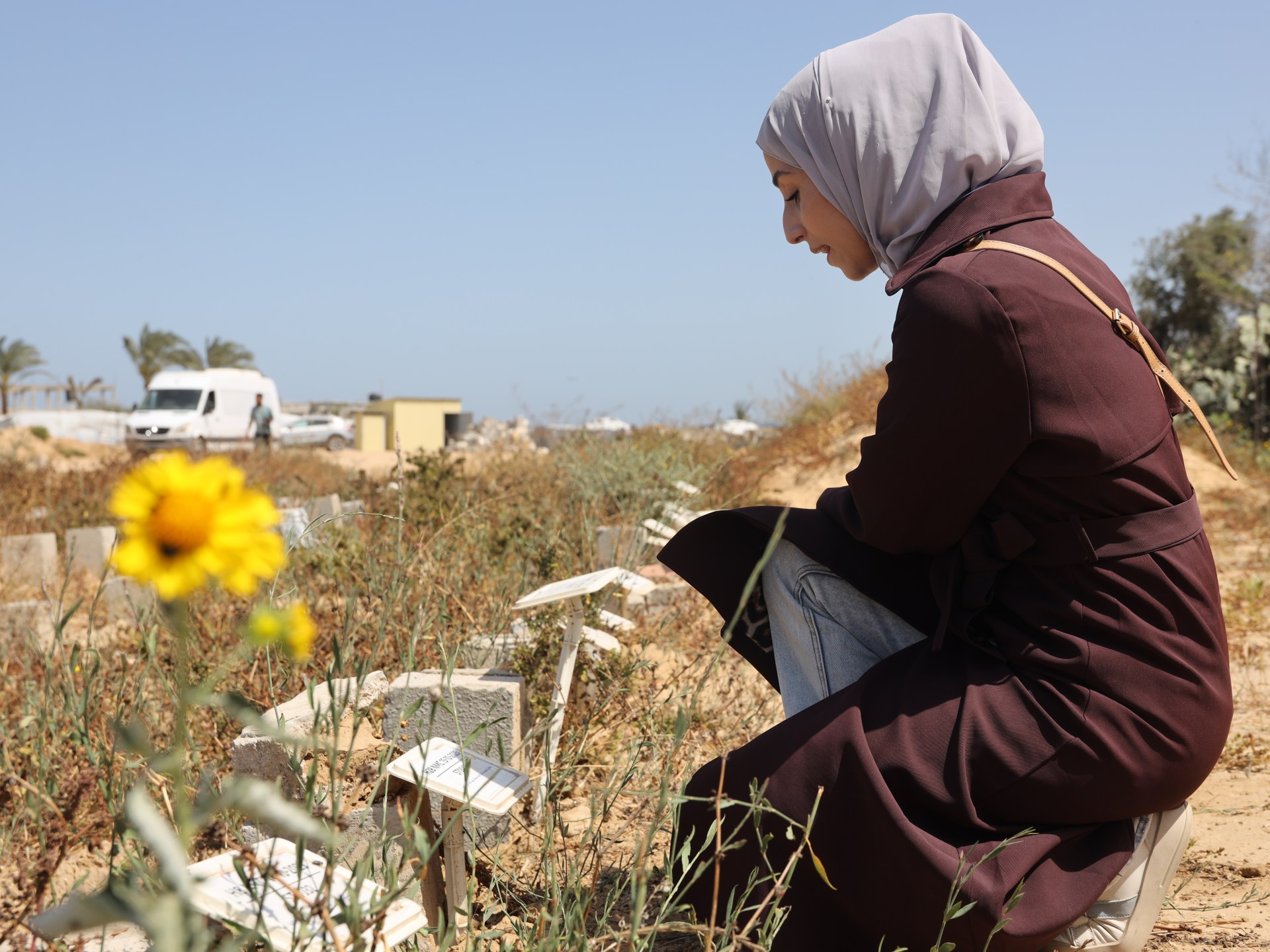
Deir el-Balah, Gaza Strip – Beside an unmarked grave, Lina al-Assi sits quietly picking flowers and pouring water over the soil, believing it to be her husband’s resting place.
Jihad Tafesh went missing at the beginning of Israel’s genocidal war on Gaza in October 2023.
Recommended Stories
list of 3 itemsend of list
Lina is a regular visitor to the site, one of about 1,200 where unidentified bodies and missing persons who could not be identified are buried.
The 26-year-old mother of two lost contact with her husband on October 8, 2023, on the second day of the war. Under heavy Israeli bombardment, he stayed behind in their home in Gaza City’s Shujayea area with his parents, while she fled with their children.
“The shelling was everywhere and the area where my house was located was very dangerous and close to the border,” Lina says. That same day, in the lulls between Israeli attacks, she searched for Jihad, who was 28 at the time.
But she couldn’t find him. No concrete information about Jihad’s fate has ever reached Lina.
“We contacted the Red Cross to check his fate, but with no result,” she says. “We did not know whether he was detained, injured, or killed. Nothing.”
‘Different kind of suffering’
Lina was forced to adjust to the struggle of living through war and displacement while taking care of her two children alone, five-year-old Hanaa and four-year-old Jouri, and without the support of the person she most wishes was there to help her.
The October 2025 ceasefire deal between Israel and Hamas allowed Lina to focus on her search for Jihad, particularly after Israel began transferring the bodies of dead Palestinians to Gaza as part of the agreement.
Bodies were transferred in stages via the Red Cross to the Nasser Medical Complex in Khan Younis, with 285 bodies received by November 5.
But their identities were often unclear. Some arrived with identification, or were marked only with numbers, forcing families to attempt identification through clothing, marks on their bodies, or personal belongings.
Lina was among those searching at the hospital.
“With every photo shown on the screen, I prayed he would not be among them,” she says. “The bodies were extremely disfigured, some showed signs of injury and abuse, others were in advanced decomposition.”
“It is a different kind of suffering… to see someone you love in that condition,” she says.
Lina spent more than two weeks going back and forth to the hospital, trying to identify a body matching her husband’s description. One body was possibly Jihad’s, but she wasn’t sure. After two weeks away from the hospital, mulling over her thoughts, she returned and informed staff that one of the bodies resembled her husband. But she was too late: he had already been buried.

Cemetery of the missing
The Deir el-Balah cemetery was established in October 2025 and is locally known as the “cemetery of the missing”, or the “numbered graves cemetery”, created as an emergency response to the growing number of unidentified bodies.
Ziad Obaid, head of the cemeteries department at Gaza’s Ministry of Religious Endowments, told Al Jazeera that Deir el-Balah was established due to the urgent need for more burial sites, as most cemeteries in Gaza City and northern Gaza were closed or in areas difficult to access.
According to Obaid, the bodies buried in the cemetery come from a range of places: some are recovered from under rubble, from streets, or from hospital and school courtyards where they had been temporarily buried during Israeli attacks; while others arrived through exchanges mediated by the International Committee of the Red Cross.
Additional bodies are retrieved daily from across Gaza.
“The main challenge is not only the number of bodies, but their condition, as many arrive severely decomposed or disfigured, making visual identification nearly impossible,” Obaid noted.
And even when Israel occasionally does send DNA reference codes with returned bodies, they are largely unusable in Gaza due to the absence of functioning laboratories in the Palestinian enclave capable of conducting genetic testing or matching samples with families of the missing.
“Despite repeated calls over the past year and a half to introduce DNA facilities or transfer samples abroad, no progress has been made,” Obaid said.

Complicated protocol
Under the established system, bodies are transferred from the Red Cross to Gaza’s main hospitals, where forensic teams photograph the bodies, collect samples and preserve belongings or distinguishing marks.
Each body is then assigned a unique code by the Ministry of Health or the Ministry of Religious Endowments.
The bodies are displayed for six to ten days in designated hospital rooms to allow families to attempt identification, before burial in the cemetery if there is no recognition.
“Despite these procedures, identification remains extremely limited, leading to a growing accumulation of unidentified bodies,” said Obaid.
He also points to several complicating factors, including the exhumation of Palestinian bodies by Israeli forces, and the transfer of partial body parts rather than whole human remains.
Obaid warns that the continued absence of DNA facilities and delays in identification are deepening the humanitarian and psychological crisis of families of the missing, who remain suspended between hope and grief.
“We need international pressure to enable proper forensic testing or the transfer of samples abroad so that the unknown can finally be given back their names.”
Herbert Mushumba, a forensic specialist at the International Committee of the Red Cross (ICRC), acknowledged a critical gap because there are currently no DNA analysis facilities in Gaza.
Samples collected from bodies are therefore stored under proper conditions, with ICRC support provided to forensic authorities for storage infrastructure, pending the possibility of future analysis, either locally or abroad.
Mushumba told Al Jazeera the Deir el-Balah cemetery was opened with the organisation’s support after the start of the war, and has been in use since last year.
According to the ICRC, the cemetery contains around 1,400 graves, of which approximately 350 remain unused.
For Lina, the mother-of-two still searching for her husband, the graveyard has become her sanctuary.
“The hardest feeling is when a loved one is buried as unknown, without a name or official identification, under a number… a deep pain that still lives in my heart,” she says, standing near a grave marked with a numbered code that she believes belongs to her husband.
“All I want is for my husband to have a grave with a name, so I can visit him with my children whenever we want.”