

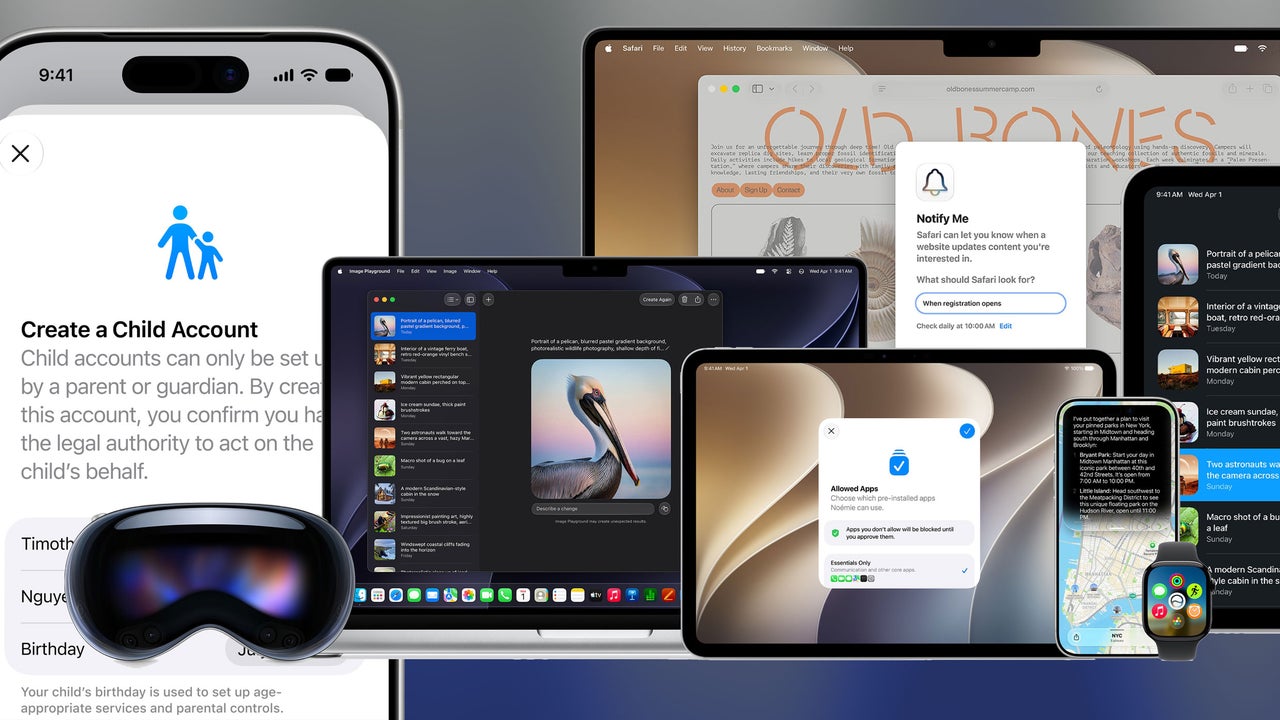
On Monday, Apple held its annual Worldwide Developers Conference keynote, where it showcased the next versions of the operating systems that power its devices, including iOS 27, macOS 27, and iPadOS 27. The thing is—and I say this as an Apple fan—unless you’re a parent or really care about artificial intelligence, the keynote was pretty meh.
After spending about 10 minutes discussing minor operating system tweaks and improvements, Apple dedicated the next 10 minutes to a single set of features—new parental controls—and then spent the next 40 minutes showing off its new artificial intelligence tools, including the new Siri AI. While the new AI tools were always going to be the main focus of the keynote, the announcements weren’t anything we didn’t already expect. This was Apple playing catch-up to the other AI giants, after all.
Still, one thing about the keynote did interest me, and it has nothing to do with what the new AI tools can do. If you paid careful attention, the keynote revealed three key insights into how Apple sees AI fitting into its business model and brand image.
AI will be a driver of services revenue
Love AI or hate it, one thing is for sure: It costs companies a lot of money to run. If you’re an AI-only company like OpenAI, that means you are still years away from achieving a meaningful profit. On the other hand, if you’re an existing tech giant like Google, you can essentially eat the costs of running AI because you have other lucrative revenue streams to draw on.
In this way, Apple is a lot like Google: It’s got plenty of revenue streams. Many pundits thought this meant that Apple would decide not to charge users, at all, for its latest AI advancements. But thanks to a brief comment an hour and seven minutes into the keynote by Apple’s software head, Craig Federighi, we know that’s not the case.
Federighi revealed that Apple is indeed placing daily usage limits on its more advanced AI features, such as image generation, but users can extend those limits by subscribing to select iCloud+ plans. iCloud+, one of Apple’s main subscription services, gives users more online storage and advanced privacy features. And the fact that Apple is now bundling increased AI usage with its subscriptions suggests that the company sees AI as a way to increase its services revenue.
AI will be a reason to upgrade your devices (even if they aren’t that old)
Apple also clearly sees AI as a way to boost its hardware business. While many of the new Apple Intelligence and Siri AI features will run on Apple devices that currently support Apple Intelligence, Apple took time in the keynote to explain that in order to use all the latest AI improvements, you’ll need Apple devices no older than a few years.
Specifically, Apple noted that its new on-device AI models, which let users run AI locally on their phone, tablet, or laptop without an internet connection, will require the iPhone 17 Pro, iPhone Air, an iPad with an M4 chip or later, or a Mac with M3 or later (both of the latter with at least 12GB of RAM). Yes, even the iPhone 17 can’t run all the AI features Apple has announced—and that phone is only nine months old.
You’ll also need those aforementioned devices in order to use other new AI features, such as improved dictation and Siri AI voice customization. And if you want to run the new Siri AI on your Apple Watch, you’ll need a Series 9 or later.
Of course, there are legitimate hardware reasons for these requirements. The AI needs a device with enough RAM and CPU power to run the most advanced features. But there’s almost no chance that Apple isn’t counting on these AI limitations to spur hardware sales among customers who want to use Apple’s latest AI to its fullest potential.
AI (slop tools) will challenge the company’s brand image
Most tech giants have the luxury of just drinking the Kool-Aid and claiming that AI is great, regardless of its destructive impact on the livelihoods of artists and creatives. But Apple isn’t like most tech giants.
Throughout its 50 years, Apple has built much of its brand value around the idea that it creates tools that allow people to express themselves to their full potential—and make a living doing it.
But that image doesn’t really align with tools now able to create AI slop on every device the company sells. And the keynote made it obvious that Apple hasn’t yet found a way to reconcile this incongruity.
At the one-hour mark, Apple showcases its upgraded slop machine app, Image Playground, highlighting how cool it is that it can now generate photorealistic images. But less than three minutes later, Apple proclaims that it “has a deep respect for the craft of photography”—you know, the field that realistic AI slop risks destroying. Therefore, Apple says, its new AI tools in the separate Photos app are designed to “respect the original [photo] moment.”
To me, this seems like Apple talking out of both sides of its mouth. The company doesn’t yet know how to square its AI slop tools with its creative brand image. You can’t be shipping a slop-generating app on your devices while also saying you respect the craft of photography.
It will be interesting to see how Apple addresses this incongruity going forward, especially as the backlash against AI slop only continues to grow.