

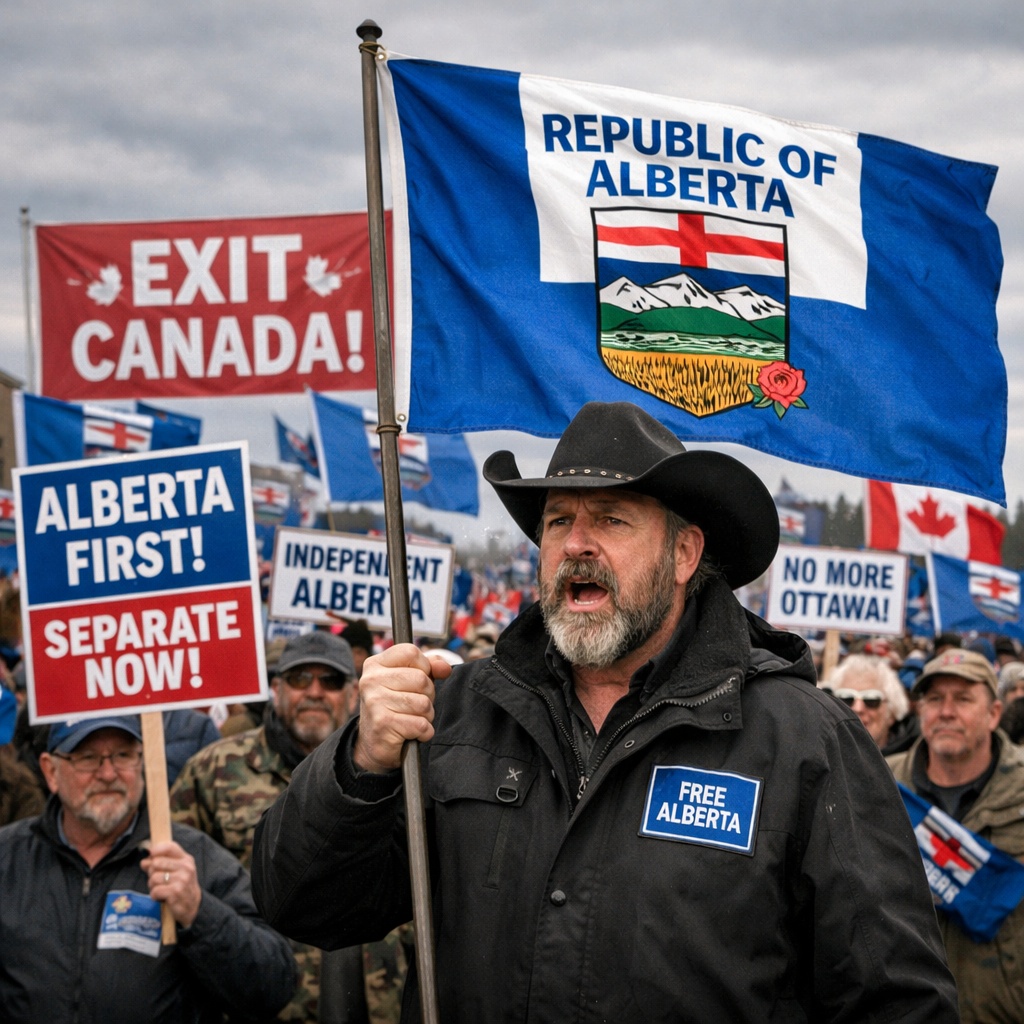
I have warned for years that Alberta would eventually reach a breaking point with Ottawa because the federal government has systematically undermined the very industries that support Canada’s economy. Now we are seeing separatist tensions escalating to a new level after Elections Alberta secured a court order forcing a pro-sovereignty organization known as the Centurion Project to remove a searchable voter database containing information tied to millions of Albertans.
The establishment media is focusing narrowly on “privacy concerns,” but they are ignoring the larger political reality underneath this entire story. Separatist organizations do not seek voter data for entertainment purposes. They want to identify, organize, mobilize, and communicate directly with people who may support Alberta sovereignty outside the traditional political system.
According to court filings, Elections Alberta determined the voter list had originally been legally distributed to the Republican Party of Alberta, a political party openly advocating Alberta independence. The Centurion Project, registered as a third-party advertiser, later posted the information online in searchable form. Reports indicate the database included names, addresses, and voting district information connected to millions of Alberta voters.
Why would a separatist movement want such a list? Because modern political movements are built on data. The objectives are likely voter targeting, grassroots organizing, fundraising, campaign coordination, petition drives, volunteer recruitment, and identifying regions most supportive of sovereignty. Every major political operation in the world now relies heavily on voter databases. The difference here is that Alberta’s sovereignty movement exists outside the traditional federal establishment, which immediately makes Ottawa nervous.
The political class understands something else as well. Once regional independence movements become digitally organized and data-driven, they become far harder to suppress.
I have repeatedly stated that Alberta has every economic reason to separate from Canada. The province has effectively become the financial engine forced to subsidize a federal structure increasingly hostile toward energy production itself. Alberta possesses enormous oil and gas reserves, generates massive export revenues, and contributes disproportionately to federal finances, yet Ottawa continues imposing carbon taxes, pipeline restrictions, emissions caps, and climate policies directly damaging Alberta’s economy.
At some point, productive regions begin asking why they should remain attached to governments actively undermining their future. This is not unique to Canada. I have seen this pattern repeatedly throughout history. Once centralized governments become too disconnected from regional economic realities, fragmentation pressures emerge naturally. Catalonia, Scotland, northern Italy, Brexit, these movements all stem from economic resentment mixed with political alienation.
Ottawa’s policies increasingly resemble the same anti-energy ideology that destroyed competitiveness across Europe. Canada is attacking the productive sectors that generate actual wealth while expanding bureaucracy, debt, regulation, and redistribution. Alberta’s oil industry has been treated as though it were politically inconvenient despite being one of the primary pillars supporting Canada’s national economy.
Alberta holds approximately 165 billion barrels of proven oil reserves and remains one of the world’s largest energy-producing regions. The province has contributed hundreds of billions in revenues and equalization imbalances over the decades, yet much of the federal political establishment behaves as though Alberta’s industries should be phased out entirely.
The ECM has projected increasing political fragmentation globally because confidence in centralized governments is collapsing. As living standards weaken, taxes rise, and debt expands, people begin identifying more regionally than nationally. They stop believing national institutions represent their interests.
The sovereignty movement in Alberta will continue growing so long as Ottawa pursues policies viewed as economically punitive toward the province. Court orders and database removals may slow organizational efforts temporarily, but they do not eliminate the underlying resentment driving the movement itself.