

The trove of documents released by the Department of Justice (DOJ) in relation to Jeffrey Epstein have revealed just how close the convicted child sex offender and financier was to all sorts of politicians, academics, business leaders, and other prominent figures.
These figures not only talked about visits to Epstein’s private island, but also shared news articles, discussed personal events, and had long debates about science and philosophy.
Epstein’s views, those conversations reveal, included peddling climate denialism and ecofascism—and illustrate how the ultra-wealthy undermine meaningful climate action.
‘Potentially a good thing for the species’
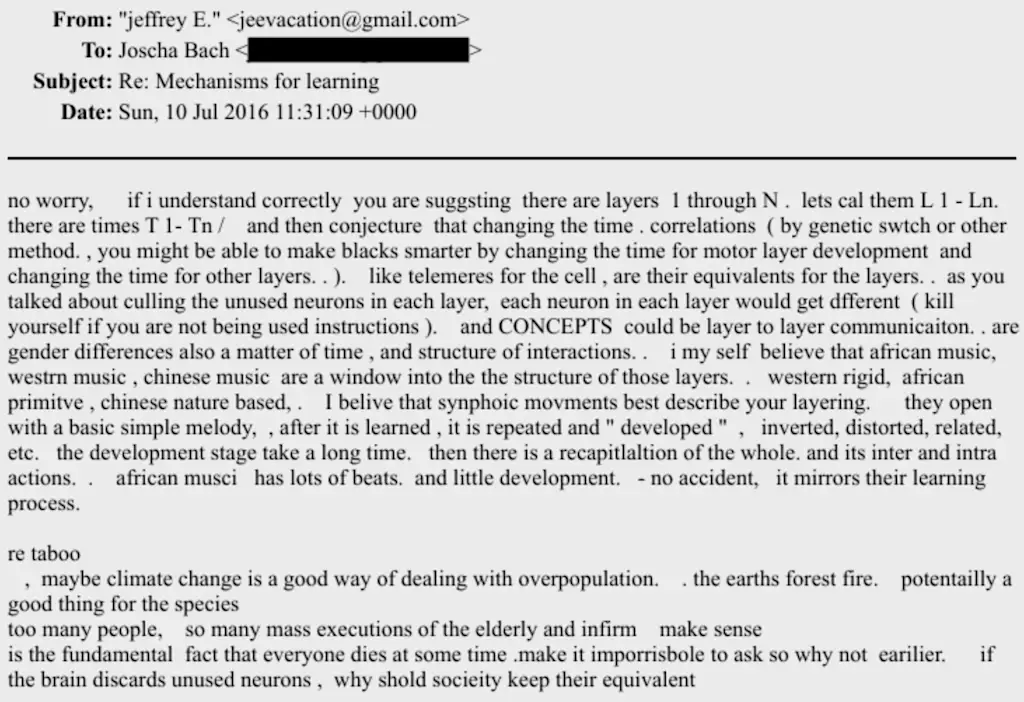
In a series of July 2016 emails with Joscha Bach, a German philosopher, AI researcher, and cognitive scientist, Epstein brings up climate change in the middle of a discussion about cognition and race.
“Maybe climate change is a good way of dealing with overpopulation,” Epstein writes. “the earths forest fire. potentially a good thing for the species.”
Linking the conversation back to the earlier topic of how brains function, Epstein adds: “too many people . . . [it] is the fundamental fact that everyone dies at some time. make it [impossible] to ask so why not earlier. if the brain discards unused neurons, why [should] society keep their equivalent.”
(Regarding his correspondence with Epstein, Bach recently told SFGate that he hadn’t been aware of Epstein’s crimes after his 2008 conviction and that “his second arrest came as a shock.”)
Citing climate change as a solution to overpopulation isn’t a totally surprising position for someone like Epstein, says Michael Mann, a climatologist and coauthor, with Peter Hotez, of the 2025 book Science Under Siege: How to Fight the Five Most Powerful Forces That Threaten Our World.
The overpopulation quote is “entirely keeping with the ethos of this group,” Mann tells Fast Company via email, referring to Epstein and his elite associates.
Studies suggest that becoming richer makes you less empathetic, and that those with more power often care less about those with little power; the ultra-wealthy can then therefore be more dismissive of the needs of poor people, communities in developing countries, and their lived realities.
An example of this way of thinking, Mann notes, comes from Bjorn Lomborg, a political scientist who has been criticized for spreading climate denialism. Lomborg, who also makes an appearance in Epstein’s emails, has argued that poor people need fossil fuels.
“Lomborg cynically uses his feigned concern for the poor and downtrodden people of the Global South to justify continued fossil fuel dependence, when in fact it is they who will suffer the most from continued planetary warming,” Mann says.
According to the Epstein files, Lomborg had a meeting with the financier in September 2012. That conversation was about philanthropic investments, a spokesperson for Lomborg’s think tank, the Copenhagen Consensus Center, told Drilled Media. But there wasn’t any contact afterward, and the think tank did not receive money from Epstein.
Epstein and climate misinformation
In some places where the topic of climate change appears in the Epstein emails, Epstein is revealed to have shared messages that perpetuate climate myths.
In December 2016, for example, Epstein sent a YouTube video featuring a climate change denier to theoretical physicist Lawrence Krauss. That video, titled “Nobel Laureate Smashes the Global Warming Hoax,” features Ivar Giaever (now deceased), who had long denied the climate crisis.
Krauss does push back. “So you are listening to an old Nobel laureate whose expertise has nothing to do with this, who has never studied this in detail, built models, done experiments,” he replies.
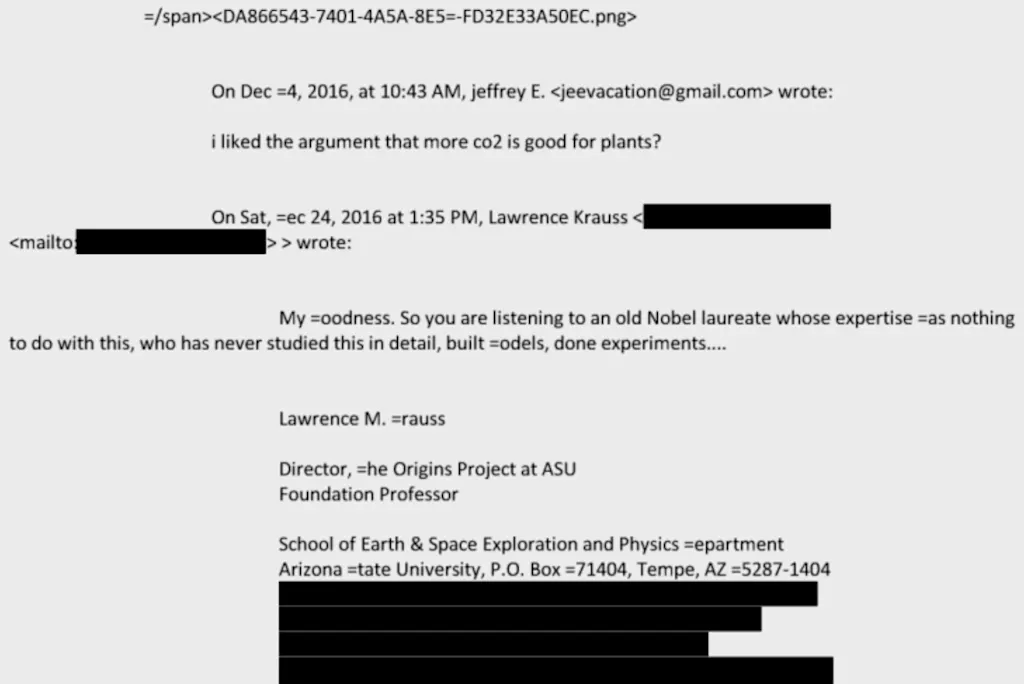
But Epstein isn’t fully deterred. “i liked the argument that more co2 is good for plants?” he says, repeating a classic myth from the climate denier’s playbook. (In reality, excess CO2 from the burning of fossil fuels leads crop yields to drop and also worsens drought, heat, and disasters that destroy harvests.)
In a later reply, Epstein repeats another piece of climate change misinformation: “is the south pole getting colder and more ice?”
Krauss responds that the “west Antarctic ice sheet is melting at an unprecedented rate.”
This wasn’t the first time that the two discussed climate change—and seemed to disagree about it. In a 2013 email, Krauss sends Epstein an op-ed he wrote for The New York Times, headlined “Deafness at Doomsday,” which touched on how policymakers should not ignore scientists about climate change.
“As usual i don’t have to agree but will support your decisions, congratulations,” Epstein replies. (Krauss recently told Nature, in response to questions about his interactions with Epstein, that he did not know about the “horrendous crimes” Epstein was accused of and that he was “as shocked as the rest of the world when Epstein was arrested.”)
How plutocrats promote climate denialism
Mann’s book details five forces that threaten science: plutocrats, pros, petrostates, phonies, and the press.
“The Epstein Files is almost an advertisement for Science Under Siege because we see all of the key promoters of climate denial and anti-science that we talk about in the book,” Mann says.
That includes, he notes, “propagandists” like Lomberg and Steven Koonin—a theoretical physicist who is only mentioned in the emails when others are sharing his work.
In 2014, Nathan Myhrvold, former CTO of Microsoft, sent Epstein a Wall Street Journal piece headlined “Climate Science Is Not Settled,” by Koonin, calling it “a good summary.”
Koonin has criticized climate science and was also an author on the Trump administration’s 2025 Department of Energy report that downplayed the climate crisis.
The Epstein files also mention connections to “petrostates” (nations whose economies are heavily driven by the extraction and export of petroleum, natural gas, and other fossil fuels), including Russia and Saudi Arabia.
And finally, it’s filled with plutocrats, like Elon Musk and Bill Gates. (Musk has denied a personal connection to Epstein; Gates has said he “regrets” his time spent with Epstein and maintains that Epstein’s claims about him in the files are false.)
Gates often writes and lectures about climate change; the billionaire Microsoft cofounder has invested billions of dollars into technologies like carbon capture and nuclear power. But Mann has also long criticized Gates’s approach for straying from the straightforward solution of stopping fossil fuel use.
To Mann, this is a common tactic from the wealthy, one he describes as “stopping short of denying the basic science of climate change, but downplaying the impacts, dismissing the real solutions (i.e., clean energy), and ultimately acting as enablers of the fossil fuel status quo.”
The Epstein files have offered a glimpse into the world of billionaires and the way they collect and wield their power—including billionaire philanthropists who are influencing our reactions to crises like climate change.
At a time when public sentiment of billionaires has become increasingly negative, people are questioning just how much influence the ultra-wealthy should have on our society.
Mann has previously made the point that the solution to the climate crisis isn’t going to come from “benevolent plutocrats.” “If nothing else,” he tells Fast Company, “the Epstein Files really drive home this point.”