

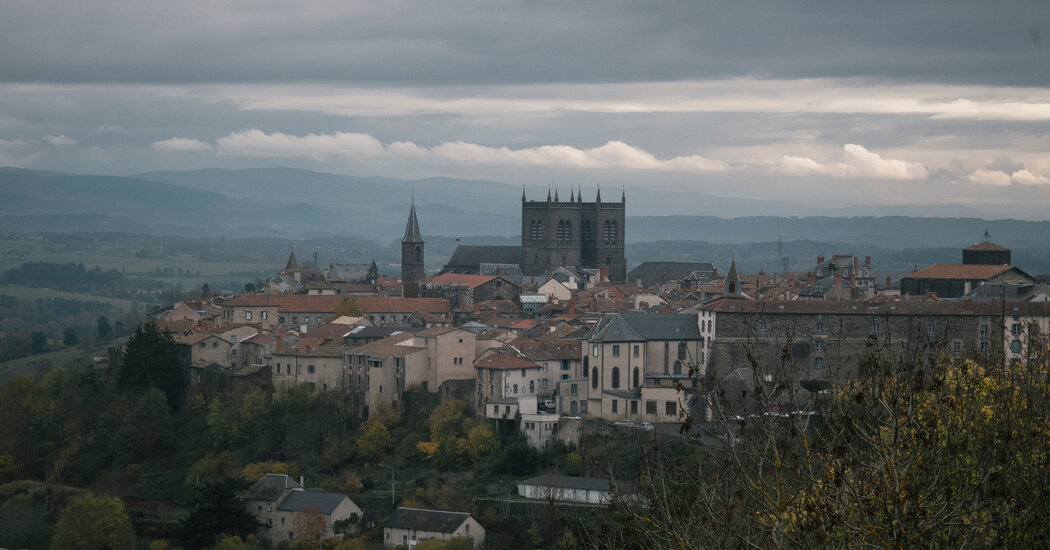
Struggling to raise funds for the restoration of his cathedral’s antique organ, a priest from St.-Flour, a small town in France’s heartland, came up with a creative solution. He turned one of the bell towers into a curing workshop where farmers could hang their hams to dry.
For nearly two years, after being blessed by a local bishop, pork legs swayed in peace in the dry air of the cathedral’s north tower, bringing in much-needed funds and delighting charcuterie lovers. Then an inspector for the organization that oversees France’s architectural heritage stepped in.
After noticing a grease stain on the floor of the bell tower, as well as other infractions, the inspector ordered that the hams be taken down. They were a fire hazard, he said in a report in December 2023, according to cathedral officials. When the cathedral refused to remove the hams, the dispute escalated all the way to the country’s minister of culture, Rachida Dati.
The battle over the St.-Flour hams was widely derided as an example of how overzealous officials can quash innovative local initiatives. It also spoke to a larger issue that aging churches across France have been grappling with as they face costly reparations: Who is going to pay to maintain the country’s vast religious heritage?
After the French Revolution, church properties were seized by the state, which eventually took responsibility for overseeing most of them. But the central government and local municipalities have struggled to fund the maintenance of the country’s cathedrals and churches.
The restoration of Notre-Dame Cathedral in Paris, which was ravaged by a devastating fire in 2019, was funded by about $900 million in donations. But religious buildings in the rest of the country have been largely left to fend for themselves.
Across France, an estimated 15,000 religious buildings out of 45,000 are classified as historical monuments, according to the Culture Ministry. More than 2,300 of them are in poor condition, and 363 are considered endangered, the ministry said.
“The situation is alarming,” said Hadrien Lacoste, the vice president of the Religious Heritage Observatory, an independent nonprofit group. “There’s a drop in religious practice,” he added, “and there’s a drop in demographics in rural areas.”
Despite a decline in church attendance, towns like St.-Flour, which has a population of about 6,400, see their cathedrals and churches as defining elements of their identities and feel a strong need to maintain them.
“We’ve realized that each of our churches is a little Notre-Dame, that the village without the church is like Paris without Notre-Dame,” said Mathieu Lours, a French historian who specializes in religious architecture.
In France — as has been the case elsewhere in Europe — decaying churches are often transformed into gyms, restaurants, hotels or housing.
In St.-Flour, a renaissance church adjacent to the cathedral was deconsecrated and is now a market and a cultural venue.
Maintaining the cathedral itself was seen as an essential, if costly, town effort. St.-Flour is at the heart of Cantal, an area of France known for its green hilly landscapes and its local cheese. From a distance, the cathedral, at the top of rocky outcrop, looms over the town like a fortress.
“You know the saying, all roads lead to Rome?” said Patrice Boulard, the meat producer in charge of climbing the tower’s 145 steps to suspend the hams there. “Well here in St.-Flour, all roads lead to the cathedral.”
The idea for the curing workshop in the bell tower was the brainchild of Gilles Boyer, who was at the time the cathedral’s rector, after funds that were supposed to be provided by the authorities for repairing the church’s 19th-century choir organ never materialized.
A food lover who had once managed a restaurant in Paris, Mr. Boyer had already set up beehives on an unused terrace of the cathedral to produce honey for sale. The bell tower was also unused space. Why not use it for hanging hams, a specialty of the region, he wondered?
“It all started as a joke,” he said, “but it wasn’t so dumb after all.”
Altitude, a local charcuterie cooperative made up of some 40 pig breeders, loved the idea, partly for the marketing potential, but also for what they believed to be the special quality of the air and conditions in the tower for curing hams.
“It creates a link between business and heritage, between a product and its terroir,” said Thierry Bousseau, the company’s communication manager.
The project was approved by both state and church authorities, and the first batch of hams was put on sale in markets, in the church and online in the spring of 2022, for about $150 each, about $50 more than what an average local artisanal ham would fetch. The profits, once Altitude recouped its costs, were given to the cathedral.
Overall, about 300 hams have been sold and more than $12,000 was spent to finally restore the organ, Mr. Bousseau said.
The project was called “Florus Solatium,” a tribute to the town’s supposed founder, a fifth-century saint called Florus whose relics are kept in the cathedral. According to legend, the saint miraculously escaped bandits by reaching the top of the cliff, where residents welcomed him with a traditional local ham. “Quid solatium!” he was said to have exclaimed. “What a solace!”
Most of the maturation process for the hams takes place in Altitude warehouses in a nearby town. But Mr. Boyer, the former rector, is convinced that the three months they spend attached to the tower’s wooden beams, exposed to the wind and to the bell’s vibrations, is what gives the meat its special quality.
“Most hams are dried in places where the hygrometry is always the same, the ventilation is always the same,” said Aurélien Gransagne, the chef at Restaurant Serge Vieira, a nearby Michelin-starred restaurant, referring to the humidity in the air. In the bell tower, he added, “you have fluctuations, and that’s what makes a product special.”
The thick, rosy flesh, is as good as the best prosciutto from Italy or jamón from Spain, he said. Mr. Gransagne’s restaurant offers diners rose-shaped slices of the meat alongside other appetizers — and a bit of storytelling about its provenance.
Given the success of the tower-cured hams, Jean-Paul Rolland, who took over as rector from Mr. Boyer in 2022, said he decided to put his foot down when the heritage architect declared the project dangerous.
“The building is dedicated to religious practice,” he said, “so it’s not up to the administration to tell us what we can do or not inside.”
The grease stain probably appeared on the age-old parquet floor long before the hams were brought up, he said.
“It’s like the landlord telling a tenant that he is not allowed to change a painting’s place in the living room,” Mr. Rolland added.
He did make some small changes, like placing carpets on the floor of the towers and barring access to visitors. But the hams would continue to hang, he said.
In October, Ms. Dati, the culture minister, announced a decision: The hams will stay, provided a “detailed study” will have examined the “administrative, material and organizational conditions” for the hams to be matured safely, her office said in an email. That process is still continuing.
Whatever the eventual decision, the hams have become something of a cause célèbre in a country that values the gastronomic offerings of small producers as much as the country’s religious heritage. St.-Flour made national headlines, and sales of the hams have been brisk. The Élysée Palace in Paris has a standing order for hams every three months, and served slices of it at a buffet in June, Altitude says. (It is not clear if President Emmanuel Macron tried some, and the Elysée did not respond to requests for comment.)
Still, not everyone in St.-Flour is happy with the idea of turning the church into something of a marketplace.
“There were bees, now there’s hams. What’s next, cheese?” asked Roger Merle, 68, the owner of a clothing store in the town.