

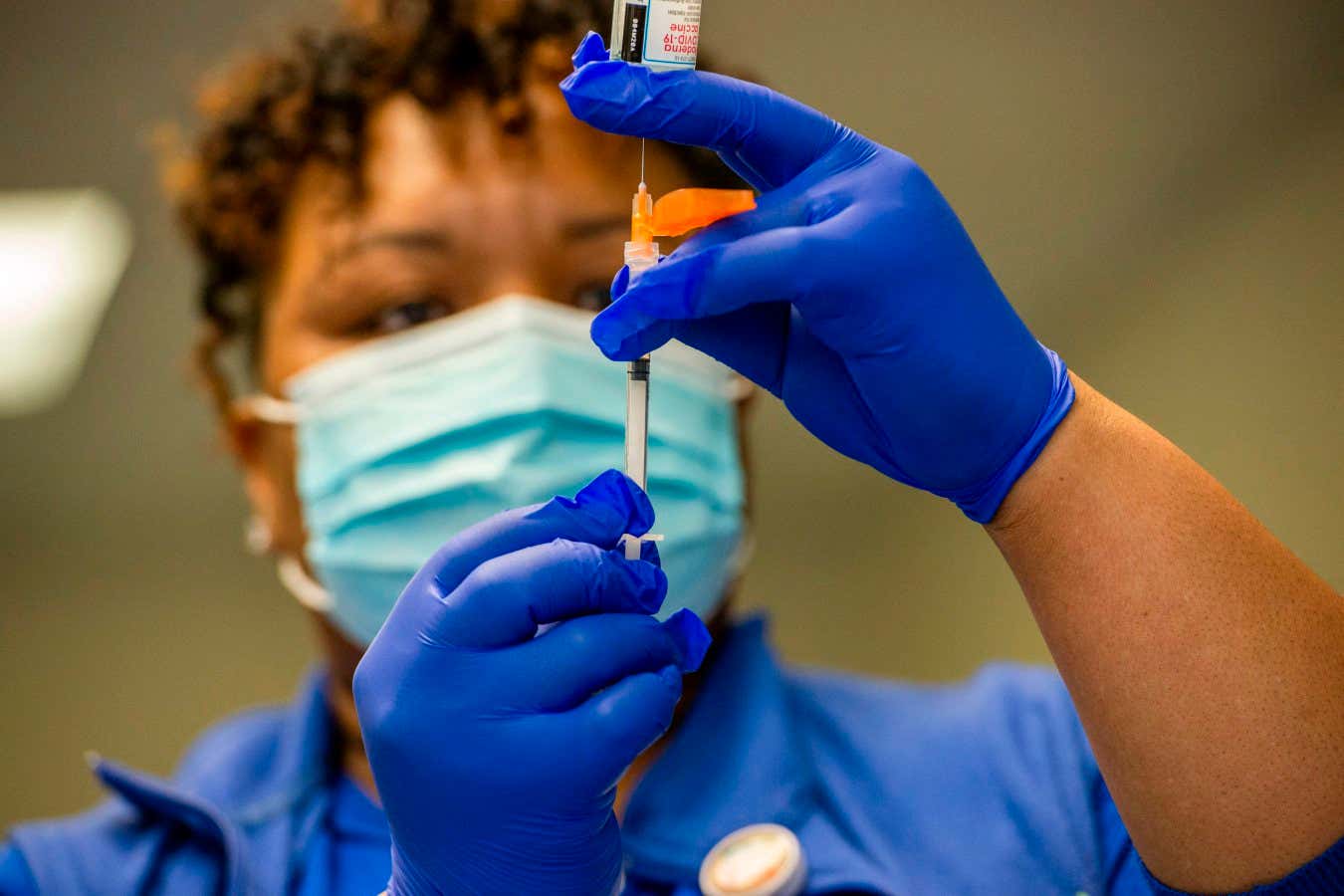
mRNA vaccines are increasingly showing their potential to transform medicine
JOSEPH PREZIOSO/AFP via Getty Images
The mRNA covid-19 vaccines seem to have an unexpected benefit: extending the lives of people being treated for cancers by boosting the effectiveness of immunotherapy.
An analysis of the records of nearly 1000 people being treated for advanced skin and lung cancers shows those who were given an mRNA covid-19 vaccine within 100 days of starting drugs called immune checkpoint inhibitors lived nearly twice as long as people who did not get vaccinated within this time. The findings will now be confirmed in a clinical trial that is due to start before the end of the year.
“The results are just remarkable,” says Elias Sayour at the University of Florida, who thinks it will one day be possible to create mRNA vaccines that optimise this response. “Could we make a master key in the form of an mRNA vaccine that wakes up the immune response in everybody with cancer?” he says. “You can imagine what the potential of that is.”
In the meantime, should people who have just started taking checkpoint inhibitors get vaccinated against covid-19 to boost their treatment success? “I don’t like making clinical recommendations unless things are proven,” says Sayour. “When you’re trying to use the immune system to fight cancer, there are also risks.” People should continue to follow existing vaccine guidelines, he says.
The background to this finding is our immune system kills off many cancers long before they become a problem. But some tumours develop the ability to shut down this response. They do this by taking advantage of “off switches” on the immune cells called T-cells, which kill cancerous cells. For instance, one common off switch is a protein called PD-1, which protrudes from the surface of these T-cells.
PD-1 is flipped to the off position when it binds to a protein called PD-L1, found on the surface of some cells. This is a safety mechanism by which cells can effectively say, “stop attacking me, I’m friendly”.
Many cancers hijack this by producing lots of PD-L1. Checkpoint inhibitors work by stopping PD-1 or other off switches being flipped. They have greatly improved survival rates for lung cancers and melanomas, among others, and won a Nobel prize for their creators in 2018.
But the effectiveness of checkpoint inhibitors varies greatly. If a person’s immune system hasn’t responded to a tumour by sending out T-cells to attack it, the drugs can’t help much.
So combining checkpoint inhibitors with vaccines that stimulate the immune system to attack tumours can be much more effective than either approach alone. Cancer vaccines are typically designed to trigger a response to mutant proteins found on cancerous cells, and are often personalised to individuals. “We try to figure out what’s unique to their tumour,” says Sayour. “That takes a lot of time and cost and complexity.”
During trials of cancer vaccines, his team realised the non-specific mRNA vaccines they were using as controls also seemed to have a big effect. “That was an absolute surprise,” says Sayour.
In July this year, Sayour and his colleagues reported how mRNA vaccines boost anti-tumour responses, even if they do not target a cancer protein, according to studies in mice. The vaccines trigger an innate immune response that acts like a siren, he says, rousing the immune system and making T-cells migrate from tumours to lymph nodes, where they stimulate other cells to launch a targeted attack.
If this is a general property of mRNA vaccines, the team realised, it should also be true of the covid-19 ones. Now, Sayour and his colleagues have looked at the records of people treated at the University of Texas MD Anderson Cancer Center.
Of the 884 people with advanced lung cancer given checkpoint inhibitors, 180 had an mRNA covid-19 vaccination with 100 days of starting the drugs. They had a survival time of around 37 months, compared with 20 months for those who were not vaccinated.
In addition, 210 people had melanomas that had begun to spread to other parts of the body, 43 of whom were vaccinated within 100 days of starting to take checkpoint inhibitors. They had a survival time of around 30 to 40 months, compared with 27 months for those who were not vaccinated within this time – and as some of the vaccinated people were still alive when the analysis was done, their survival time may be even higher. The team presented the results at a meeting of the European Society for Medical Oncology Congress in Berlin, Germany, today.
There have previously been some case reports of tumours shrinking after people got the mRNA covid-19 vaccines, suggesting they can, on occasion, have anti-tumour effects even if people are not taking checkpoint inhibitors. “It’s certainly possible, but more research would be necessary to answer that,” says Sayour.
The US recently announced big cuts in funding for the development of mRNA vaccines, despite their immense benefits during the pandemic and enormous potential for developing treatments beyond vaccines.
Topics: