
Close Menu
    Trending
    • The end of the ‘good enough’ worker
    • Can Apple and Google stop children from sharing explicit images?
    • Amsterdam Bans Meat Ads As The War On Food Expands
    • Katie Holmes And Joshua Jackson Spark ‘Soul-Level’ Love Chatter
    • Singapore Airlines, Southwest Airlines partner to expand access to nearly 120 US destinations
    • Trump warns Netanyahu: ‘You’ll be on your own’ if attacks on Iran continue | US-Israel war on Iran News
    • Cristiano Ronaldo, ‘The Bosnian Diamond’ headline the World Cup 40-and-over club
    • How housing market inventory is shifting across every state
    Benjamin Franklin Institute
    Tuesday, June 9
    • Home
    • Politics
    • Business
    • Science
    • Technology
    • Arts & Entertainment
    • International
    Benjamin Franklin Institute
    Home»Technology»OpenAI stops ‘disrespectful’ Martin Luther King Jr Sora videos
    Technology

    OpenAI stops ‘disrespectful’ Martin Luther King Jr Sora videos

    Team_Benjamin Franklin InstituteBy Team_Benjamin Franklin InstituteOctober 19, 2025No Comments3 Mins Read
    Share Facebook Twitter Pinterest Copy Link LinkedIn Tumblr Email VKontakte Telegram
    Share
    Facebook Twitter Pinterest Email Copy Link


    Liv McMahonTechnology reporter
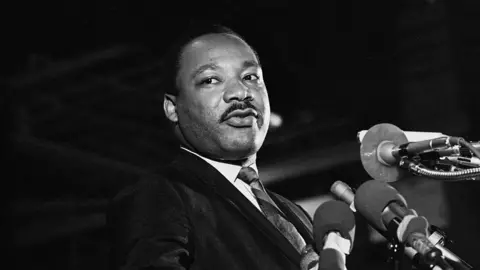
    Bettmann Archive/Getty Images A black and white photograph of the late Dr Martin Luther King Jr. He is standing at a podium, surrounded by microphones, as he speaks, looking to the right of the stage.Bettmann Archive/Getty Images

    OpenAI has stopped its artificial intelligence (AI) app Sora creating deepfake videos portraying Dr Martin Luther King Jr, following a request from his estate.

    The company acknowledged the video generator had created “disrespectful” content about the civil rights campaigner.

    Sora has gone viral in the US due to its ability to make hyper-realistic videos, which has led to people sharing faked scenes of deceased celebrities and historical figures in bizarre and often offensive scenarios.

    OpenAI said it would pause images of Dr King “as it strengthens guardrails for historical figures” – but it continues to allow people to make clips of other high profile individuals.

    That approach has proved controversial, as videos featuring figures such as President John F. Kennedy, Queen Elizabeth II and Professor Stephen Hawking have been shared widely online.

    It led Zelda Williams, the daughter of Robin Williams, to ask people to stop sending her AI-generated videos of her father, the celebrated US actor and comic who died in 2014.

    Bernice A. King, the daughter of the late Dr King, later made a similar public plea, writing online: “I concur concerning my father. Please stop.”

    Among the AI-generated videos depicting the civil rights campaigner were some editing his infamous “I Have a Dream” speech in various ways, with the Washington Post reporting one clip showed him making racist noises.

    Meanwhile others shared on the Sora app and across social media showed figures resembling Dr King and fellow civil rights campaigner Malcolm X fighting one another.

    Allow X content?

    This article contains content provided by X. We ask for your permission before anything is loaded, as they may be using cookies and other technologies. You may want to read  and  before accepting. To view this content choose ‘accept and continue’.

    AI ethicist and author Olivia Gambelin told the BBC OpenAI limiting further use of Dr King’s image was “a good step forward”.

    But she said the company should have put measures in place from the start – rather than take a “trial and error by firehose” approach to rolling out such technology.

    She said the ability to create deepfakes of deceased historical figures did not just speak to a “lack of respect” towards them, but also posed further dangers for people’s understanding of real and fake content.

    “It plays too closely with trying to rewrite aspects of history,” she said.

    ‘Free speech interests’

    The rise of deepfakes – videos which have been altered using AI tools or other tech to show someone speaking or behaving in a way they did not – have sparked concerns they could be used to spread disinformation, discrimination or abuse.

    OpenAI said on Friday while it believed there were “strong free speech interests in depicting historical figures”, they and their families should have control over their likenesses.

    “Authorised representatives or estate owners can request that their likeness not be used in Sora cameos,” it said.

    Generative AI expert Henry Ajder said this approach, while positive, “raises questions about who gets protection from synthetic resurrection and who doesn’t”.

    “King’s estate rightfully raised this with OpenAI, but many deceased individuals don’t have well known and well resourced estates to represent them,” he said.

    “Ultimately, I think we want to avoid a situation where unless we’re very famous, society accepts that after we die there is a free-for-all over how we continue to be represented.”

    OpenAI told the BBC in a statement in early October it had built “multiple layers of protection to prevent misuse”.

    And it said it was in “direct dialogue with public figures and content owners to gather feedback on what controls they want” with a view to reflecting this in subsequent changes.


    A green promotional banner with black squares and rectangles forming pixels, moving in from the right. The text says: “Tech Decoded: The world’s biggest tech news in your inbox every Monday.”


    Source link

    Share. Facebook Twitter Pinterest LinkedIn Tumblr Email Telegram Copy Link

    Related Posts

    Technology

    IEEE Celebrates Technology’s Brightest at Annual Event

    June 8, 2026
    Technology

    50 Years of The Institute

    June 5, 2026
    Technology

    What It Takes for Future-Ready Power Distribution

    June 4, 2026
    Technology

    7 Ways New Engineers Can Flourish in the Age of AI

    June 3, 2026
    Technology

    Tech Life – Microsoft’s big quantum bet

    June 2, 2026
    Technology

    Direct-to-Cell Technology: Enabling Satellite Connectivity for Legacy Devices

    June 2, 2026
    Editors Picks

    Jayson Tatum shuts down injury worries after triple-double vs. Heat

    April 2, 2026

    What to read this week: How Flowers Made Our World by David George Haskell

    March 28, 2026

    What if the idea of the autism spectrum is completely wrong?

    January 5, 2026

    Mariners’ J.P. Crawford’s injury opens the lane for one player to start

    June 8, 2026

    Kyle Schwarber brutally rejected one team in free agency

    January 8, 2026
    About Us
    About Us

    Welcome to Benjamin Franklin Institute, your premier destination for insightful, engaging, and diverse Political News and Opinions.

    The Benjamin Franklin Institute supports free speech, the U.S. Constitution and political candidates and organizations that promote and protect both of these important features of the American Experiment.

    We are passionate about delivering high-quality, accurate, and engaging content that resonates with our readers. Sign up for our text alerts and email newsletter to stay informed.

    Latest Posts

    The end of the ‘good enough’ worker

    June 9, 2026

    Can Apple and Google stop children from sharing explicit images?

    June 9, 2026

    Amsterdam Bans Meat Ads As The War On Food Expands

    June 9, 2026

    Subscribe for Updates

    Stay informed by signing up for our free news alerts.

    Paid for by the Benjamin Franklin Institute. Not authorized by any candidate or candidate’s committee.
    • Privacy Policy
    • About us
    • Contact us

    Type above and press Enter to search. Press Esc to cancel.