
Close Menu
    Trending
    • Katie Holmes And Joshua Jackson Spark ‘Soul-Level’ Love Chatter
    • Singapore Airlines, Southwest Airlines partner to expand access to nearly 120 US destinations
    • Trump warns Netanyahu: ‘You’ll be on your own’ if attacks on Iran continue | US-Israel war on Iran News
    • Cristiano Ronaldo, ‘The Bosnian Diamond’ headline the World Cup 40-and-over club
    • How housing market inventory is shifting across every state
    • What is a ‘normal’ memory slowdown, and when should I worry?
    • Ariana Grande And Ethan Slater Are ‘Still Friends’ Following Split
    • US says BYD, Baidu, Alibaba and other tech giants are aiding China’s military
    Benjamin Franklin Institute
    Tuesday, June 9
    • Home
    • Politics
    • Business
    • Science
    • Technology
    • Arts & Entertainment
    • International
    Benjamin Franklin Institute
    Home»Science»New Horizons images enable first test of interstellar navigation
    Science

    New Horizons images enable first test of interstellar navigation

    Team_Benjamin Franklin InstituteBy Team_Benjamin Franklin InstituteJuly 2, 2025No Comments4 Mins Read
    Share Facebook Twitter Pinterest Copy Link LinkedIn Tumblr Email VKontakte Telegram
    Share
    Facebook Twitter Pinterest Email Copy Link


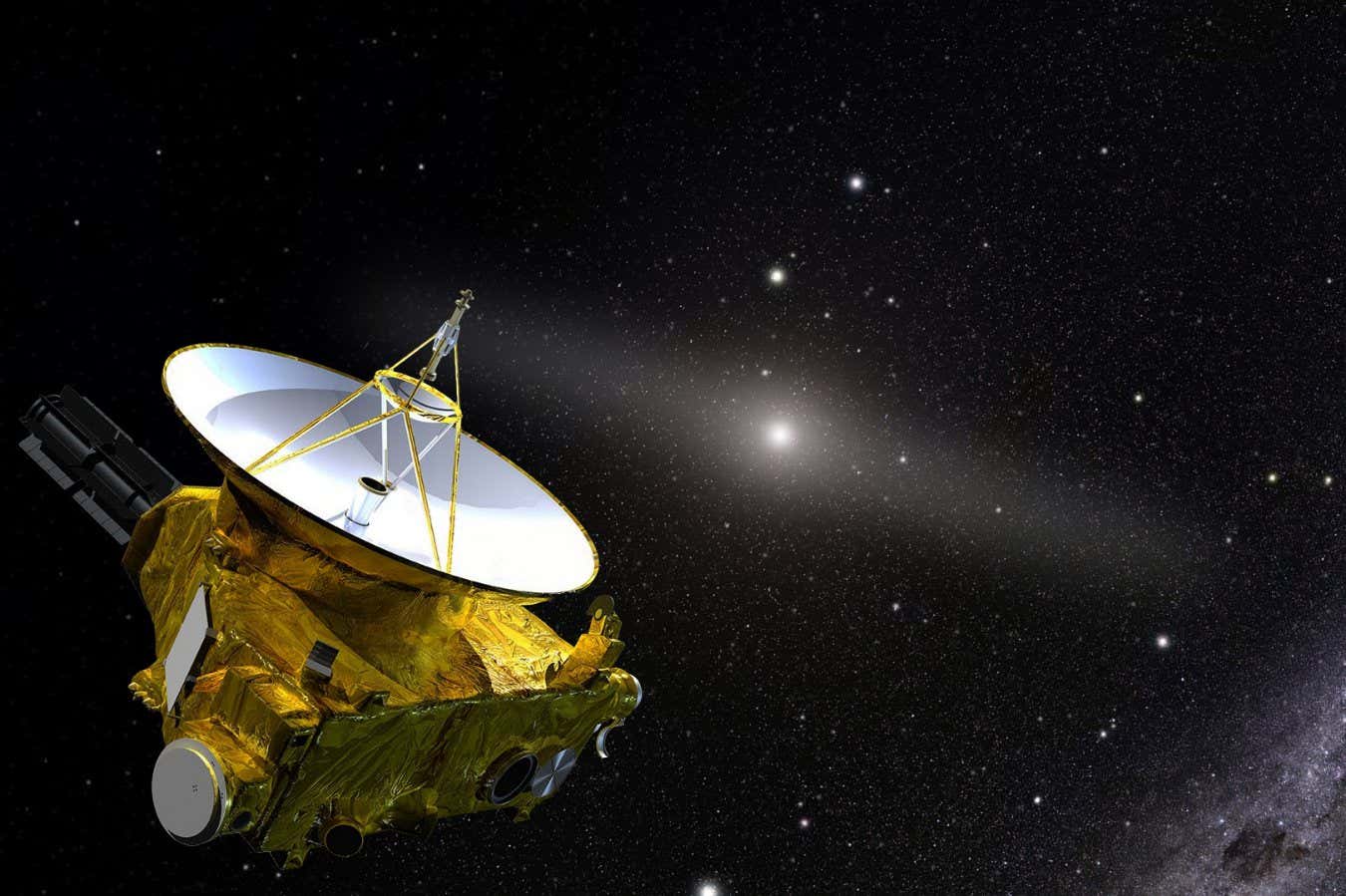
    Artist’s illustration of NASA’s New Horizons spacecraft in the outer solar system

    Joe Olmsted/STScI

    As it hurtles out of our solar system, NASA’s New Horizons spacecraft is so far from Earth that the stars in the Milky Way appear in markedly different positions compared with our own view. Astronomers have now used this change in perspective to work out the probe’s position in the galaxy, in the first ever example of interstellar navigation.

    New Horizons was launched in 2006, initially to study Pluto, but it has since travelled way beyond this point, ploughing on through the Kuiper belt, a vast, wide band of rocks and dust billions of miles from the sun. It is now speeding at tens of thousands of kilometres per hour.

    When gazing at the night sky from Earth, the stars are so far away that they don’t appear to change positions when viewed from different locations, unless you have a powerful telescope. But from New Horizons’ viewpoint, there is a significant change in star positions due to the parallax effect. This was demonstrated in 2020 when the probe beamed back pictures of two nearby stars, Proxima Centauri and Wolf 359, to Earth.

    Now, Tod Lauer at the US National Optical-Infrared Astronomy Research Laboratory in Arizona and his colleagues have used this effect to work out the position of New Horizons. They did it by comparing the probe’s photos of Proxima Centauri and Wolf 359 with measurements from the Gaia space telescope, which has produced the most detailed map of stars in our Milky Way.

    “We have a good enough three-dimensional map of the galaxy around us that you can find out where you are,” says Lauer. “It’s a remarkable accuracy, with your own camera [on board a spacecraft].”

    To calculate the spacecraft’s position, he and his team looked at the position of the stars as they appeared from New Horizons’ on-board camera, drawing a line of sight back from both stars and working out where the two lines were closest. Then, they used the precise position of both stars from Gaia’s star map to work out where this point was in relation to the solar system.

    New Scientist. Science news and long reads from expert journalists, covering developments in science, technology, health and the environment on the website and the magazine.

    This two-frame animation shows the shifting position of Proxima Centauri as viewed from Earth and New Horizons

    Almost all spacecraft calculate their bearings to within tens of metres using NASA’s Deep Space Network (DSN), a collection of radio transmitters on Earth that send regular signals out to space. In comparison, the parallax method was far less accurate, locating New Horizons within a sphere with a radius of 60 million kilometres, about half the distance between Earth and the sun.

    “We’re not going to put the Deep Space Network out of business – this is only a demo proof of concept,” says Lauer. However, with a better camera and equipment they could improve the accuracy by up to 100 times, he says.

    Using this technique for interstellar navigation could offer advantages over the DSN because it could give more accurate location readings as a spacecraft gets further away from Earth, as well as being able to operate autonomously without needing to wait for a radio signal to come from our solar system, says Massimiliano Vasile at the University of Strathclyde, UK.

    “If you travel to an actual star, we are talking about light years,” says Vasile. “What happens is that your signal from the Deep Space Network has to travel all the way there and then all the way back, and it’s travelling at the speed of light, so it takes years.”

    However, there are no missions in the works to go deep into interstellar space by any agency, says Vasile, so the utility of this particular technique is limited until one takes shape, he says.

    Topics:


    Source link

    Share. Facebook Twitter Pinterest LinkedIn Tumblr Email Telegram Copy Link

    Related Posts

    Science

    What is a ‘normal’ memory slowdown, and when should I worry?

    June 9, 2026
    Science

    Wildlife thrives in solar farm built on restored peatland

    June 8, 2026
    Science

    You don’t need to worry about recursive-self-improving AI – yet

    June 8, 2026
    Science

    Understanding anorexia’s grip on the brain could unlock new therapies

    June 8, 2026
    Science

    Why GLP-1 drugs might reduce cancer risk

    June 8, 2026
    Science

    Landmark pancreatic cancer treatment paves way for targeting other tricky tumors

    June 8, 2026
    Editors Picks

    Step inside the gorgeous, futuristic offices of Vast, the startup designing the next-gen space station

    May 5, 2026

    ENIAC, the General-Purpose Digital Computer, Is 80

    March 18, 2026

    House Oversight Demands Answers About ‘Cover Up’ Of Biden’s Health Decline

    May 26, 2025

    What are the threats facing Europe? | Show Types

    June 8, 2025

    Fractional Banking V Matched Funding

    December 31, 2025
    About Us
    About Us

    Welcome to Benjamin Franklin Institute, your premier destination for insightful, engaging, and diverse Political News and Opinions.

    The Benjamin Franklin Institute supports free speech, the U.S. Constitution and political candidates and organizations that promote and protect both of these important features of the American Experiment.

    We are passionate about delivering high-quality, accurate, and engaging content that resonates with our readers. Sign up for our text alerts and email newsletter to stay informed.

    Latest Posts

    Katie Holmes And Joshua Jackson Spark ‘Soul-Level’ Love Chatter

    June 9, 2026

    Singapore Airlines, Southwest Airlines partner to expand access to nearly 120 US destinations

    June 9, 2026

    Trump warns Netanyahu: ‘You’ll be on your own’ if attacks on Iran continue | US-Israel war on Iran News

    June 9, 2026

    Subscribe for Updates

    Stay informed by signing up for our free news alerts.

    Paid for by the Benjamin Franklin Institute. Not authorized by any candidate or candidate’s committee.
    • Privacy Policy
    • About us
    • Contact us

    Type above and press Enter to search. Press Esc to cancel.