

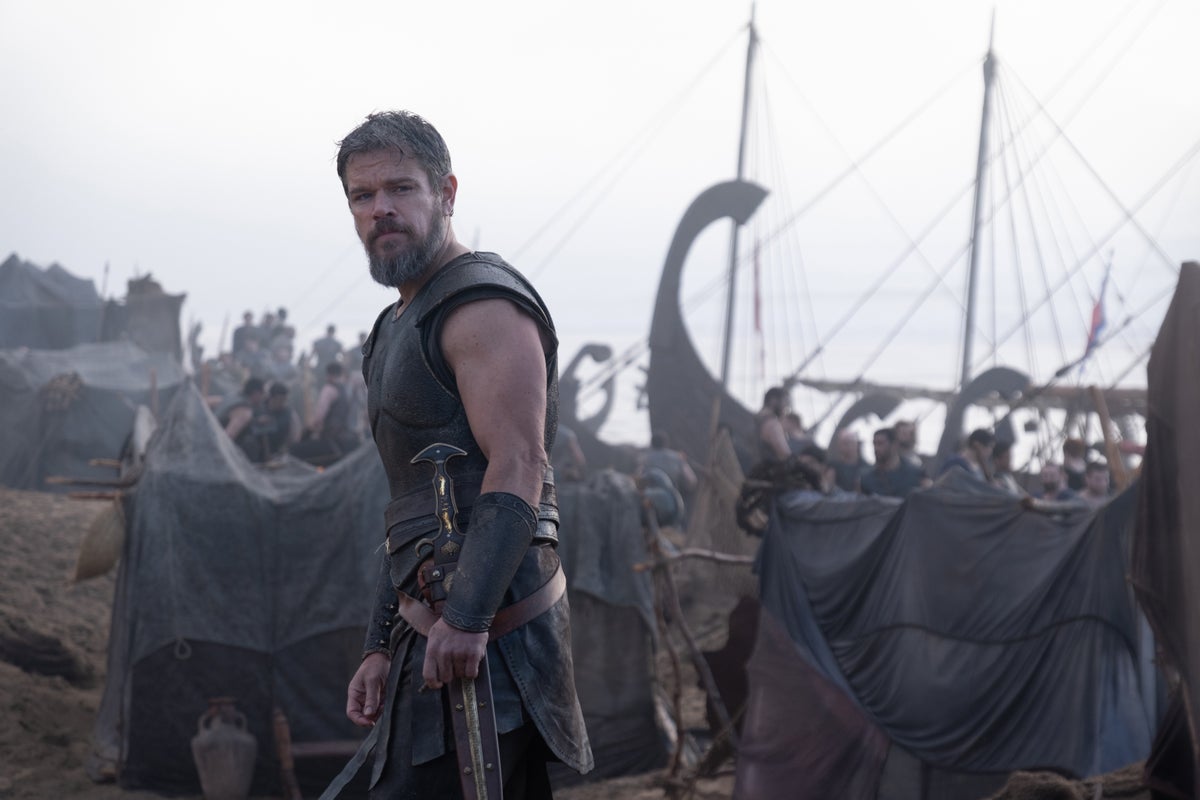
More than two and a half millennia after The Odyssey’s epic homecoming story was first told, it still resonates with audiences. A new movie version from director Christopher Nolan both transports viewers back in time (albeit with historically inaccurate costumes) and gives them a fresh take for today.
This story may endure for a reason. Its narrative structure, known as a “hero’s journey,” has shaped modern fiction, from Star Wars to Barbie. And psychology researchers have found that the tool helps us make meaning of our own lives, too, by thinking of ourselves as the Odysseus of our own stories. “If your life story felt similar to a [familiar] type of story…, that would feel comfortable and coherent,” says Ben Rogers, who studies these narratives at Boston College. “That’s a big aspect of finding your life meaningful.”
The term “hero’s journey” was popularized by mythologist Joseph Campbell, who took inspiration from psychoanalyst Carl Jung to argue that stories are metaphors that help us access realities in life. Although The Odyssey is a major reference in Campbell’s characterization of the hero’s journey, he argued it is a universal structure, or “monomyth,” that was established by many ancient myths and stories across the world. (Indeed, this narrative structure appears in the Epic of Gilgamesh, which dates to around 2100 B.C.E. in Mesopotamia.)
On supporting science journalism
If you’re enjoying this article, consider supporting our award-winning journalism by subscribing. By purchasing a subscription you are helping to ensure the future of impactful stories about the discoveries and ideas shaping our world today.
According to Campbell, the hero’s journey involves 17 steps, but a 2023 study by Rogers and his team condensed the number to seven elements: a protagonist, a shift, a quest, allies, a challenge, a transformation and a legacy. Rogers’s team collected the life stories of more than 1,200 people and then asked them to report their sense of meaning in life, life satisfaction and level of depression. The researchers found that people who included more of the seven elements when telling their life stories reported more meaning in life and less depression. The team also found that prompting people to “restory” their lives as hero’s journey narratives could improve their well-being and sense of meaning in life.
Two of the seven steps were most important: challenge and transformation. “The heart of it, the most predictive part of it, is that central challenge and then transformation,” Rogers says. In various stories, the transformation step can often be fantastical, such as when a superhero gains new powers. But the transformations that participants reported in their life stories were mostly psychological experiences, such as gaining emotional intelligence or undergoing a cognitive shift toward a new perspective. “That is really one of the key, if not the key, parts of what makes a life meaningful,” Rogers says.
While casting yourself as a hero in your own story can be helpful, however, other researchers have suggested that abandoning self-narrative can be even more freeing. In a 2025 paper in American Psychologist, the authors argued that having a robust self-narrative drawn from popular literature is not the only way to find meaning and that it can even hold us back.
“A counterpoint was missing to [this] more dominant storyline about the importance of stories and hero’s journey—and particularly, I think, in [the U.S.] and Western contexts,” says the 2025 paper’s co-author Daniel Newark, who studies decision-making and identity at HEC Paris. “I think there is, by definition, self-focus to these stories.” Some people may not resonate with putting themselves at the center of their life stories. Certain narratives can even be detrimental, such as those that focus on a victim persona or a lack of agency. These self stories can lock people in place and lead them to ruminate on their own disempowerment.
In their American Psychologist paper, Newark and his co-author suggested two alternative ways to make meaning without mythologizing oneself. One, called arbitrary commitment, involves doing something not because it’s an important part of your story (or a “canon event,” as a Gen Zer might say) but because you’ve decided to find fulfillment through the process of doing it. The other is traditional mindfulness, which include techniques that focus not on internal monologues and rationalizations but on staying grounded in one’s surroundings and present circumstances.
“Just being present—by noticing, by observing—some of those existential questions may quiet down a little bit. You may experience meaning a little bit more directly without necessarily going through a verbal or linguistic path,” Newark says. “That’s another way that people find motivation and meaning—by being attuned to where they are.”
Despite its potential for igniting narcissism, Rogers argues, the hero’s journey can be a prosocial mental structure that encourages us to look beyond ourselves when it is applied correctly. To speak in terms of The Odyssey, it’s not just about charting a course between Troy and Ithaca; it’s also about gaining the strength to return home for your loved ones.
“It’s just a structure that puts together what humans in general really value in this story,” Rogers says. “The importance of growing, having new experiences, having allies, challenging yourself and growing from those things, giving a legacy…. These are all just human values.”
It’s Time to Stand Up for Science
If you enjoyed this article, I’d like to ask for your support. Scientific American has served as an advocate for science and industry for 180 years, and right now may be the most critical moment in that two-century history.
I’ve been a Scientific American subscriber since I was 12 years old, and it helped shape the way I look at the world. SciAm always educates and delights me, and inspires a sense of awe for our vast, beautiful universe. I hope it does that for you, too.
If you subscribe to Scientific American, you help ensure that our coverage is centered on meaningful research and discovery; that we have the resources to report on the decisions that threaten labs across the U.S.; and that we support both budding and working scientists at a time when the value of science itself too often goes unrecognized.
In return, you get essential news, captivating podcasts, brilliant infographics, can’t-miss newsletters, must-watch videos, challenging games, and the science world’s best writing and reporting. You can even gift someone a subscription.
There has never been a more important time for us to stand up and show why science matters. I hope you’ll support us in that mission.