

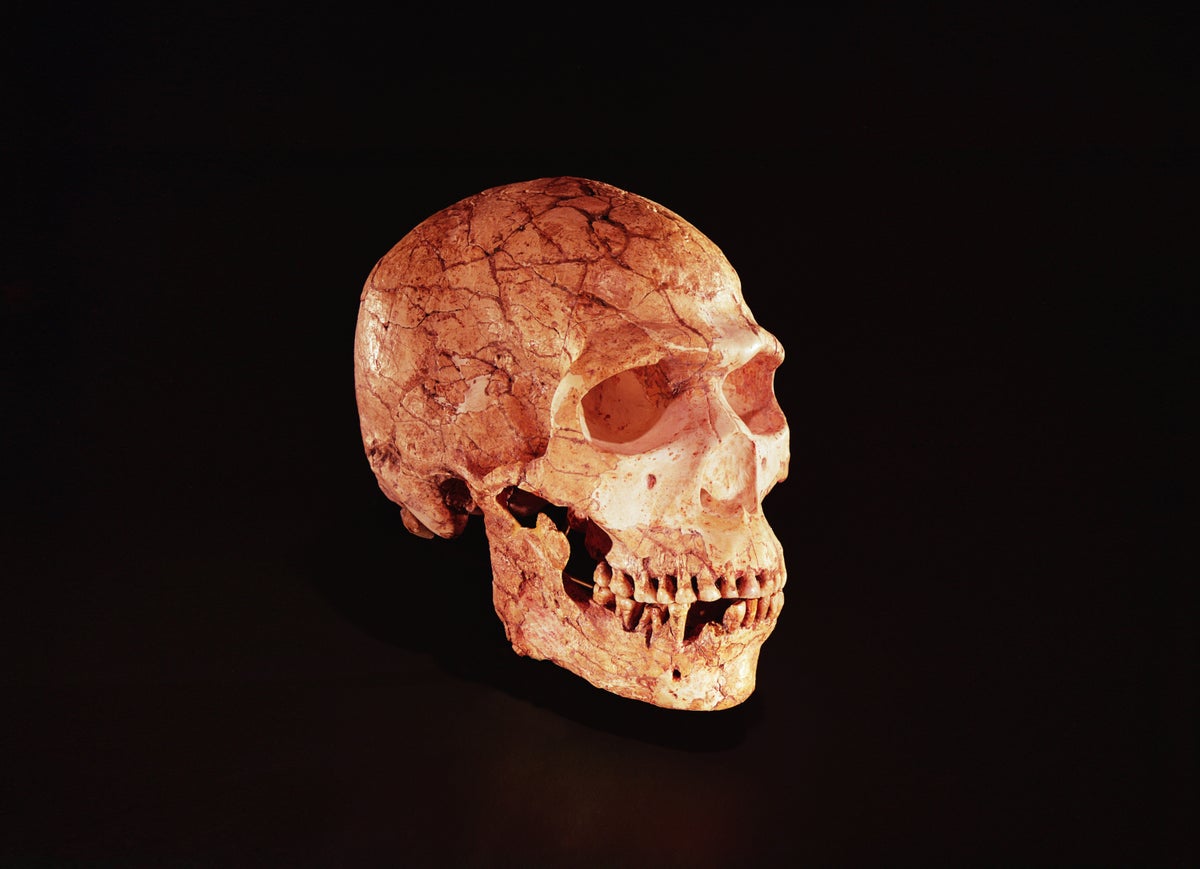
Neanderthals flourished across Eurasia for more than 300,000 years before the arrival of anatomically modern humans, only to vanish after just a few thousand years of coexistence. Scientists have long proposed that modern Homo sapiens outcompeted their robust cousins through sheer intelligence. Using Neanderthal cranium shapes to estimate specific brain regions’ volume, some investigators claimed to see signs of a mind with feeble linguistic abilities, poor executive function and an unremarkable memory.
But a new study argues that Neanderthal cognition may have rivaled our own. “I don’t think we would detect a difference if they were around today,” says Tom Schoenemann, an anthropologist at Indiana University Bloomington and lead author of the study, which was published in the Proceedings of the National Academy of Sciences USA. “I think they would fit comfortably within the range of cognitive functioning that we see among modern humans.”
The study relied on a technique called deformation mapping: to create digital reconstructions of the inner surface of the skull to infer the volume of different brain regions. This approach is “possibly the best we’ll get,” Schoenemann says, barring the discovery of a preserved Neanderthal brain. Deformation mapping is far from a perfect way to deduce internal brain anatomy, he says, but as provisional results, the new findings indicate, at most, a modest intelligence gap between modern humans and Neanderthals.
On supporting science journalism
If you’re enjoying this article, consider supporting our award-winning journalism by subscribing. By purchasing a subscription you are helping to ensure the future of impactful stories about the discoveries and ideas shaping our world today.
To make the comparison, the researchers estimated the average volumes of more than a dozen brain regions in modern people of Han Chinese and European descent, as well as in Neanderthals. For several of those regions, they found greater variation between the two modern populations than between Neanderthals and today’s humans—our much-maligned ancient cousins would have largely fit right in based on neuroanatomy.
On top of that, larger brain region volume doesn’t necessarily mean higher cognitive ability. There’s only a faint link between the two, reinforcing the idea that Neanderthals likely spanned an intelligence spectrum that was comparable to that of their human neighbors.
This study builds upon deformation mapping research from 2018 that suggested that, on average, Neanderthals had a smaller cerebellum than early humans did. Given the cerebellum’s importance to language processing, memory and other cognitive functions, the 2018 study’s authors reasoned that this neuroanatomical difference might have given modern humans the upper hand. Yet if we consider that difference evolutionarily significant, Schoenemann says, we must view similar differences between today’s human groups in the same light—a conclusion that, he notes, is not supported by the vast majority of recent research. He suspects that, rather than being outsmarted, Neanderthals simply merged with modern H. sapiens through interbreeding and that their genes were subsumed into the vastly larger population.
University of Tokyo biomechanics researcher Naomichi Ogihara, a co-author of the 2018 study, agrees that this process of “genetic swamping” played a role in Neanderthals’ disappearance. But he argues that a complete explanation must also include an intelligence gap, minuscule though it may be. “Even a small average difference in cognitive or behavioral tendencies could have evolutionary significance over many generations,” Ogihara says.
It’s Time to Stand Up for Science
If you enjoyed this article, I’d like to ask for your support. Scientific American has served as an advocate for science and industry for 180 years, and right now may be the most critical moment in that two-century history.
I’ve been a Scientific American subscriber since I was 12 years old, and it helped shape the way I look at the world. SciAm always educates and delights me, and inspires a sense of awe for our vast, beautiful universe. I hope it does that for you, too.
If you subscribe to Scientific American, you help ensure that our coverage is centered on meaningful research and discovery; that we have the resources to report on the decisions that threaten labs across the U.S.; and that we support both budding and working scientists at a time when the value of science itself too often goes unrecognized.
In return, you get essential news, captivating podcasts, brilliant infographics, can’t-miss newsletters, must-watch videos, challenging games, and the science world’s best writing and reporting. You can even gift someone a subscription.
There has never been a more important time for us to stand up and show why science matters. I hope you’ll support us in that mission.