

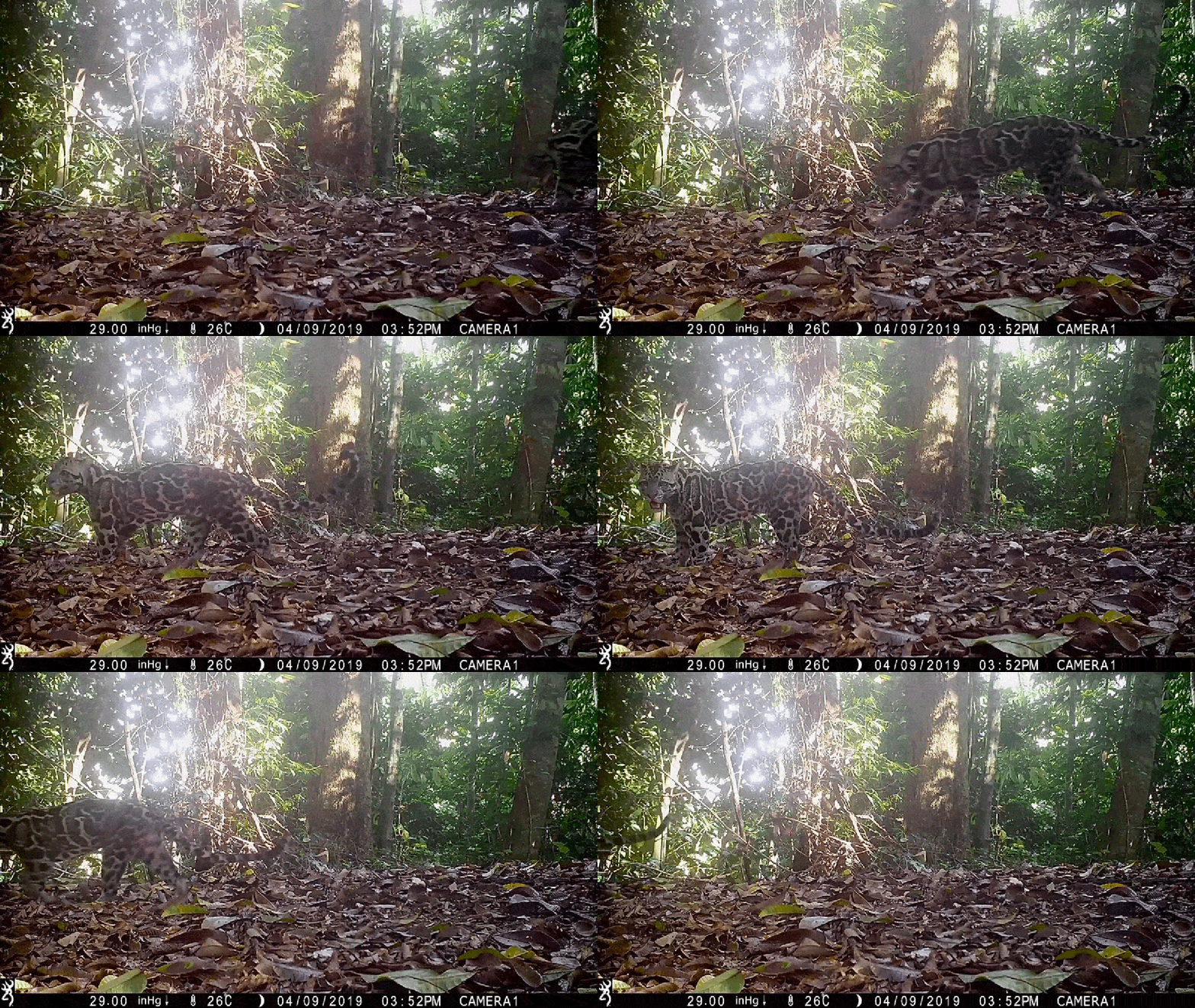
The Sunda clouded leopard stalks the dense rainforests of Borneo and Sumatra in search of bearded pigs and mouse deer to prey on. Its tawny coat, accented by dark, cloud-shaped spots, blends into its surroundings. Beyond such basics, however, much remains unknown about these elusive big cats, sometimes called “ghosts of the forest,” including how long they live and how they spend their time.
But a new set of images and data, captured between 2007 and 2023 in three reserves in the state of Sabah in Malaysian Borneo, reveal a never-before-seen glimpse into their secretive lives.
On supporting science journalism
If you’re enjoying this article, consider supporting our award-winning journalism by subscribing. By purchasing a subscription you are helping to ensure the future of impactful stories about the discoveries and ideas shaping our world today.
A recent study in Biotropica analyzing the 15 years of photos and other data observed 52 adult individuals, including 30 males and 22 females, helping to answer some of the questions about the species.
What really surprised the researchers was “how difficult it is to get females in front of the lens,” says the study’s lead author Katharina Kasper, a biologist with the Polish Academy of Sciences and the Leibniz Institute for Zoo and Wildlife Research.
A Sunda clouded leopard mother and cub caught on camera—a rarity—in Sabah, Borneo.
That’s because females, it turns out, spend much of their time in the trees—much more time than males do. “Their physique hints at this, as their bodies are usually more slender and they have fluffier tails that help them balance,” Kasper says of the females. “Resident males, by contrast, spend much time circling and re-marking their territories [with urine], hence we capture them more often.”

The oldest known wild clouded leopard—a female—captured on camera trap in Malaysian Borneo. This individual is estimated to have been 8.5 years old.
The study, which was conducted by Kasper, as well as researchers from the global wild cat conservation organization Panthera and the Sabah Forestry Department, observed a single female over many years and determined that these cats may live up to 8.5 years in the wild—a new record for the species. (Although there are not enough members of this species in zoos to have solid numbers, a close relative, the mainland clouded leopard, lived to 20 years of age in a zoo, which aligns with the general trend of captive cats living about twice as long as wild ones.)

Kasper says the study has already helped the group tweak its research efforts to look at what factors influence the disturbance and survival of Sunda clouded leopards. In turn, this will help guide conservation efforts for this species, which is classified as vulnerable by the International Union for Conservation of Nature—one step up from endangered.
It’s Time to Stand Up for Science
If you enjoyed this article, I’d like to ask for your support. Scientific American has served as an advocate for science and industry for 180 years, and right now may be the most critical moment in that two-century history.
I’ve been a Scientific American subscriber since I was 12 years old, and it helped shape the way I look at the world. SciAm always educates and delights me, and inspires a sense of awe for our vast, beautiful universe. I hope it does that for you, too.
If you subscribe to Scientific American, you help ensure that our coverage is centered on meaningful research and discovery; that we have the resources to report on the decisions that threaten labs across the U.S.; and that we support both budding and working scientists at a time when the value of science itself too often goes unrecognized.
In return, you get essential news, captivating podcasts, brilliant infographics, can’t-miss newsletters, must-watch videos, challenging games, and the science world’s best writing and reporting. You can even gift someone a subscription.
There has never been a more important time for us to stand up and show why science matters. I hope you’ll support us in that mission.