

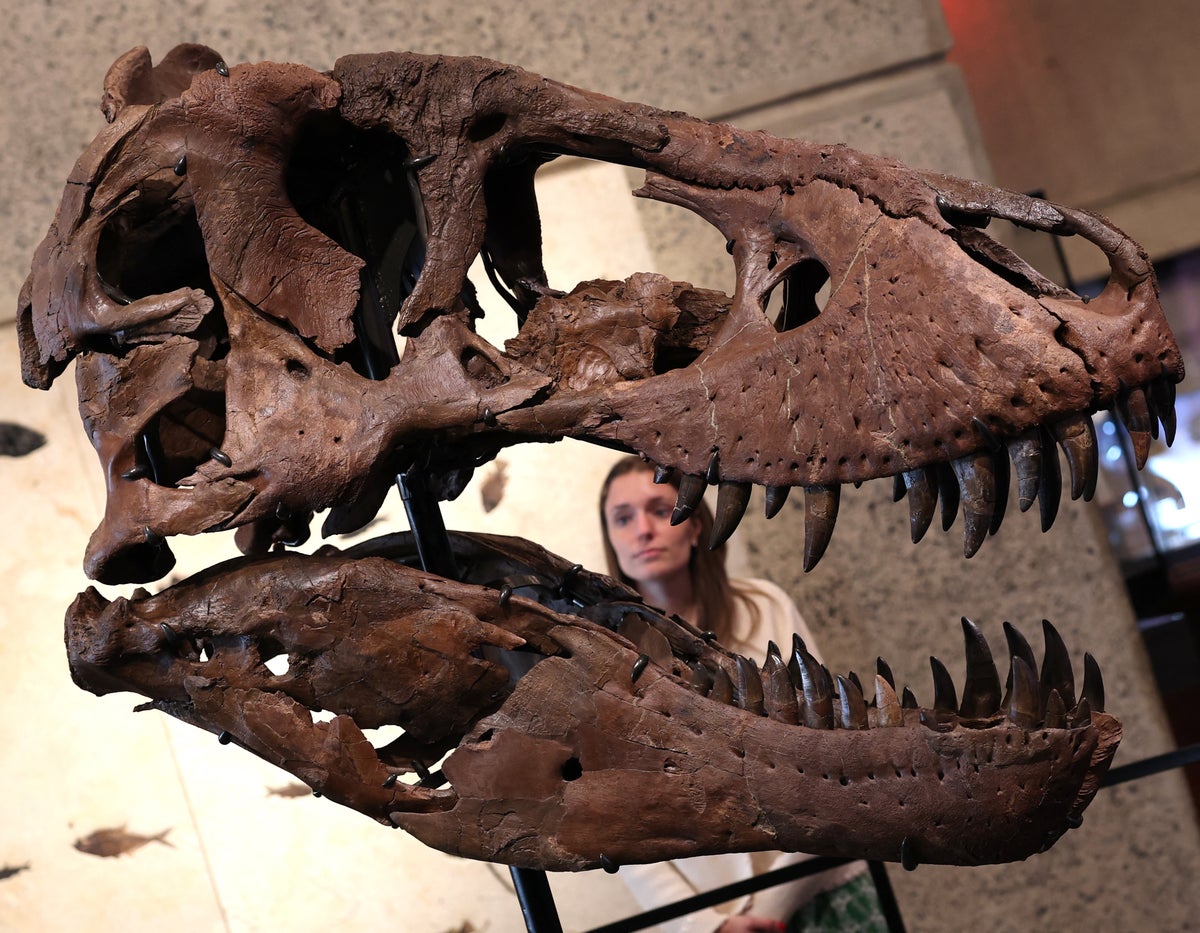
A Tyrannosaurus rex fossil named “Gus” became the most expensive dinosaur ever to sell at auction on Tuesday.
Gus sold for $50,130,000—far above the estimated $20-million to $30-million price tag that had been set earlier by the auction house Sotheby’s.
The skeleton stands about 12.5 feet (3.8 meters) tall and is approximately 38 feet long—the dinosaur’s skull alone is some 4.5 feet long, according to Sotheby’s, and weighs so much that it must be handled separately. (The skull mounted on the fossil skeleton that is currently displayed at the auction house is a replica.) The skeleton is estimated to be about 61 percent complete, and Sotheby’s said this makes it among the most complete T. rex fossils ever found.
On supporting science journalism
If you’re enjoying this article, consider supporting our award-winning journalism by subscribing. By purchasing a subscription you are helping to ensure the future of impactful stories about the discoveries and ideas shaping our world today.
Gus is unusual, according to the auction house, because the fossil retains some bones called gastralia. Also known as “belly ribs,” gastralia are free-floating bones located in the abdominal wall. Today they are still found in certain reptiles, such as crocodiles and tuatara.
The 67-million-year-old skeleton, which was found during an excavation on private land in South Dakota and comprises 183 fossil bones, representing up to 80 percent of the animal’s total bone mass.
TIMOTHY A. CLARY/AFP via Getty Images
The fossil was discovered in 2021 on a South Dakota ranch. It is believed to be roughly 67 million years old. The bones bear evidence of bite marks from other tyrannosaurs, and Sotheby’s said these may have been “sustained by either combat or post-mortem scavenging.” Gus also shows signs of “injuries which occurred during the life of the individual, with fractured and healed bones discernable in several ribs and gastralia,” according to the auction house.
The value of Gus eclipses that of “Stan,” another T. rex fossil found in South Dakota, which was sold for $31.8 million in October 2020 and is now in a history museum in Abu Dhabi, and the Stegosaurus “Apex,” which was bought for $44.6 million by billionaire Ken Griffin in 2024. Gus went to an unknown phone bidder.
Scientists have long criticized the practice of auctioning off dinosaur fossils like these. Researchers have argued that allowing private buyers to own such specimens deprives paleontologists the opportunity to study them. And the extreme prices the fossils command mean most museums or academic institutions can’t compete in a bidding war.
It’s Time to Stand Up for Science
If you enjoyed this article, I’d like to ask for your support. Scientific American has served as an advocate for science and industry for 180 years, and right now may be the most critical moment in that two-century history.
I’ve been a Scientific American subscriber since I was 12 years old, and it helped shape the way I look at the world. SciAm always educates and delights me, and inspires a sense of awe for our vast, beautiful universe. I hope it does that for you, too.
If you subscribe to Scientific American, you help ensure that our coverage is centered on meaningful research and discovery; that we have the resources to report on the decisions that threaten labs across the U.S.; and that we support both budding and working scientists at a time when the value of science itself too often goes unrecognized.
In return, you get essential news, captivating podcasts, brilliant infographics, can’t-miss newsletters, must-watch videos, challenging games, and the science world’s best writing and reporting. You can even gift someone a subscription.
There has never been a more important time for us to stand up and show why science matters. I hope you’ll support us in that mission.