

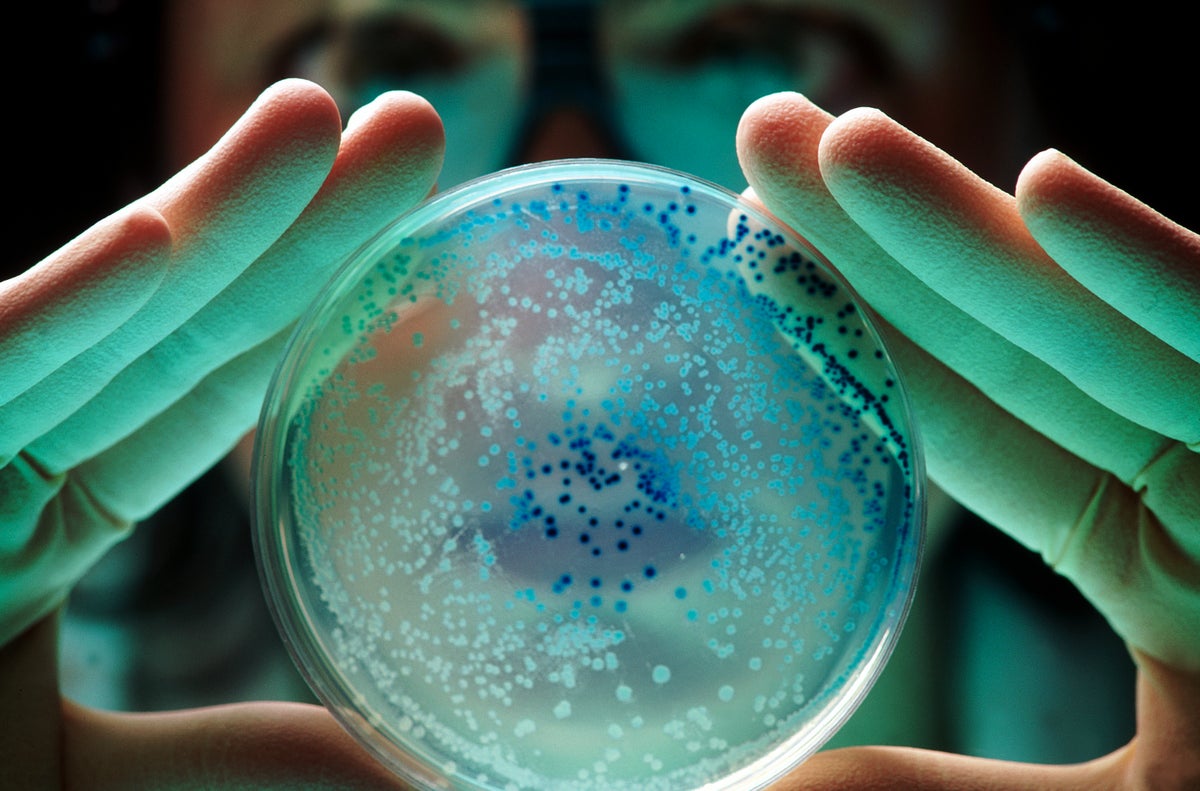
When antibiotics attack microbes, their stressed neighbors ship them proteins to help them survive, new work suggests.
Bacteria share DNA related to antibiotic resistance through a process called horizontal gene transfer, but microbiologists have long suspected they might trade more than just the genes. Multiple papers have proposed that microbes use vesicles, tiny fluid-filled bubbles enclosed in fatty membranes, to ferry functional proteins to their buddies as well. “But if you go back to these papers, there was no evidence,” says Christophe Herman, a microbiologist at Baylor College of Medicine. In a recent study published in the journal Science, Herman and his colleagues have, for the first time, caught bacteria in the act of transferring proteins to each other in this way.
To achieve this, the scientists created two Escherichia coli bacterial populations. One group of cells, the recipient bacteria, carried a disabled, inverted gene that made them unable to metabolize a simple sugar called galactose. A donor bacteria population, in turn, had the ability to create a protein named Cre recombinase that could fix the inverted gene in the recipients. With a working version of that gene, the recipient bacteria, in theory, could again feast on galactose. Only a cell that physically received the Cre protein could flip that gene back on.
On supporting science journalism
If you’re enjoying this article, consider supporting our award-winning journalism by subscribing. By purchasing a subscription you are helping to ensure the future of impactful stories about the discoveries and ideas shaping our world today.
“[Herman] went on vacation, and I was in the lab doing these experiments. I don’t think we thought anything would come of it,” recalls study lead author Alice X. Wen, a microbiologist also at Baylor. But to the researchers’ surprise, the bacteria in fact sent proteins to each other, albeit very slowly.
The team then found that exposure to antibiotics kicked the exchange into high gear, making the protein transfer rate jump roughly 4,000-fold. In nature, antibiotic stress splits bacteria into two camps. Most cells ramp up a membrane stress response and shed vesicles loaded with protein cargo, leaving themselves exposed to the antibiotics. The others go dormant, shutting down protein production and reproduction to survive the antibiotic onslaught. Herman suspects incoming vesicles deliver repair proteins that the dormant cells can no longer make themselves, such as a DNA polymerase to restart replication when the bombardment is over. This process even worked when the donor and recipient cells were different bacterial species.
The team doesn’t yet know why stressed cells help their neighbors survive. “We just know at this point that it happens,” Wen says. Herman speculates that, besides working as a population survival mechanism, capturing a neighbor’s protein could also let a cell sample what it has to offer—going through a microbial version of a free trial before committing to something more permanent, such as taking its DNA.
This study, which had multiple control groups to rule out other explanations for the bacteria’s survival, “is a very elegant way to demonstrate that there actually is protein transfer,” says Laurence Van Melderen, a microbiologist at the Université Libre de Bruxelles in Belgium, who was not involved in the study but co-authored an accompanying commentary in Science. “I’m pretty confident they have the right thing,” she adds.
Scientists hope this mechanism’s discovery will one day help us stop bacteria from mutating to withstand antibiotics. “Persistence is the first step to resistance,” Herman says. “If we could stop that, I think it would be very helpful in stopping the rise of antibiotic resistance.”
It’s Time to Stand Up for Science
If you enjoyed this article, I’d like to ask for your support. Scientific American has served as an advocate for science and industry for 180 years, and right now may be the most critical moment in that two-century history.
I’ve been a Scientific American subscriber since I was 12 years old, and it helped shape the way I look at the world. SciAm always educates and delights me, and inspires a sense of awe for our vast, beautiful universe. I hope it does that for you, too.
If you subscribe to Scientific American, you help ensure that our coverage is centered on meaningful research and discovery; that we have the resources to report on the decisions that threaten labs across the U.S.; and that we support both budding and working scientists at a time when the value of science itself too often goes unrecognized.
In return, you get essential news, captivating podcasts, brilliant infographics, can’t-miss newsletters, must-watch videos, challenging games, and the science world’s best writing and reporting. You can even gift someone a subscription.
There has never been a more important time for us to stand up and show why science matters. I hope you’ll support us in that mission.