

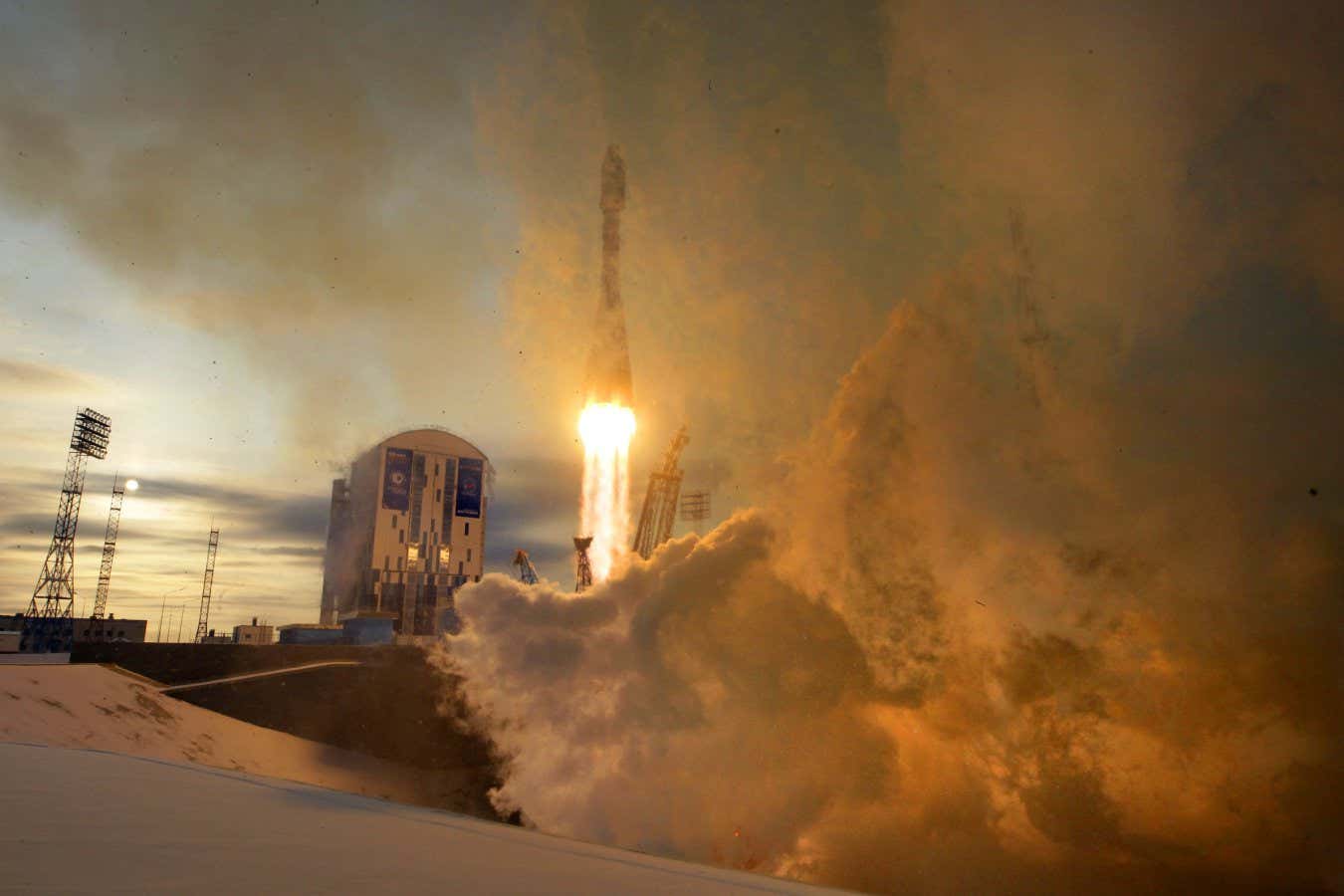
Satellite launches like this one in Russia are normally registered on a United Nations list – but not right now
Photo by Maxim Shipenkov/EPA-EFE/Shutterstock
A United Nations list of every object launched into space, conceived during the cold war as a way to avoid paranoia and conflict, has been unavailable for months due to an unexplained IT problem.
“This is not OK,” says Jonathan McDowell at Durham University, UK. “Especially at a time of rising tensions in space, [with] accusations about bad behaviour flying back and forth between various space powers.”
The UN Office for Outer Space Affairs (UNOOSA) oversees the UN Committee on the Peaceful Uses of Outer Space (COPUOS), a place where 104 nations – many of whom have tense relationships with each other or are even in active conflict – can discuss and resolve technical, political or safety problems regarding space travel.
One part of UNOOSA’s job is to maintain a public list of every satellite launch around the world. This idea was first raised at the UN in 1961 and later expanded by the Convention on Registration of Objects Launched into Outer Space in 1974 as a way to promote transparency around the space race, as countries were designing spacecraft with surveillance and military applications. The result is that countries must provide a name for each launched object, a date and place of launch, details on its orbit and the device’s general function.
But the Online Index of Objects Launched into Outer Space list has been unavailable for months, with the UN’s website saying only that it is due to “mandatory changes made to the UNOOSA website’s IT infrastructure”. UNOOSA didn’t respond to questions about the nature of the problem or how long it was expected to last.
McDowell says that the database has been unavailable for at least several months. The most recent updates to the list mentioned on the website – the last sign of it functioning – were made on 23 February.
“It’s a security transparency regime that was agreed that has been working for 50 years, more or less. But it’s useless if the documents go to the UN and then no one can see them,” says McDowell. “Right now, we don’t know what the Russian satellites are and what they’re called. We don’t know what the US satellites are and what they’re called. The secret ones – they only get included in the UN filings.”
McDowell says that even secretive military or surveillance satellites were previously listed on the UN website, although their purpose would often be vague, such as “performing functions for the ministry of defence”, or disingenuous, such as “carrying out research and spacecraft techniques and technology” – but the mere fact that they were listed promoted at least some degree of transparency.
“It’s important to have at least an official reference [so] you can say, ‘well, you know, the Russians say they did this, the USA [say] they did this’. It served us well for years and we need to get back to it,” says McDowell.
Ram Jakhu at McGill University in Montreal, Canada, says the outage will “not only pose threats to international peace and security, but also hinder effective implementation of the UN treaties on outer space, particularly in cases of accidents caused by space objects and debris”.
The database is a very straightforward and basic list, but states taking part and publicly sharing information makes the world a slightly more predictable and safe place, says Thomas Cheney at Northumbria University in the UK.
“The international space-law regime is really permissive. You can do pretty much whatever you want up there,” he says. “And in exchange, we ask you to tell us what you’re doing. It’s more a symbolic statement.”
Cheney says the issue is a glimpse at the wider problem of the UN’s financial crisis, largely caused by the US withdrawing part of its previous funding. Another impact of that on space regulation was that UNOOSA’s COPUOS meeting in Vienna this year was two days shorter than usual to cut costs, says Cheney – another measure that puts strain on international relations.
“You get conversations between the Chinese and the Americans that only happen in Vienna because it’s done under the guise of the UN, and if it was a more formalised state-to-state meeting, it would be more complicated and a bigger deal,” he says.
Topics: