

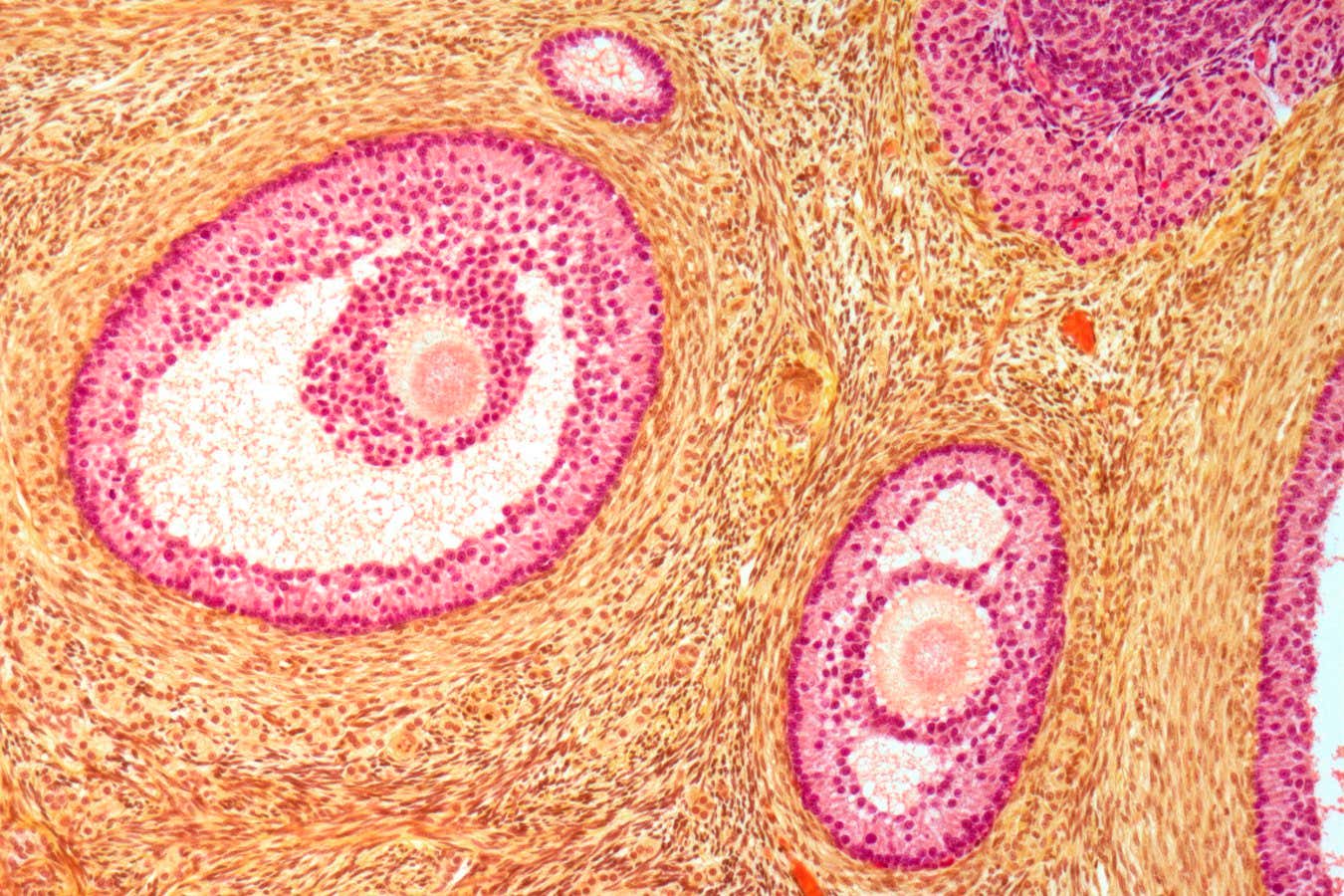
Light micrograph of a section through follicles, which house immature eggs, in an ovary. The immature eggs (orange) are surrounded by fluid-filled cavities (light pink) and granulosa cells (dark pink), which provide them with nutrients and hormones
STEVE GSCHMEISSNER/SCIENCE PHOTO LIBRARY
Our fertility window could be extended by making the ovaries less stiff. A drug that softens the organ more than doubled the conception rate of older rats with declining fertility and increased their litter size fivefold. It needs to be tested on women, but the results have raised hopes that the intervention could help them conceive at an older age.
Women’s fertility tends to start declining in their mid-thirties. However, in countries like England and Wales, many are choosing to have children later in life. The number and quality of a woman’s immature eggs, one of which matures and is released during ovulation, decline with age. There is also evidence that ovaries become stiffer over time, which may further affect egg development and quality.
To understand what’s driving this, Shixuan Wang at Huazhong University of Science and Technology in Wuhan, China, and his colleagues measured the protein levels of the ovaries of women aged 18 to 28, 35 to 42, and 47 to 52. All of the women had a history of gynaecological cancer; however, their ovaries were unaffected when removed.
The researchers found that a protein called interleukin-11 increased in the ovaries with age. This activates cells in connective tissue called fibroblasts, which make collagen – a driver of ovarian stiffness.
Next, the team genetically modified a group of mice to be unable to respond to interleukin-11. Not only did this reduce ovarian stiffness – measured via microscopy – as the mice aged, but the animals also ovulated more than an unmodified control group.
Finally, the researchers tested the potential of an experimental drug that blocks interleukin-11’s production by silencing the gene behind it. They injected the drug into the tails of 36-week-old mice – roughly equivalent to a person in their late 30s or early 40s – twice a week for four weeks.
This caused their ovaries to become 36 per cent less stiff compared with an untreated control group. What’s more, it doubled their conception rate from 25 per cent to 50 per cent, and increased their litter size from three to five pups, on average. Among similarly aged rats, the conception rate rose from 20 per cent to 50 per cent, and the litter size increased fivefold, from one pup to five.
Francesca Duncan at Northwestern University in Illinois says the intervention could lead to similar outcomes in premenopausal women, given that interleukin-11 also increases with age in human ovaries. However, she adds that the increase the team observed was in women with a history of gynaecological cancer, so we can’t be sure the same trend occurs without such conditions.
While further research is required, Barbara Vanderhyden from the University of Ottawa, Canada, says the intervention could benefit women’s health more generally. “Beyond preserving fertility, finding ways to prolong ovarian function could delay the health impacts of menopause”, such as a higher risk of osteoporosis and heart conditions, she says.
The team wants to be able to send the drug more directly to the ovaries before testing it on people. The mice and rats didn’t experience any known side effects. However, Duncan says that interleukin-11 is expressed in many tissues in the human body, so this is a risk. “The safety bar to any drug targeting the ovary is incredibly high given that this tissue contains the egg cells that can give rise to the next generation,” she says.
It is also unclear for how long the drug would need to be taken to potentially improve reproductive outcomes in people. “It might be possible to achieve the reduction in ovarian stiffness [in women] using short-term therapies, but we have little information yet on how much time would be needed for a therapy to have its positive or negative effects,” says Vanderhyden.
Topics: