

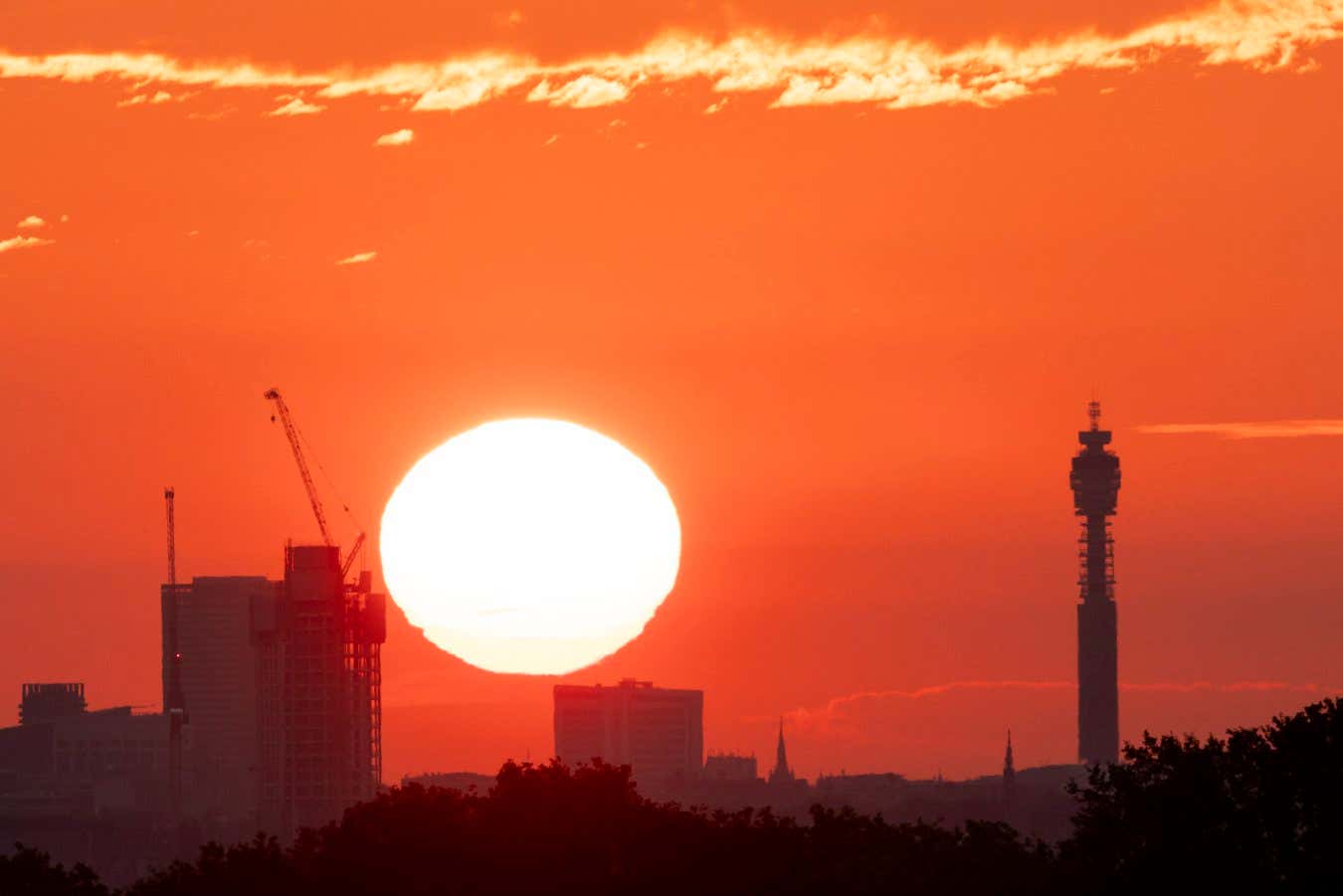
A red warning for extreme heat was issued for various parts of the UK this week, including London
Brook Mitchell/Getty Images
I’m finding the heatwave hitting Europe really scary. It’s bad enough in itself, with many records being broken, especially for the higher nighttime temperatures that make it so much harder to cope. But I just keep thinking, “If it’s like this now, what’s it going to be like in 10, 20 or 30 years’ time?”
The answer, of course, is hotter and hotter and hotter. In the UK, national weather service the Met Office has just warned that, by 2056, there could be nine days in a row with temperatures above 40°C (104°F), with some places hitting 45°C (113°F). In just 30 years! I’ve seen at least one piece asking “is this the new normal?” about the current heatwave, but we’re never going to have normal in our lifetimes again – just ever more extreme heat.
It’s possible to get through even worse heatwaves than this if all your infrastructure and systems are geared up to cope. But the UK is very much not prepared. The air conditioning in New Scientist’s office, for instance, is failing to keep up with the heat as I write – and lots of people have to endure this hot weather without any air conditioning at all. In a sign of the times, a meeting on adapting to extreme heat – part of London Climate Action Week – got cancelled because of extreme heat.
Climate scientists are continually warning of the need to prepare for hotter heatwaves, worse droughts, more flooding and rising seas. During heatwaves like this one, they might even get a little media coverage. But then the weather cools, the news agenda moves on and nothing is ever done.
That’s not just my view – it’s the official verdict of the UK’s Climate Change Committee, which advises the UK government. “Adaptation progress is either too slow, has stalled, or is heading in the wrong direction,” it said in a report last year. Everyone seems to assume this green and pleasant land is going to remain green and pleasant, but it won’t. We’re heading towards catastrophe, but never looking up.
There are many aspects of this that frighten me. Firstly, emissions are still rising, so the fundamental cause of the problem is getting worse. True, it’s not getting worse as fast as it was, but we are currently on course for average global surface temperatures to rise by between 2.1°C and 3.3°C by 2100, and possibly even more.
Even these alarming numbers are a little misleading because the oceans that cover most of the planet don’t warm as fast as the land. Average land temperatures are therefore going to go up by a lot more than the above numbers imply.
And what really matters to us is extreme weather, not the average. The projections for future extremes are already dire, and there are reasons to think that we’re in for extremes even greater than those currently projected for a given level of warming. For starters, heatwaves are already more extreme than projected in some parts of the world. One reason for this is that climate models may not be capturing how the dynamics of the jet streams change in a warmer world. Another is that regional models haven’t accounted for reductions in sunlight-blocking air pollution.
The next level beyond is how bad the knock-on effects of this extreme weather will be. These kinds of things are very difficult to project because so many complex systems are involved, but here, too, there is reason to think we are underestimating the impacts.
For starters, we could see mass deaths even among young people as heatwaves get more extreme. Then there’s our ability to feed people, the basis of civilisation. There’s growing evidence that global warming is already hitting food production, pushing up prices and causing yet more deforestation as farmers try to compensate.
As ever more weather extremes hit the world at the same time, the economic impacts are going to get ever more serious, too. One 2024 study warned that the result could be the worst global financial crisis ever.
And I haven’t even mentioned the wild cards, such as the Amazon drying up or the Atlantic Meridional Overturning Circulation shutting down. One researcher I chatted with at a recent conference thinks a slowdown of this crucial current system around 12,000 years ago triggered extreme seasonality in places like Britain, with sweltering summers, but temperatures plummeting tens of degrees below freezing in winter.
The fact is, the world is changing fast and we need to change just about every aspect of our lives to adapt – our homes and offices, factories and schools, cars and trains, farms and gardens, and so on. But it’s not happening. That’s why if you’re not scared witless by this heatwave, you should be.
Topics: