

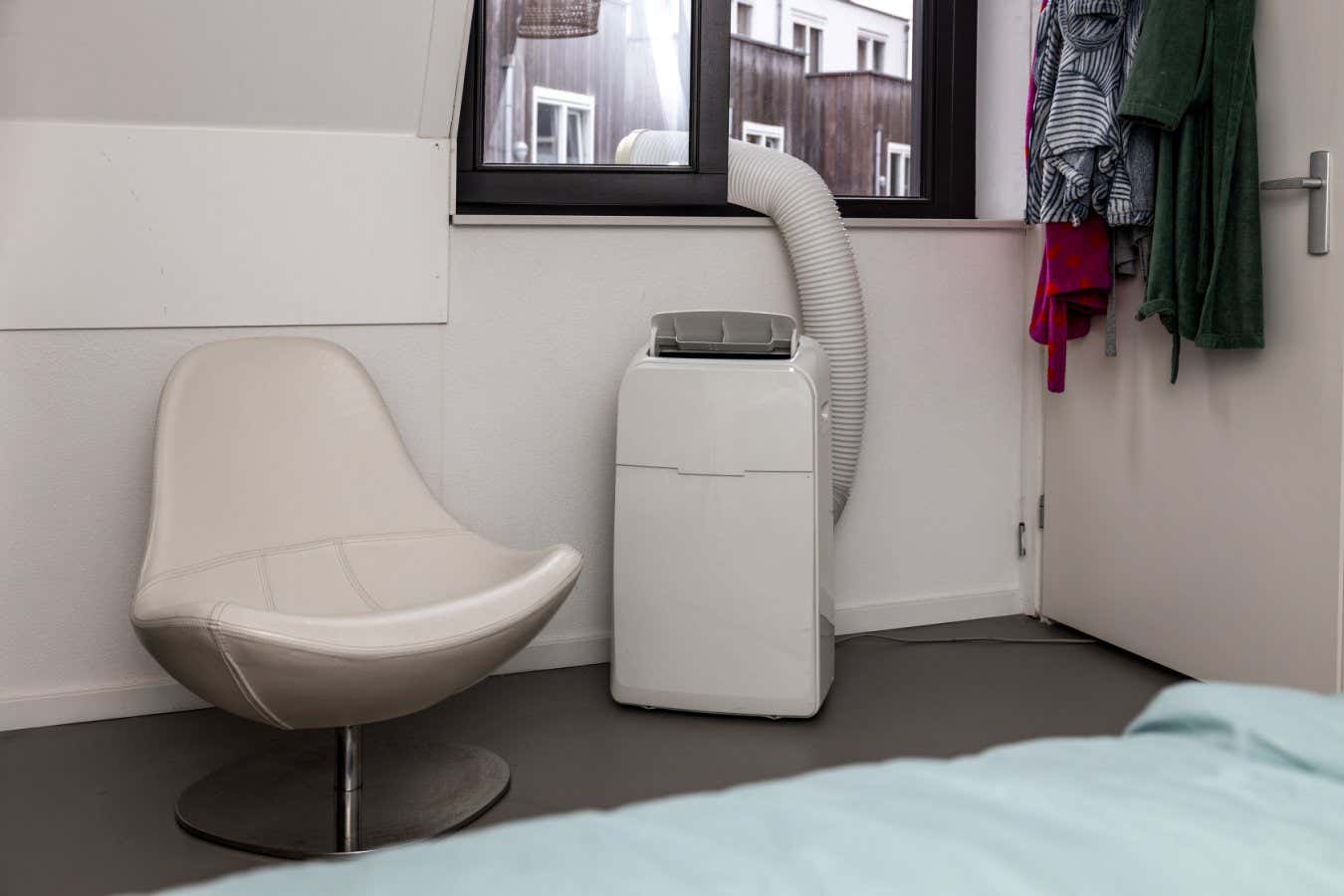
Single-hose air conditioners suck hot air in from outside
Ton Hazewinkel/Getty Images
Thinking of getting a portable air conditioner as sweltering heatwaves become more common? You will want to know that many, if not most, portable air conditioners have a serious design flaw – and that there is no label required to inform buyers of this.
I had no idea about it when I bought a portable air conditioner. What’s most shocking is that there is an easy fix – and I think the law needs to be changed so that no portable air conditioners can be sold without it.
First, let’s deal with the idea, especially common in the UK, that it is somehow wrong to buy an air conditioner. If you don’t need it where you are, great. But lots of us live in homes that get too hot during heatwaves, even when you do all the right things, like shutting blinds and windows during the day. And being too hot is bad for our health – sometimes, it is even deadly. It also makes it hard to work or do schoolwork. If it is OK to use energy to heat homes, I think it is also OK to use energy to stay cool – what’s the difference?
The fact is that, as the world heats up, more and more of us will resort to air conditioning to stay cool. Reducing the energy used by all these extra air conditioners is really important to minimise extra carbon emissions that result in even more warming – and even more need for air conditioners.
To understand the design flaw, you need to know how air conditioners work. The most efficient ones have a split system. There’s an outside unit, where a refrigerant is compressed to make it liquid, heating it up. It is then cooled by a heat exchanger over which outside air is blown.
The refrigerant then goes through a narrow pipe to the inside unit, where it is turned into a gas, cooling it down. That goes through another heat exchanger over which the room air is blown, cooling that air by transferring its heat to the refrigerant.
So the room air stays in the room, and only the heat is taken out. There is also less noise with split systems, because the compressor is outside. But they are almost all expensive, built-in systems – very few portable split systems are available, in part because, for upstairs rooms, there is usually nowhere to put the outside unit.
Instead of an outside unit, some portable air conditioners bring air from outside into the room. There is a wide air intake hose that sucks in outside air, and the heated air is blown out of a similar hose.
Dual-hose air conditioners, as they are known, are less efficient than split systems. The outlet hose transfers some heat to the room – you can reduce this by wrapping a blanket around it – and if the hose ends are too close, heated air can get sucked into the intake. But as with split systems, room air stays in the room.
With single-hose portable air conditioners, however, there’s no air intake hose. Instead, room air is used to cool the hot refrigerant and then blown out of the single hose, which means hot outside air is continuously sucked into the room.
If there’s a window open, hot air will come in through that. With the windows closed, the hot air will come via other parts of your home, warming them along the way. Either way, the air conditioner is constantly having to cool hot outside air, and so it has to use much more energy. It’s like adding mud to laundry detergent.
What’s more, the efficiency of single-hose air conditioners falls rapidly as it gets hotter outside. They will fail to keep a room cool much sooner than a similarly powered dual-hose one.
This is a huge design flaw, but in Europe, none of the labels tells you this. The specifications for an air conditioner state its cooling capacity in British thermal units, but this is simply a measure of heat transfer within a machine. It doesn’t take into account the fact that more heat has to be transferred if hot air is continuously sucked into a room.
The same is true of the seasonal energy efficiency ratio, or SEER, numbers you might find. These are just the cooling capacity divided by the electricity consumed. By these measures, dual-hose air conditioners appear no better than single-hose ones that are easier to set up.
“Consumers find dealing with the two ducts difficult and often don’t have the space to vent two ducts out of the room,” says Chris Michael at the cooling company Meaco. So it isn’t surprising that people choose single-hose units and that dual-hose ones are very hard to find in the UK.
The US is doing better on the labelling front. It has introduced two measures that take into account hot air sucked into a room and heat coming off the air outlet hose. There’s the seasonally adjusted cooling capacity, or SACC, which is much lower than the unadjusted capacity number, typically by a third or more.
Even more important is the combined energy efficiency ratio, or CEER. It’s here that you start to see how much more efficient dual-hose air conditioners are.
But in my view, these numbers still don’t give buyers the full picture. Both the SACC and CEER measurements assume the outdoor temperature is 28°C (82.4°F) for 80 per cent of the time an air conditioner is running, and 35°C (95°F) for 20 per cent. I don’t need air conditioning at 28°C – it’s how an air conditioner performs when the thermometer hits 40°C (104°F) that’s most important to me.
Now here’s the most ridiculous thing. Most single-hose air conditioners are essentially dual-hose units that come with only one hose. All you need to fix this flaw is another hose and an attachment. At least one manufacturer, GE, sells a conversion kit for some of its single-hose models – and advertises it as increasing cooling power by three times. Three times!
Lots of people make DIY conversions, ranging from tape-and-cardboard affairs to 3D-printed parts, and every account I have read says it makes a big difference. That was my experience when I tried a crude conversion during the May heatwave in the UK, with the whole house feeling much cooler.
So, in my view, at the very least, the labelling of portable air conditioners needs to be changed in the UK and the European Union to reflect their real-world performance during the hottest heatwaves. It is bizarre and misleading that single-hose air conditioners can have “A” ratings for efficiency.
Better still would be a complete ban on the sale of single-hose air conditioners. All portable units should be sold as dual-hose, with the option to use them as single-hose when people really cannot have a dual-hose setup. Put another way, no single-hose air conditioner should be sold without a conversion kit. Michael says Meaco is considering introducing such a machine in 2027.
I tried to find out who in the UK is responsible for regulating portable air conditioners, and hit a blank. The Department for Energy Security and Net Zero did not respond to a request for comment. Nor did the Energy Saving Trust get back to me. But hopefully the right person might end up reading this. There’s an easy climate win to be achieved here.
Topics: