

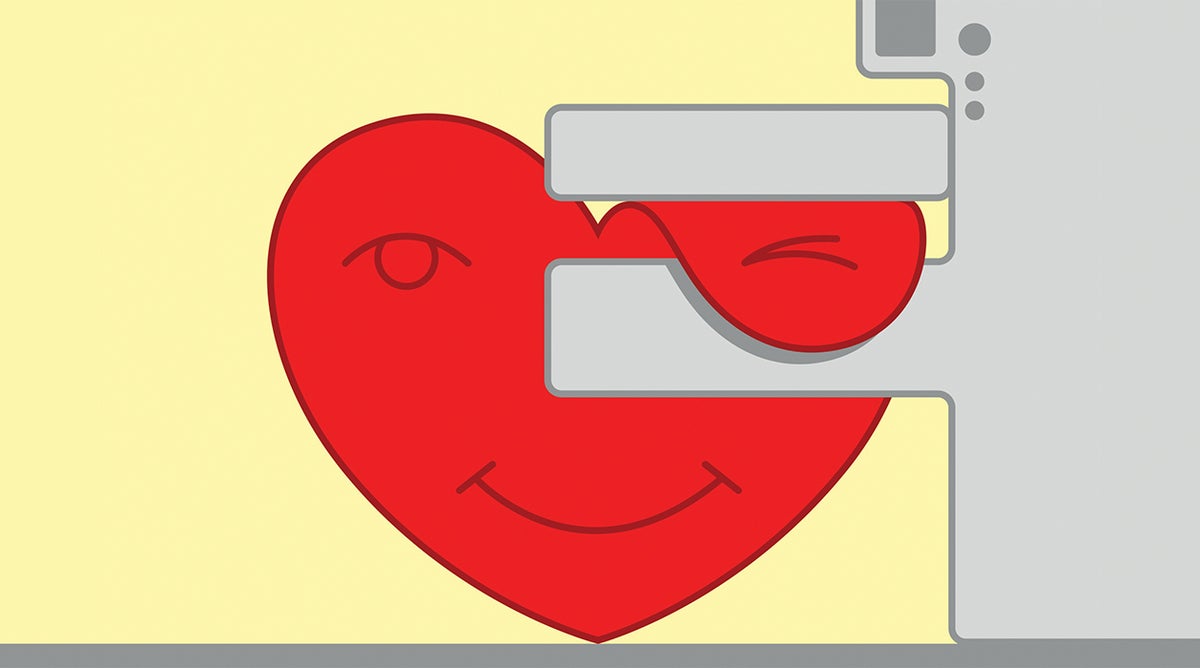
Mammograms, which are key to detecting breast cancer, could be paired with artificial intelligence to predict heart disease risk, too. Researchers have developed an AI model that scans mammograms to quantify bright streaks of calcium buildup, a marker of stiffened breast artery tissues. The severity of these so-called breast arterial calcifications (BAC) can help to predict associated heart disease risk, researchers report in the European Heart Journal. The model “can be run on every single mammogram without any additional work,” says study co-author Hari Trivedi, an Emory University radiologist—and more than 40 million mammograms are conducted in the U.S. every year.
Breast cancer can leave behind tiny calcium deposits as cells rapidly die. On a mammogram, these appear as small clusters—an early sign of abnormal growth and tumors. Breast arterial calcifications look strikingly different, often showing up as two bright “railroad-track” stripes zigzagging through the breast tissue, Trivedi says. BAC itself doesn’t harm breast tissue or increase the risk of breast cancer, he says. But it could signify that calcification is developing elsewhere in the body—and that’s an indicator of potential heart disease because stiffening vessels mean poorer circulation.
Other research groups have investigated using mammograms to assess heart disease risk, and some radiologists look out for BAC during screenings, but Trivedi says his team’s model offers the first way to measure and track the amount of BAC and tie that amount to higher disease risk. (Other AI-powered BAC-detection tools exist, including one cleared by the U.S. Food and Drug Administration, but quantifying the specific amount makes it possible to further predict risk level, he adds.)
On supporting science journalism
If you’re enjoying this article, consider supporting our award-winning journalism by subscribing. By purchasing a subscription you are helping to ensure the future of impactful stories about the discoveries and ideas shaping our world today.
Trivedi’s team focused on two populations: 74,124 people at Emory Healthcare in Atlanta and 49,638 people at Mayo Clinic sites in Arizona, Florida, Minnesota and the upper Midwest. The researchers found that even small increases in BAC correlated with slightly raised cardiovascular risk, and severe levels of BAC were associated with fourfold to eightfold increases in events such as heart attack and stroke compared with rates in those who have none.
The new model could also help take “the burden off the radiologist” to spot BAC and choose to evaluate and report risk, adds radiologist Laurie Margolies, who specializes in breast imaging at Mount Sinai in New York City and was not involved in the study. She and her colleagues at Mount Sinai are currently studying whether people will pursue cardiovascular care if a BAC assessment is included with mammogram results—and, more important, whether heart health outcomes in those people improve.
Widespread routine mammograms have helped to dramatically reduce breast cancer deaths in the U.S. Mammograms are recommended for most women every other year beginning at age 40, making the approach particularly enticing for catching heart disease earlier, Trivedi says. “If you have BAC and are under 50, you are at a higher risk of a cardiovascular event within the next 10 years.”
Given how many people get mammograms, “a lot of people could really benefit from this,” says Margolies’s colleague Mary Ann McLaughlin, a cardiologist also at Mount Sinai. Margolies calls this result “a bonus finding.”
“You come looking for breast cancer, but you also get this information,” Margolies says. “It’s no extra radiation; it’s no extra time. It’s not another appointment. It’s on your regular, routine mammogram.”
It’s Time to Stand Up for Science
If you enjoyed this article, I’d like to ask for your support. Scientific American has served as an advocate for science and industry for 180 years, and right now may be the most critical moment in that two-century history.
I’ve been a Scientific American subscriber since I was 12 years old, and it helped shape the way I look at the world. SciAm always educates and delights me, and inspires a sense of awe for our vast, beautiful universe. I hope it does that for you, too.
If you subscribe to Scientific American, you help ensure that our coverage is centered on meaningful research and discovery; that we have the resources to report on the decisions that threaten labs across the U.S.; and that we support both budding and working scientists at a time when the value of science itself too often goes unrecognized.
In return, you get essential news, captivating podcasts, brilliant infographics, can’t-miss newsletters, must-watch videos, challenging games, and the science world’s best writing and reporting. You can even gift someone a subscription.
There has never been a more important time for us to stand up and show why science matters. I hope you’ll support us in that mission.