

President Trump has vowed to prevent Iran from getting a nuclear weapon — and central to that pledge is the fate of its highly enriched uranium, which could be used to build at least 10 bombs.
Much of the uranium is believed to be stored so far underground that even powerful U.S. bunker-buster bombs may not be able to destroy it. A raid by U.S. forces to retrieve the uranium would carry enormous risks, including from the material itself, which could become highly toxic if it were to leak and be exposed to moisture.
The Trump administration is now focusing on diplomatic efforts by trying to convince Iran to turn over the material in return for incentives.
“Iran is being sanctioned because they have highly enriched uranium, Iran is being sanctioned because of their nuclear activities,” said U.S. Secretary of State Marco Rubio, while testifying Tuesday at a Senate Committee on Foreign Relations. “If they agree to give up those things, there will be sanctions relief associated with their commitment and compliance with those agreements.”
Iran had a stockpile of about 970 pounds of uranium enriched to 60 percent as of June 2025, the International Atomic Energy Agency, or I.A.E.A., said in February. The material is often stored in canisters about the size of scuba tanks, allowing the stockpile to be split among several locations.
It is impossible to know exactly where Iran’s nuclear material is stored without full I.A.E.A. inspections. Here’s a look at where experts believe it may be, and why it would be so difficult to retrieve.
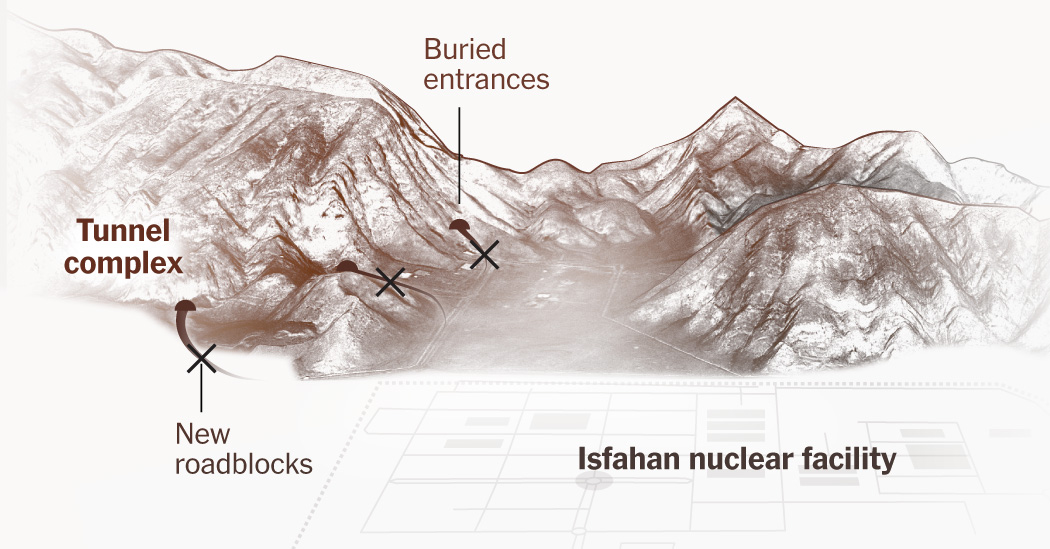
A deep complex at Isfahan
Most of Iran’s enriched uranium likely remains stored underground, near the Isfahan nuclear complex, according to Rafael Grossi, who leads the I.A.E.A. The material would require only a few weeks of processing to be usable for a nuclear weapon.
The complex is buried deep under a mountain, most likely beyond the reach of bunker-buster bombs, according to an analysis from the Jewish Institute for National Security of America, a Washington research organization.
When the United States briefly joined Israel in the 12-day war last year, its airstrikes heavily damaged the tunnel entrances to the Isfahan site. Satellite imagery suggests that an effort was made to clear debris from some of the entrances. But Iran covered them up with soil again early this year, apparently as a protective measure, before the most recent war began in February.
Images also show the addition of dirt barriers this year, which could be intended to defend against a ground operation, according to the Institute for Science and International Security, a research organization. Other new structures visible near one entrance may be shelters for defensive military equipment, said Sarah Burkhard, a senior researcher at the institute.
There is also limited visual evidence that Iran may have transferred enriched uranium into Isfahan, some analysts say. Before the 12-day war last June, satellite imagery from Airbus appeared to show a cargo truck near one of the complex’s entrances. Its load resembled the containers used to carry nuclear material. The image was initially reported by Le Monde.
Much remains uncertain. “There are a lot of unknowns about whether that material was the uranium or was just other chemicals involved in the metallurgy process that Iran wants to protect,” said Joseph Rodgers, a nuclear expert at the Center for Strategic and International Studies.
Natanz, and nearby Pickaxe Mountain
A smaller share of the highly enriched uranium may be at Natanz, Iran’s largest enrichment site, according to Mr. Grossi, the I.A.E.A. head.
The United States and Israel bombed Natanz in June 2025, causing severe damage. They attacked again in March, during the most recent war, and that might have been aimed at burying enriched uranium at the site, said Mr. Rodgers, the nuclear expert. Again, the fate of any uranium there is not known.
About a mile from the Natanz nuclear complex is another underground site called Pickaxe Mountain, which experts say has been under construction since 2020. Satellite images suggest that Iran continued work on the site after the June 2025 war. More recently, a security wall was built around its perimeter and some of the entrances were reinforced, apparently to protect against future attacks.
Under the rubble of Fordo
The underground Fordo site was effectively destroyed when U.S. forces struck it with a dozen bunker-buster bombs in June 2025. In recent weeks, satellite imagery has indicated that Iran has added obstacles on the roads leading to buried tunnel entrances, in what could be an effort to slow down a potential attack, according to the Institute for Science and International Security.
It is also possible that enriched uranium could be stored in a separate unknown location, in addition to Isfahan, Natanz and Fordo. That could make the retrieval or disposal of Iran’s stockpile even more challenging without the government’s cooperation, experts say.
“If Iran was worried about the U.S. or Israel or some combination coming in and trying to steal the material or remove it through military force, you would think that they would want to spread that out to different places,” said Scott Roecker, vice president of the nuclear materials security program at the Nuclear Threat Initiative, a Washington-based organization.
Iran also has more uranium than just its stocks enriched to 60 percent. In total, the country has more than 19,930 pounds of enriched uranium, according to the I.A.E.A.’s latest assessment, including 405 pounds enriched up to 20 percent and 13,280 pounds enriched up to 5 percent.
While it would take time to convert that uranium to bomb grade, Iran would retain the ability to do so as long as it retains an operational enrichment site.