
Close Menu
    Trending
    • How big can a galaxy get?
    • The Real Reason Russia Would Invade Europe
    • Jennifer Lopez’s 18-Year-Old Child Unveils New Name, Pronouns
    • Trump asked for tougher terms in proposed Iran war deal: US media
    • PSG beat Arsenal to win back-to-back Champions League titles after shootout | Football News
    • NASCAR Cracker Barrel 400 preview: Favorite, underdog, top storylines
    • Opinion | What Trump Actually Wants From the G.O.P.
    • Science says you can indeed buy happiness—for as little as $30
    Benjamin Franklin Institute
    Sunday, May 31
    • Home
    • Politics
    • Business
    • Science
    • Technology
    • Arts & Entertainment
    • International
    Benjamin Franklin Institute
    Home»Science»NASA’s Hubble captures gorgeous new photo of a spiral galaxy as it wanders through the Virgo Cluster
    Science

    NASA’s Hubble captures gorgeous new photo of a spiral galaxy as it wanders through the Virgo Cluster

    Team_Benjamin Franklin InstituteBy Team_Benjamin Franklin InstituteMay 30, 2026No Comments4 Mins Read
    Share Facebook Twitter Pinterest Copy Link LinkedIn Tumblr Email VKontakte Telegram
    Share
    Facebook Twitter Pinterest Email Copy Link


    May 30, 2026

    2 min read

    Add Us On GoogleAdd SciAm

    NASA’s Hubble captures gorgeous new photo of a spiral galaxy as it wanders through the Virgo Cluster

    Messier 88 is an active galaxy with a central supermassive black hole that is gobbling up gas and dust
    By Adam Kovac edited by Claire Cameron

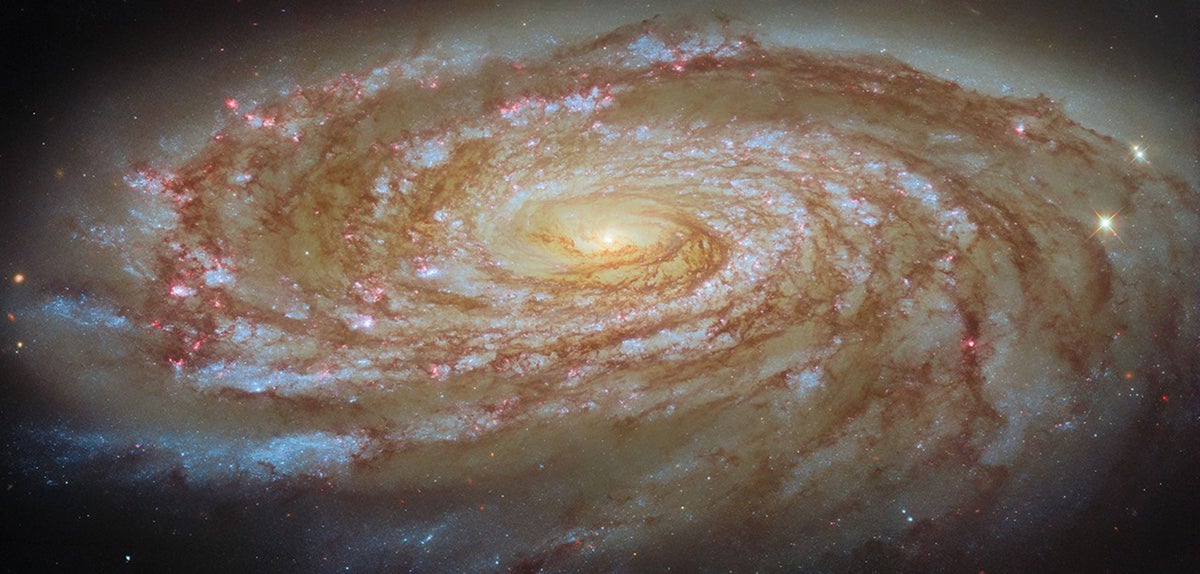
    This NASA/ESA Hubble Space Telescope image features the spiral galaxy Messier 88 (M88).

    ESA/Hubble/NASA/D. Thilker

    NASA’s Hubble Space Telescope snapped a delicate dance of celestial bodies in a new image of a distant galaxy that’s on a course toward the center of a large cluster of other galaxies.

    The photograph of the galaxy Messier 88 (M88), also known as NGC 4501, shows the bright glow created by its central black hole—which is estimated to be around 100 million times more massive than our sun—as it sucks up gas and dust. The numerous bright red dots strewn around M88’s spiral arms are old stars, while the pink and blue represent star clusters and dust clouds.

    The galaxy itself is large, stretching around 130,000 light-years in diameter, but it’s just one part of the larger Virgo Cluster, which is made up of more than 1,000 galaxies. As M88’s stars spin around its central black hole, the galaxy itself is twirling around the cluster’s center. Its journey is bringing it closer to both the middle of that swarm and some of the other individual galaxies in the cluster.


    On supporting science journalism

    If you’re enjoying this article, consider supporting our award-winning journalism by subscribing. By purchasing a subscription you are helping to ensure the future of impactful stories about the discoveries and ideas shaping our world today.


    Eventually, after some 200 million to 300 million years, M88 will reach its closest point to the neighboring galaxy Messier 87. The gravitational effects of the two galaxies’ proximity are already being observed. In the new Hubble image, some of the gas on the outer edge of M88 can be seen compressing and piling up. M88 also appears to have less cold gas, which fuels star formation, than should be present in a galaxy of its size. This is all because of a process known as ram pressure stripping, where the gravitational pull of another celestial body strips gas away.

    Despite being located about 60 million light-years away in the constellation Coma Berenices, M88 is a fairly bright object in the night sky. The galaxy was discovered by its namesake, astronomer Charles Messier, in 1781. It was a particularly productive day for Messier—M88 was just one of nine celestial objects he discovered that night.

    It’s Time to Stand Up for Science

    If you enjoyed this article, I’d like to ask for your support. Scientific American has served as an advocate for science and industry for 180 years, and right now may be the most critical moment in that two-century history.

    I’ve been a Scientific American subscriber since I was 12 years old, and it helped shape the way I look at the world. SciAm always educates and delights me, and inspires a sense of awe for our vast, beautiful universe. I hope it does that for you, too.

    If you subscribe to Scientific American, you help ensure that our coverage is centered on meaningful research and discovery; that we have the resources to report on the decisions that threaten labs across the U.S.; and that we support both budding and working scientists at a time when the value of science itself too often goes unrecognized.

    In return, you get essential news, captivating podcasts, brilliant infographics, can’t-miss newsletters, must-watch videos, challenging games, and the science world’s best writing and reporting. You can even gift someone a subscription.

    There has never been a more important time for us to stand up and show why science matters. I hope you’ll support us in that mission.


    Source link

    Share. Facebook Twitter Pinterest LinkedIn Tumblr Email Telegram Copy Link

    Related Posts

    Science

    How big can a galaxy get?

    May 31, 2026
    Science

    Why high-bandwidth memory is a bottleneck for AI chips

    May 31, 2026
    Science

    New protein-folding AI vastly expands on Alphafold’s efforts

    May 30, 2026
    Science

    Mirror life: Scientists clash over threat of lab-engineered bacteria

    May 30, 2026
    Science

    The best new science-fiction books of June 2026 include novels from Adrian Tchaikovsky and M. John Harrison

    May 30, 2026
    Science

    Europe’s deadly spring heat wave is obliterating temperature records

    May 30, 2026
    Editors Picks

    Denise Richards Flaunts Her ‘New Face’ On The Red Carpet

    March 28, 2026

    The One Trait That Quietly Determines Whether Founders Win or Fade Out

    May 12, 2026

    Mike Tomlin provides more details on T.J. Watt situation

    December 12, 2025

    Valencia coach Fernando Martin dies in Indonesia boat accident

    December 28, 2025

    49ers earn major Trent Williams victory ahead of 2026 NFL Draft

    April 20, 2026
    About Us
    About Us

    Welcome to Benjamin Franklin Institute, your premier destination for insightful, engaging, and diverse Political News and Opinions.

    The Benjamin Franklin Institute supports free speech, the U.S. Constitution and political candidates and organizations that promote and protect both of these important features of the American Experiment.

    We are passionate about delivering high-quality, accurate, and engaging content that resonates with our readers. Sign up for our text alerts and email newsletter to stay informed.

    Latest Posts

    How big can a galaxy get?

    May 31, 2026

    The Real Reason Russia Would Invade Europe

    May 31, 2026

    Jennifer Lopez’s 18-Year-Old Child Unveils New Name, Pronouns

    May 31, 2026

    Subscribe for Updates

    Stay informed by signing up for our free news alerts.

    Paid for by the Benjamin Franklin Institute. Not authorized by any candidate or candidate’s committee.
    • Privacy Policy
    • About us
    • Contact us

    Type above and press Enter to search. Press Esc to cancel.