

This sponsored article is brought to you by Wetour Robotics.
A field technician on a wind turbine, harness clipped, both hands on a wrench, needs to send a command to the diagnostic device hanging at her belt. A logistics worker on a loading dock, gloves on, eyes on the pallet, needs to redirect a connected lift. A person using an assistive mobility device on a crowded street wants to nudge it forward without taking out a phone or speaking aloud. None of these moments call for a smarter robot. They call for a smarter way to be heard by the machines that already exist.
The industry has been building from one side
The past three years of Physical AI have been a story of remarkable progress on the robot side of the loop. Companies like Boston Dynamics, Figure, and Unitree have advanced actuators, locomotion, and dexterity to a level that would have seemed implausible a decade ago. Google DeepMind’s Gemini Robotics has redefined what vision-language-action models can do in unstructured settings. The trajectory of the hardware and the foundation models is real, and it is accelerating.
But there is another side to this loop, and it has been treated as a solved problem for too long. The interface between humans and machines has defaulted, for 40 years, to three input modalities: screens, buttons, and voice. Each of those assumes the user can stop, look down, and translate intent into structured commands. That assumption breaks the moment the work moves into a real environment. On a turbine. On a dock. On a sidewalk. In any setting where hands are occupied, eyes are committed, or speaking is impractical, the conventional interface stack quietly fails.
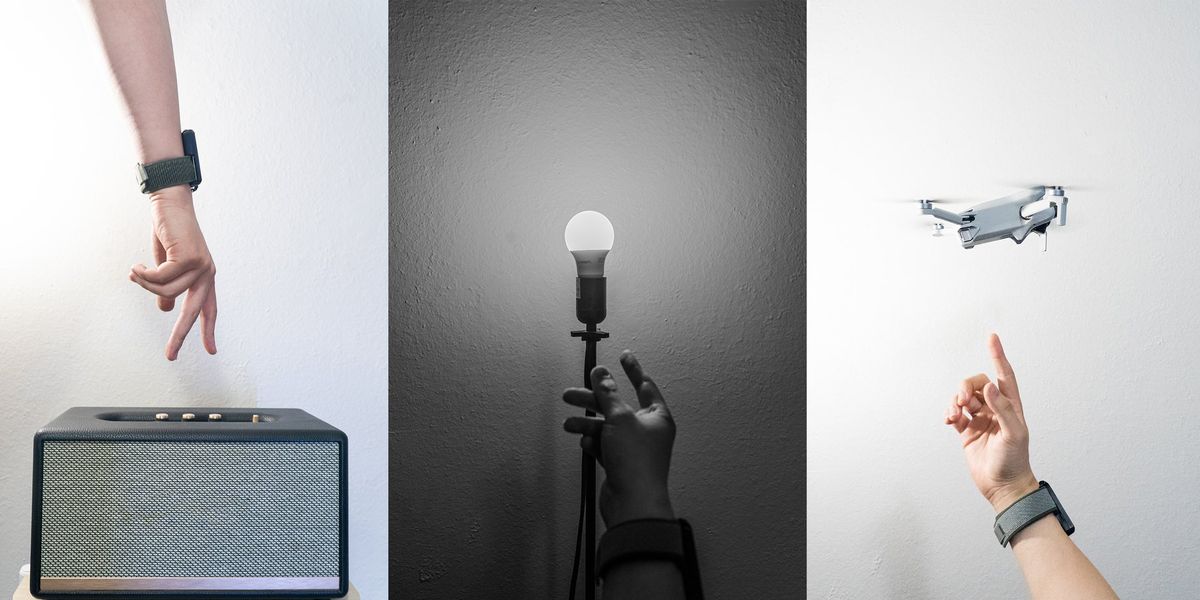
Spatial Intent Fusion is the simultaneous processing of three streams of human-centered information, namely spatial position, visual context, and gestural intent: Your body is the interface.
The bottleneck on the human side of the loop is becoming as important as the one on the machine side. And solving it requires a different question. Not how do we make the robot more capable, but how do we let the human participate in the computing system as naturally as the robot already does.
Wetour Robotics’ bet: put the human back into the computing loop
Wetour Robotics is betting that the next architectural leap in Physical AI is not about making the robot more capable. It is about making the human a first-class node in the computing network, with the same kind of low-latency, high-fidelity participation that connected devices already enjoy.
Wetour Robotics’ engineers frame the problem this way: a wristband that recognizes a gesture is not enough. A camera that recognizes a scene is not enough. The information a human carries about what they are about to do is distributed across multiple channels, including where their body is in space, what their eyes are attending to, and what their muscles are preparing to do, and any single channel observed in isolation is ambiguous. Reconstructing intent reliably means fusing those channels at the operating system level, with latency low enough that the loop feels closed rather than mediated.
This approach has a name. Wetour Robotics calls it Spatial Intent Fusion: the simultaneous processing of three streams of human-centered information, namely spatial position, visual context, and gestural intent, fused into a single real-time command for any connected physical device. It is the technical implementation behind a simpler positioning statement the company uses externally: your body is the interface.
Orchestra is a portable intelligent hub running the operating system that handles sensor fusion, intent inference, command translation, and safety arbitration. The reference compute platform is NVIDIA Jetson Orin Nano Super, which provides enough on-device inference capacity to keep the entire control loop at the edge, with no cloud dependency on the critical path. Wetour Robotics
The architecture: three layers, four engines, one loop
Orchestra is not a single device but a layered platform, designed from the start to be sensor-flexible and actuator-agnostic. The architecture decomposes into three perception layers and four coordination engines.
Orchestra itself is the local compute and orchestration core: a portable intelligent hub running the operating system that handles sensor fusion, intent inference, command translation, and safety arbitration. The reference compute platform is NVIDIA Jetson Orin Nano Super, which provides enough on-device inference capacity to keep the entire control loop at the edge, with no cloud dependency on the critical path. Edge inference is non-negotiable for this application. Full-chain latency from biosignal acquisition to actuator command is held under 100 milliseconds, the envelope inside which closed-loop control feels natural rather than laggy.
VisionLink handles visual and spatial perception. Cameras feed into vision models that identify objects, estimate distances, and track environmental context. VisionLink is designed not as a passive recognition layer but as a real-time command generator: its outputs feed directly into Orchestra OS to be fused with biosignal data.
Conductor is the biosignal pipeline. It ingests raw surface electromyographic (sEMG) data from a wrist-worn device, classifies temporal patterns into discrete gestures or continuous control signals, and outputs actuator commands. The technically interesting property of sEMG for this use case is that the signal precedes visible motion. Motor unit action potentials appear at the skin surface roughly 50 to 80 milliseconds before a finger completes the corresponding gesture. Wetour Robotics calls this property pre-motion intent sensing, and it is what allows Orchestra to anticipate user intent rather than react to it.
On top of the three perception layers, Orchestra OS runs four coordination engines. The Perception Engine ingests and normalizes raw sensor streams. The Intent Engine performs Spatial Intent Fusion across modalities, resolving what the user is trying to do given where they are, what they are looking at, and what their hand is signaling. The Orchestration Engine translates intent into device-specific command sequences for any connected actuator. The Safety Engine arbitrates conflicting commands, enforces operational envelopes, and gates execution against runtime safety conditions.
Wetour Robotics
The trade-offs we’re honest about
No system that bridges the human body and the digital world is finished. Three engineering challenges remain open, and the company addresses each with a deliberate trade-off rather than a claim of having fully solved it.
Baseline stability of sEMG under motion. In a stationary user, continuous gesture recognition from sEMG is reliable. Once the user is walking, climbing, or otherwise moving, motion artifacts and electrode drift degrade the signal in ways that are difficult to fully compensate for. Rather than overpromise on continuous control in dynamic settings, Orchestra defaults to a smaller set of robust discrete gestures in complex operating environments, and reserves continuous control modes for contexts where the signal-to-noise ratio supports them.
Miniaturization of edge AI compute. Running the Orchestra control loop entirely at the edge requires real on-device inference, which has historically meant trading off between compute capacity, battery life, and form factor. Wetour Robotics’ approach has been a compact carrier board paired with a thermal design and a battery module sized for all-day wearability. The result is a hub that travels with the user rather than tethering them to a desk, and that performs the full perception-to-actuation loop without offloading to the cloud.
Heterogeneity of third-party device protocols. The actuator side of the loop is a fragmented landscape. Different manufacturers expose different command interfaces, different communication stacks, and different safety conventions, and a Physical AI operating system has to integrate with all of them. Wetour Robotics uses an AI-agent layer to negotiate connection and protocol translation adaptively, so that Orchestra OS can ingest data from a wide range of devices, run them through neural network models that infer human intent, and emit the right command on the right protocol for the device on the other end.
Why this matters, and why it helps the rest of the field
The history of computing is a history of interface revolutions. Command lines gave way to graphical user interfaces, which gave way to touch, which gave way to voice. Each transition expanded who could participate in the system and what they could do with it. The next transition is not about a new screen or a new microphone. It is about treating the human body itself as a participant in the computing network, capable of contributing intent at the same speed and fidelity that any other connected node can.
The history of computing is a history of interface revolutions. The next transition is not about a new screen or a new microphone — it is about treating the human body itself as a participant in the computing network.
This path is not a competitor to the work being done on humanoid robots, foundation models for embodied AI, and dexterous manipulation. It is the missing complement to that work. The hardest open problem for humanoid systems is the data: every natural interaction between a human and the physical world is a potential training signal, and most of those interactions are currently invisible to any computing system. As more humans become first-class nodes in the loop, those interactions become observable, structured, and ultimately useful for training the next generation of embodied AI, including the humanoid robots being developed today.
In other words: putting the human back into the computing loop is not just about better interfaces for individual users. It is about generating the kind of grounded, in-the-wild human-machine interaction data that the broader Physical AI ecosystem will need to keep advancing. The robot side and the human side of the loop are not two competing futures. They are two halves of the same one.
That is what Wetour Robotics means when it says: Your body is the interface.
Learn more at wetourrobotics.com.