

Ryan Wills for New Scientist; Alamy; SPL
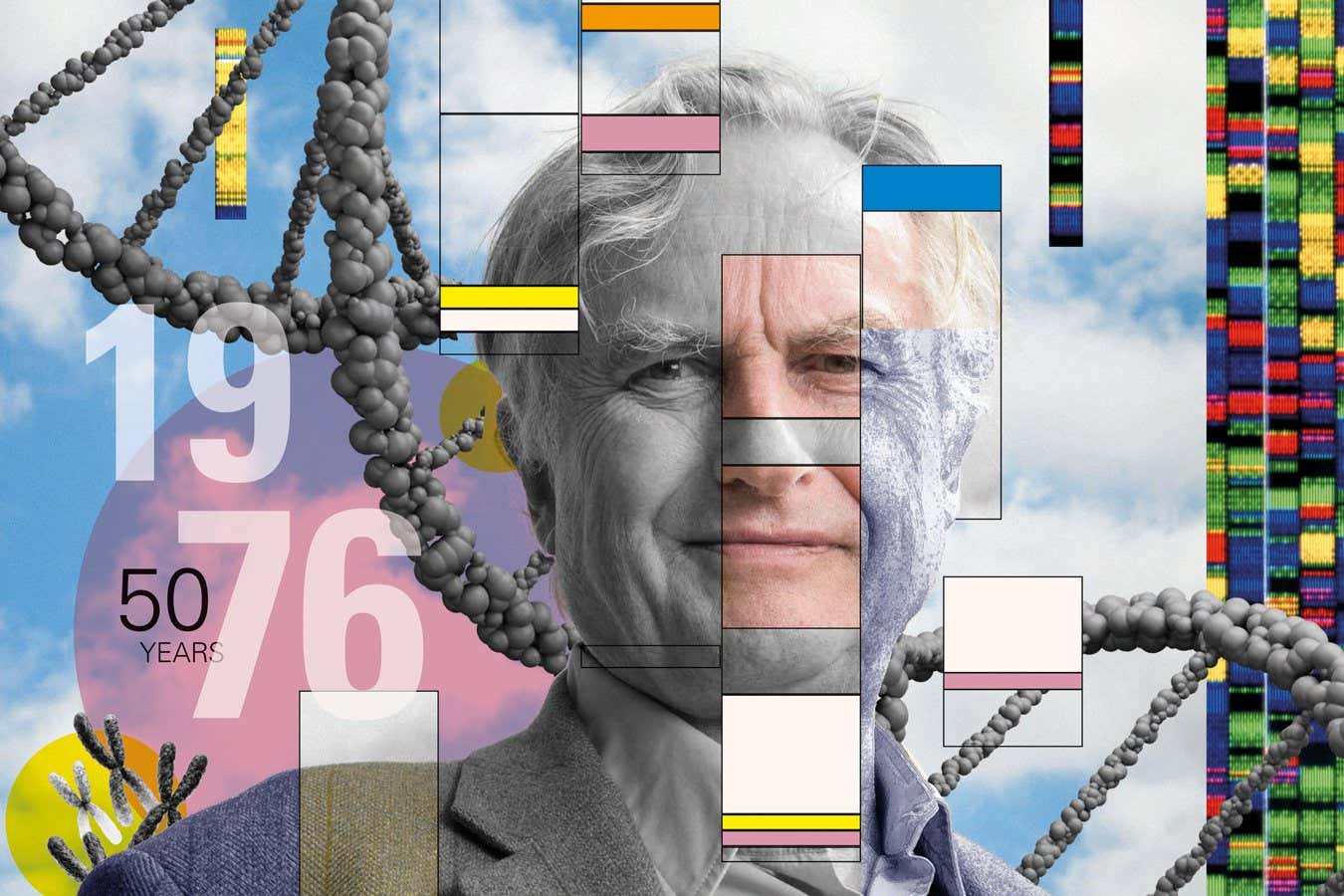
When The Selfish Gene was published in 1976, The New York Times said it was “the kind of science writing that makes the reader feel like a genius”. Few popular science books have had such an impact. As Richard Dawkins writes in the epilogue to the 50th anniversary edition, it’s rare enough for a book to be in press 50 years later, let alone that the author is still around to write an update about it.
There is a strong case that The Selfish Gene has had the biggest influence on our understanding of evolution of any book since Charles Darwin’s On the Origin of Species. It showed, in irresistible prose, how everything we see in biology can be explained by a gene-centred view of life.
Yet when it was first published, only a small number of genes had been sequenced and we didn’t even know how many we had or shared with other species. So, half a century on, with the “selfish gene” metaphor still very current, I wanted to find out if it is still a useful way to understand evolution.
Dawkins’s central point is that natural selection works to increase the number of “replicators” in a population. By replicators, he means genes made of stretches of DNA. The replicators build “vehicles” for themselves, machines that help them survive and spread. “A monkey is a machine that preserves genes up trees, a fish is a machine that preserves genes in the water,” Dawkins wrote. While we (and monkeys and fish) live for only a few years or decades, the genes we carry live for perhaps millions of years. Or as Dawkins once expressed it, in limerick form:
An itinerant selfish gene
Said: ‘Bodies a-plenty I’ve seen.
You think you’re so clever,
But I’ll live for ever.
You’re just a survival machine.’
This is why he had considered a suggestion to call his book The Immortal Gene.
Dawkins wasn’t the originator of this gene’s-eye view of evolution – that emerged from the researchers behind the “modern synthesis” that married Darwin’s ideas with those of genetics. His biggest influence was probably fellow University of Oxford biologist William Hamilton.
Hamilton’s work showed that behaviour that appears altruistic or selfless can evolve if it helps your relatives reproduce. For example, if a mating pair of birds such as long-tailed tits or bee-eaters fail to build a nest or they lose their clutch of eggs, they will help their siblings raise their chicks.

European bee-eaters appear to act altruistically by helping siblings to raise their chicks, but this actually helps ensure their own genetic legacy
Andres M. Dominguez/naturepl.com
This sort of apparently altruistic behaviour had kept Darwin awake at night, because he thought individuals should behave for the good of themselves, not for the good of others. But if you consider things from a gene’s point of view, it makes sense to help raise your nieces and nephews because you are helping copies of your genes. So, what appears altruistic is in fact “selfish” from a gene’s-eye view. This is what Hamilton showed in his kin selection equations.
Turning Hamilton’s mathematics into thrilling prose was no mean feat. “You read Hamilton and you try and explain it!” says Arvid Ågren, a biologist at Case Western Reserve University in Ohio. “But Dawkins also pushed the idea further. He’s a very logical thinker, and he’s very good at pushing an idea to its fullest expression.” In so doing, Dawkins took work that might otherwise have languished in journals and shaped it – evolved it, you might say – into a form that changed the way biology is done and thought about around the world. Even people who were the originators of these ideas learned something new – something that Hamilton acknowledged.
“
The title is a big reason why the book was and is still polarising
“
“His major contribution is bringing the gene’s-eye view into being,” says evolutionary biologist David Shuker at the University of St Andrews, UK. “It’s not just a masterwork of popular science – and I think the best popular book on evolution still – it did create a new conceptual space.”
Melissa Bateson, who researches animal behaviour at Newcastle University, UK, points out that Dawkins was made a fellow of the Royal Society in the UK for his contributions to science, not for his work on public understanding of science. “I think it was justified for how he changed how so many biologists think,” she says. “What Dawkins did was much more than just popularisation of something that was already there.”
Misleading metaphor?
The great strength of The Selfish Gene is in its power as a metaphor – that genes act in their own interest, not necessarily for the good of their host; its great weakness is in its ability to be misunderstood. “It is a dramatic but misleading title that has prompted endless confusion,” says Matthew Cobb at the University of Manchester, UK. The philosopher Mary Midgley even wrote: “Genes cannot be selfish or unselfish, any more than atoms can be jealous, elephants abstract or biscuits teleological. This should not need mentioning but… The Selfish Gene has succeeded in confusing a number of people.”
More often, the title was taken to be a statement of advocacy for right-wing economic values or to be saying that there was a gene for selfishness (both interpretations appalled Dawkins).
The title, then, is a big reason why the book was and is still polarising. “While the central argument of the gene’s-eye view holds up to a great extent, I think the problem is often, what do you take the argument of the selfishness to be?” says Ågren.
After Dawkins, some people understood the argument as suggesting that we are born selfish, an interpretation that hadn’t been made when the biologist George Williams published his landmark gene’s-eye book, Adaptation and Natural Selection, in 1966. “The gene’s-eye view is not something that began with Dawkins,” says Ågren. “George Williams has it. And, interestingly, no one is ever upset with Williams. So, partly the controversy is about personality.” Personality – and that metaphor.
Indeed, Dawkins’s text is laden with metaphors, a part of the writing process that he relished. To some, this is the joy of the book, but to others, talk of people being nothing but “gigantic lumbering robots”, survival machines “blindly programmed to preserve the selfish molecules known as genes” veers too far towards ideas of genetic determination and animism. “There are people who are really disturbed by that, who struggle to sleep after reading this. I didn’t have a reaction like that at all,” says Ågren. Nor did I.

According to the gene’s-eye view of evolution, all lifeforms – from humans to fish to bacteria – are just vehicles to propagate genes
Millennium Images, UK/Antoine BOUREAU
Over the years, many challenges have also come along to the modern form of evolutionary biology championed by Dawkins. A current critic is the biologist Kevin Lala at the University of St Andrews. Lala is an architect of the “extended evolutionary synthesis”, which takes issue with the idea that evolution is something that happens solely via genes.
Lala and others suggest that epigenetics – the “notation” made on genes that influences their expression and which can be passed on to the next generation – requires an extension of Darwinism, and contradicts Dawkins’s argument. This is because it isn’t just DNA that is inherited, it’s sometimes the “tags” that are added to the DNA as well. Epigenetics has been recognised since the 1990s as a method of fine-tuning what genes do.
Ågren bats away the objection that epigenetics is a problem. “Dawkins’s replicator concept is well suited to accommodate epigenetics precisely because it is agnostic about the molecular basis,” he says. In other words, a replicator doesn’t necessarily have to be a gene. Also, with epigenetic inheritance, the molecular tagging of genes is only stable for one or two, maybe three generations, but not much longer than that. “How much does it matter evolutionarily? It could well be a blip,” he says.
Shuker doesn’t see this as a threat either. “Epigenetic marks do not come from nowhere, they are still gene products,” he says. “[Epigenetic modifications] are evolved mechanisms of gene regulation… They evolved, selfishly!”
Similarly, the concept of plasticity is sometimes raised as a threat to The Selfish Gene. Plasticity is when organisms are able to rapidly “adapt” to conditions by non-genetic means. For example, if spadefoot toads hatch in a pond where shrimps are present, they develop larger jaws and shorter guts, to take advantage of the food supply. Some biologists say that plasticity challenges the selfish gene explanation because it demonstrates that organisms can develop differently without genetic change. But there are 14 genes in spadefoot toads that allow this “plastic” change, and those genes themselves had to evolve and be selected.
Another criticism concerns lateral gene transfer, because this is when genes move horizontally, for example between bacteria, not vertically, down the generations. But if anything, this is powerful support for a gene’s-eye view. “It shows the power of thinking from the perspective of genes,” says Ågren. “Replicators can move in all sorts of directions, and the interest of the body and its replicators may not always align.”
The genetics revolution
Dawkins wasn’t too concerned about the molecular biology of the gene. In the 1970s, it was simple and intuitive to describe a gene: as a stretch of DNA that codes for a protein. These days, we know that it is a lot more complicated than that. For one thing, you can get genes made of RNA as well as DNA. For another, genes do more than just code for proteins.
“We used to think it was the protein-coding variants of genes [known as alleles] that were the key target of selection, and while, yes, those variants are important, so too are sequences in DNA that regulate the function of genes, promoting, enhancing or even suppressing gene activity,” says Shuker. These on-off switches are also subject to evolution by natural selection in the same “selfish” way Dawkins describes for alleles. It’s just a bit more complicated than he set out 50 years ago.

A human DNA sequence, visualised as coloured bands. Genome sequencing has revealed that humans have surprisingly few genes
JAMES KING-HOLMES/SCIENCE PHOTO LIBRARY
Perhaps the biggest development since publication has been the rise of genome sequencing, which delivered the revelation that there is little variation in gene numbers across broad swathes of organisms. Shocking, too, was the discovery that humans, in all our perceived glory and complexity, have so few genes. Geneticists thought that humans would have around 100,000 genes, but it turns out we have only about 20,000 protein-coding genes, far fewer than many other species. A single-celled parasite called Trichomonas vaginalis has around 60,000 such genes. Rice has 51,000. Most organisms, however, have between 20,000 and 25,000 genes. “What we know now,” says Shuker, “is that patterns of gene expression – how genes are regulated spatially and temporally, within and among cells – is where all the amazing variety comes from.”
This means that it’s often wrong to talk about genes “for” things. Ågren thinks too much blame is directed at The Selfish Gene for this, and not to initiatives such as the Human Genome Project. Shuker has a similar view. “There has been a new genetic determinism,” he says, “not driven by a gene’s-eye view of evolution, but rather by the illusion that we can sequence our way free from disease.”
But for Dawkins, the technicalities of genomics make no difference to his thesis. “The Selfish Gene rides above such details,” he writes in the epilogue to the 50th anniversary edition. Indeed, despite the revolution in genetics that has occurred over the past half-century, all the evolutionary biologists I spoke to for this piece struggled to find major problems with The Selfish Gene – with one exception: memes (see “Memes and the spread of ideas“).
For me, what hasn’t aged as well is the emphasis on competition. Early on in The Selfish Gene, Dawkins makes the point that poet Alfred Tennyson’s “Nature, red in tooth and claw” is a good summary of how natural selection works. I always assumed that Tennyson crafted that line after he read Darwin, but he wrote it in 1844, and On the Origin of Species was published in 1859. Tennyson, in other words, was reflecting the ideas of the time, just as Darwin did when he emphasised competition as the primary force in evolution.
The power of symbiosis
Perhaps something similar was going on in 1976, when Dawkins chose the title for his book. We now know much more about the importance of symbiosis, the way two different species live and operate together. While Dawkins does talk about collaboration among genes in organisms – indeed, the explanation for the evolution of cooperation is a key part of the book – he still presents life as a competitive, bloody struggle, again a view emphasised by the title. The role of symbiosis is barely mentioned, yet the process is responsible for almost all the life around us.
I asked Dawkins about this, and he lamented that his critics were (and are) unable to grasp that symbiosis and cooperation are encompassed by his theory. “I was never able to convince, for example, Lynn Margulis [pioneer of symbiosis] or Frans de Waal [primatologist] that… symbiosis between species and cooperation within species are both utterly to be expected on the gene’s-eye view, no less than ruthless cooperation,” he says. “At the gene level, all is competition. But the consequence of gene-level competition is highly likely to be symbiosis and cooperation at higher levels, depending on ecological circumstances.” Symbiosis and cooperation are both ways to compete better, from a gene’s point of view.
Dawkins, in making his point that the details of genetics don’t matter for the central argument of his book, suggests that The Selfish Gene could have been written 100 years ago. “My presumptuous hope,” he adds, “is that the book may still be current and topical in its essentials, though not its details, in the centenary edition of 2076.”
In the final chapter of the original 1976 edition of The Selfish Gene, Richard Dawkins introduces the concept of the meme, an entity that “conveys the idea of a unit of cultural transmission, or a unit of imitation”. Ideas compete with each other, so Dawkins wanted a name, similar to gene, to describe an analogous process of selection. He came up with “meme”, derived from mimema, a Greek word meaning imitated thing. Dawkins’s point was that ideas can be spread for their own benefit, just as genes can sometimes spread even if they have a detrimental effect on their carrier.
These days, of course, we speak of internet memes – jokes and images that spread by dint of their shareability. But while the word “meme” has become ubiquitous, and books and papers on memes proliferated for a time, the idea behind it is not now well received. “It hasn’t held up well, because there isn’t anything equivalent to the gene that gets passed on and is immortal – the basic requirements for biology aren’t there with culture,” says Melissa Bateson at Newcastle University, UK. “It was a fun analogy… but it doesn’t hold up.” Despite all those cat videos.
Topics: