

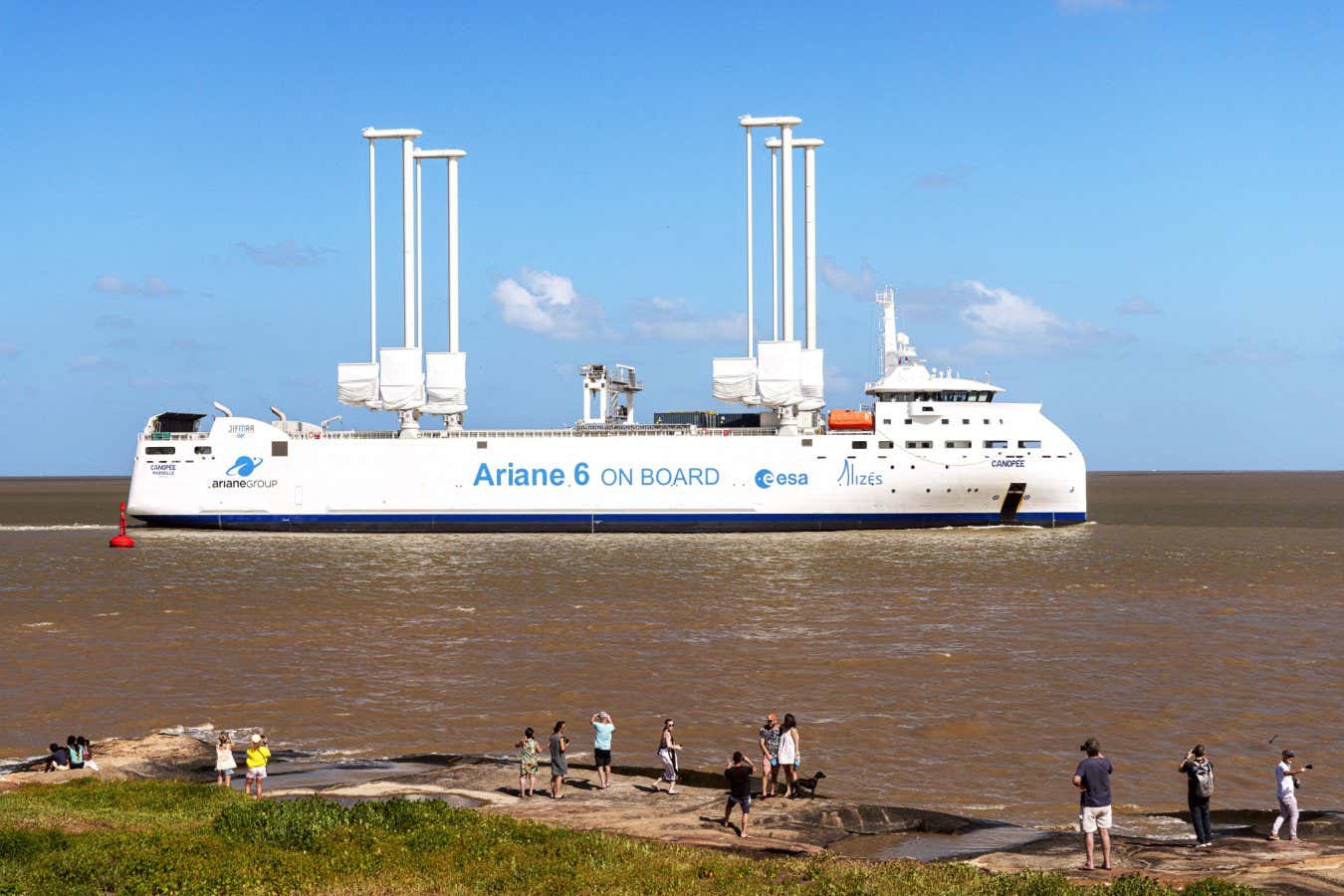
The Canopée is a sail-assisted cargo ship
JODY AMIET/AFP via Getty Images
The shipping industry is responsible for around 3 per cent of carbon dioxide emissions, and those emissions are growing – but adding high-tech sailing gear to cargo ships and greater use of wind-favourable shipping routes could cut them by more than half.
There is growing interest among shipping companies in exploiting wind power, as it can help cut fuel costs. A wide variety of approaches are being explored. Some companies are building ships with conventional sails from scratch. Others are adding various kinds of automated sails to existing vessels.
The technologies include rigid sails resembling aircraft wings, Flettner rotors consisting of rotating cylinders, suction sails that suck in air to maximise lift and even giant kites similar to those used by kitesurfers.
“There is a whole spectrum of wind propulsion vessels,” says Gavin Allwright of the International Windship Association, ranging from limited wind-assisted vessels through to those that get more than half of their power from wind.
Some wind-assisted ships are still operated like conventional ships, taking a direct route at a set speed, so Thorben Schwedt at the German Aerospace Center and his colleagues set out to explore what could be achieved if the route and speed were varied to optimise the wind boost, but without the journey taking too much longer. If there were no time constraints, it would be simple to make all trips fully wind-powered, he says, but this wouldn’t be realistic – most cargoes need to be delivered within set times, and fewer deliveries mean less income for shipowners.
The team also assumed that ships could generate and store hydrogen, an emerging technology currently used on only a few ships. The idea here is that when winds are very strong, some of the energy is used to generate hydrogen, for instance, via electricity-generating turbines underneath a ship. This hydrogen can then power engines when the winds are low.
The researchers then took data on reconstructed historical weather – a so-called hindcast – in the Atlantic Ocean over one year and used a computer model to work out optimal routes and speeds based on this weather. “The ships go completely wild routes,” says Schwedt. “You think, OK, that can’t be sane, but it appears to be so.”
On average, the energy consumption of ships taking the optimal routes would be 75 per cent lower than those taking direct routes, the team found. Schwedt presented the results at a recent meeting of the European Geosciences Union in Vienna.
“The real advantage only comes into play if you are completely open with your route, sometimes taking really big detours that you couldn’t think work out,” says Schwedt. “With this approach, we have managed to get energy savings from 50 to 100 per cent.” The team now plans to show that this route optimisation works with forecasts, and not just with hindcasts.
“I believe their expectations are justified,” says Guillaume Le Grand of TOWT, a French company building a fleet of sailing cargo ships. “That is what TOWT’s sailing cargo ships have done.”
“The idea of route optimisation tailored to the performance of wind-assisted shipping propulsion is not new and makes a lot of sense,” says Tristan Smith at University College London. Yacht racers can take what seem to be quite circuitous routes for just this reason, he says.
“Seventy-five to 100 per cent [energy saving] is certainly theoretically possible, but this very much depends on what average voyage speed you are targeting, which is also set by the economics of a ship’s operation and its cargo,” says Smith. “In our experience, the savings are significantly lower than this, for most of the sea-going vessels.”
Topics: