

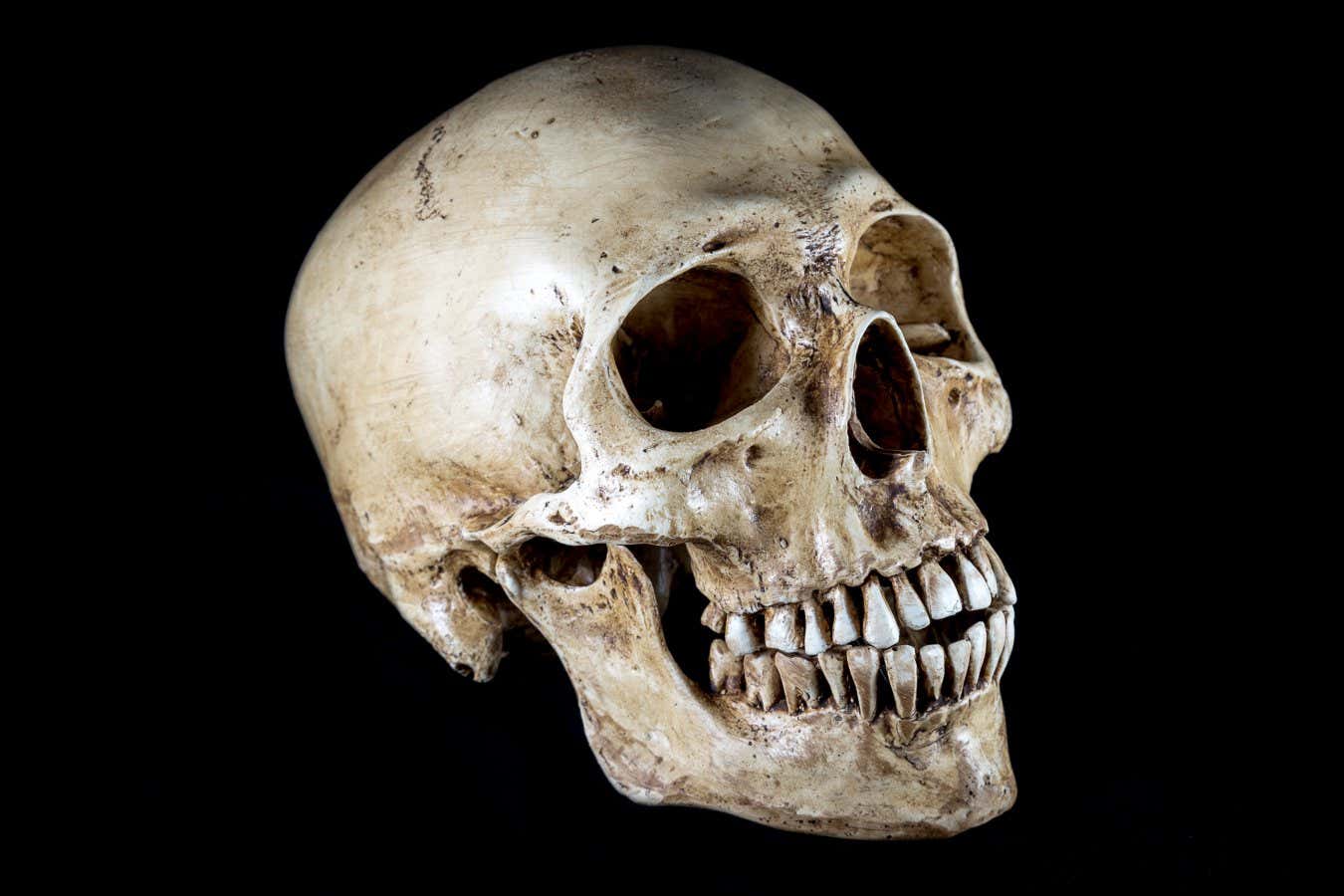
People who died a century ago had longer skulls from front to back
Yotpisai/iStockphoto/Getty Images
In the past 100 years, the heads of Japanese people have got rounder, with narrower cheekbones, wider upper jaws and slimmer, more prominent noses.
While changes outside Japan may vary, the overall trend is probably common across the globe, says Shiori Usui at the National Research Institute of Police Science in Chiba, Japan.
“It makes sense that similar morphological shifts are occurring worldwide, as lifestyles modernise globally,” she says.
Scientists often use measurements from 19th- and early 20th-century human remains as references for “modern” humans, says Usui. But we know that people are generally taller and larger today than a century ago, due in large part to changes in their health, diet and environment. Usui and her colleagues suspected those same factors might also have an effect on head shape.
To find out, the researchers carried out computed tomography (CT) scans on the skulls of 34 men and 22 women who died of natural causes between 1900 and 1920. Their bodies had been donated to the Kyoto University Medical School for dissection and later became skeleton specimens in the museum.
The team also collected scans from 29 men and 27 women who died between 2022 and 2024. Their bodies had undergone autopsy imaging – an increasingly common practice in Japan that has led to a large “virtual skeleton collection,” Usui says.
The researchers used 161 landmarks on 3D skull images to measure shape, finding subtle – but relatively consistent – changes over time. Notably, people have become more brachycephalic, meaning their skulls have mostly lost the oval shape they once had when heads were longer front-to-back and narrower side-to-side at the turn of the 20th century.
While that aligns with what other scientists already suspected based on living people, the CT scans of the dead revealed multiple other differences – which came as quite a surprise, says Usui. In addition to the new cheekbone, nose and upper jaw shapes, for example, foreheads have got shorter – starting higher on the face – and slightly more dished over time, the team reports. And the bony knobs behind the ears, known as the mastoid process, have become larger and more projecting.
The changes seem too recent to result from genetic evolution, says Usui. Rather, they probably result from lifestyle influences like better health and nutrition during childhood, and eating softer foods that require less chewing.
The differences between men and women are larger than they were 100 years ago, the team found, with male skulls having stronger brow ridges, larger mastoid areas and more projecting faces than female skulls.
“This was a striking and unexpected result for us,” says Usui, whose team thought converging lifestyles between men and women would have led to fewer physical differences. “We expected to see more ‘neutral’ facial structures. However, our analysis revealed the opposite: sexual dimorphism has actually increased.”
A 2024 US study has hinted at similar changes in men’s and women’s faces over time, she says. But another, earlier US study, published in 2000, pointed to an opposite change in general head shape – more oval than round – in the past 100 years. That could be due to technological limitations in the earlier work, but also due to the effects of ethnic changes resulting from large-scale immigration in the US population.
“We hope to see more global studies to understand how different populations have uniquely adapted to the rapid modernisation of our environment,” says Usui.
For Francesco Cappello at the University of Palermo, Italy, the study underscores that even relatively recent human populations don’t get fixed at a certain physical norm, but instead continue to change. “This raises important questions about the interplay between genetics and environment – especially in traits that have traditionally been considered relatively stable, like that of the biomorphology of the bones,” he says.
The findings suggest that scientists should consider updating their standards for identifying human remains, says Kimberly Plomp at the University of the Philippines Diliman. “If modern human crania, and potentially other bones, have significantly changed in morphology in such a short period of time, this could mean that the methods we use are no longer as accurate as hoped,” she says. “This is fundamentally important for biological and forensic anthropology.”
Topics: