

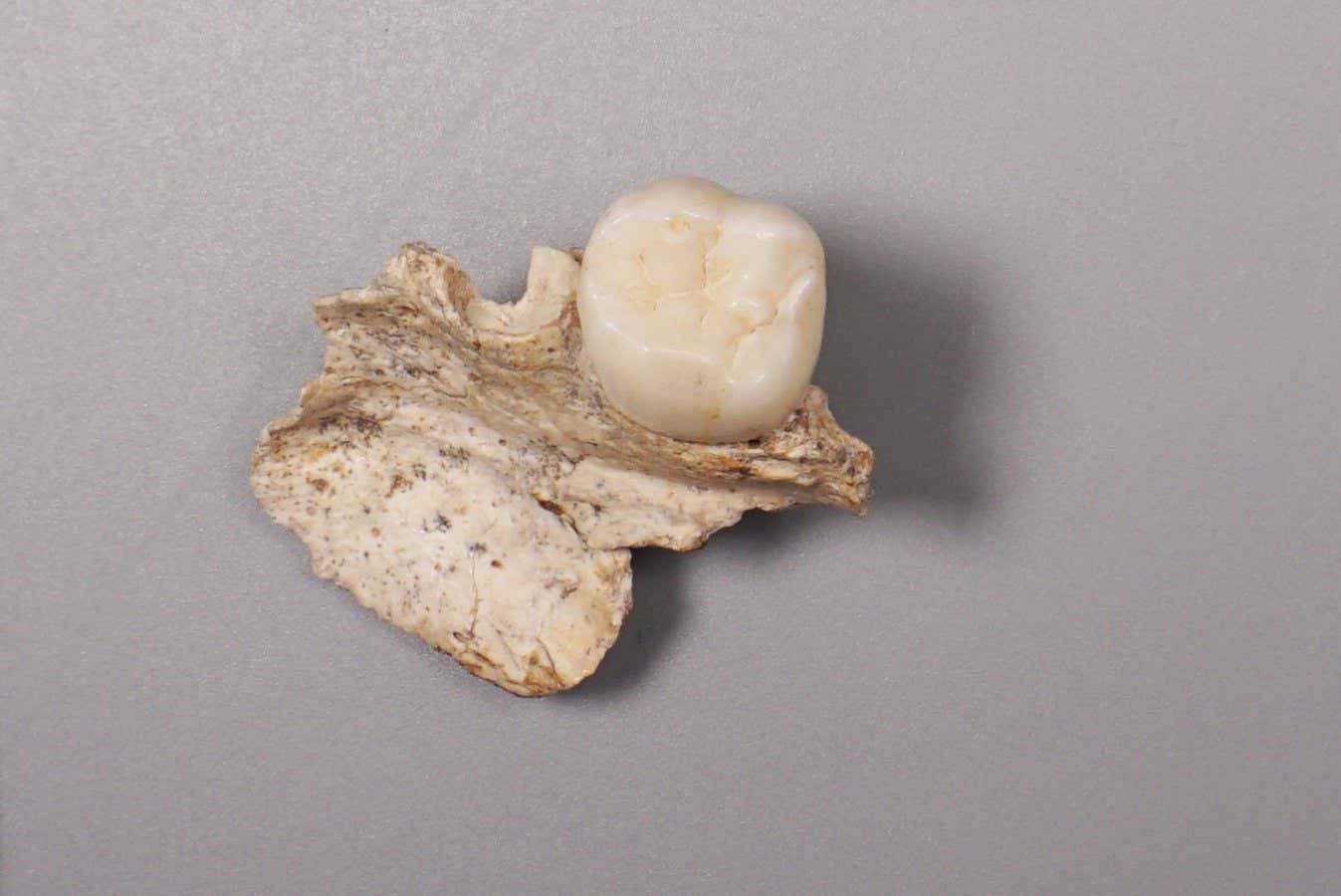
A tooth found in Sunjiadong, China, thought to belong to Homo erectus
Qiaomei Fu, Institute of Vertebrate Paleontology and Paleoanthropology, Chinese Academy of Sciences
For the first time, researchers have obtained substantial amounts of preserved protein from fossils believed to belong to the ancient human species Homo erectus.
While proteins have been recovered from H. erectus fossils before, this is the first time they have revealed meaningful information about the species. The proteins suggest that H. erectus interbred with another group of hominins in Asia, the Denisovans.
H. erectus was one of the most long-lived and widespread hominin species. They appear in the fossil record 2 million years ago in Africa and reached Eurasia by 1.8 million years ago – as shown by fossils from Dmanisi, Georgia. Some of them went all the way to Java in what is now Indonesia, where they survived until as recently as 108,000 years ago.
In 2020, researchers led by Frido Welker at the University of Copenhagen in Denmark obtained proteins from the dental enamel of one H. erectus tooth from Dmanisi. This was proof of principle that proteins could be recovered from H. erectus fossils, says John Hawks, at the University of Wisconsin-Madison. However, the data itself was disappointing: “It gave them basically no information about the Dmanisi fossil.”
Now, a team led by Qiaomei Fu at the Institute of Vertebrate Paleontology and Paleoanthropology in Beijing, China, has obtained proteins from six teeth assigned to H. erectus. All are about 400,000 years old, from sites in China: one from Zhoukoudian, two from Hexian and three from Sunjiadong. Based on a telltale protein called amelogenin Y, all belonged to males except for one of the Sunjiadong teeth, which is from a female.
Fu did not respond to requests for interviews.
All six teeth shared two specific variants in their proteins. One has never been seen in any human group, suggesting it is unique to H. erectus.
The other has been seen before: in Denisovans, who lived in east Asia in the last few hundred thousand years. The Denisovan genome was known to include DNA from an unknown hominin group, suggesting that Denisovans had interbred with this group. Fu’s team suggests that the mystery hominins were H. erectus and that the protein variant was introduced into Denisovans when they bred with H. erectus.
That may be, says Hawks, but he says it’s one of three possible interpretations of the data, which he “can’t distinguish”.
The key uncertainty, for Hawks, is whether the six teeth are H. erectus at all. While the three sites have yielded undisputed H. erectus remains, the teeth were found isolated. Furthermore, their shapes are not especially H. erectus-like – a problem compounded by the fact that the known H. erectus fossils found in China are all from much earlier periods, often over a million years ago, so we don’t have any contemporary H. erectus from China with which to compare them.
Hence Hawks’s alternative: “This population is not Homo erectus at all. It’s Denisovans.” The protein variants may simply be evidence of variation among Denisovans. In line with this, a recent study examined Denisovan DNA in 30 modern human populations and found that it originated from three distinct Denisovan populations, each of which interbred with Homo sapiens.
Alternatively, maybe Denisovans and H. erectus did breed, as Fu’s team suggested, in which case “this is a Denisovan population that has input from Homo erectus.”
Figuring out which of the three possibilities is correct will require more fossils and molecular data, says Hawks.
Such uncertainties are to be expected, says Hawks, because the study of ancient proteins is in its infancy. The first attempts to read ancient DNA ran into similar challenges. “This is like the early days of DNA,” he says.
Topics: