

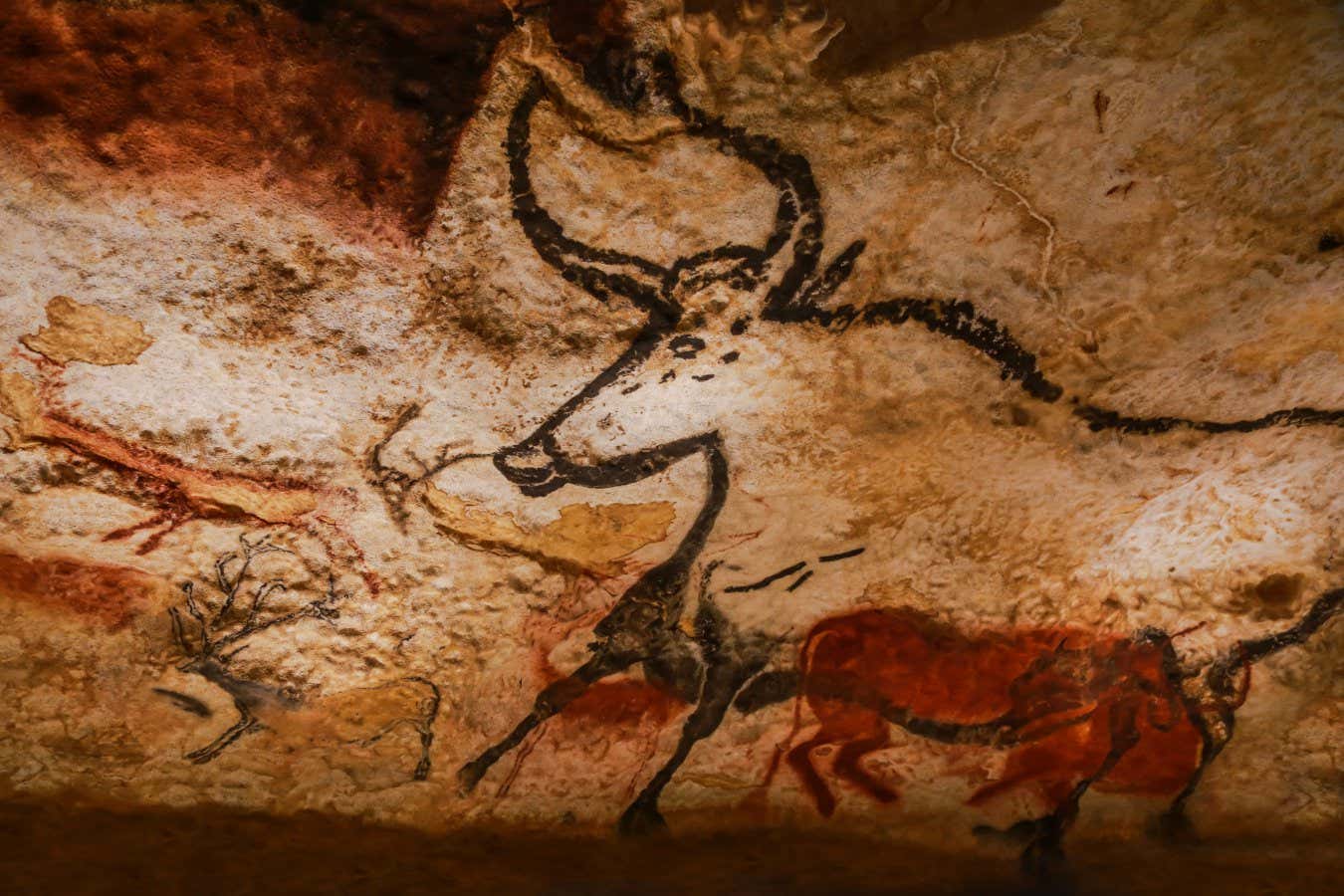
“Visceral” ancient cave art in Lascaux, France
thipjang/Getty Images
Animate
Michael Bond
Pan Macmillan UK, Pegasus US (August)
Imagine that you took an animal, tripled its lifespan, stuck the world’s knowledge in its pocket (indeed, gave it pockets at all) and, for good measure, told it about death. What might you end up with? A mightily confused, angst-ridden animal would be my bet, and I would strongly recommend it read Michael Bond’s Animate: How animals shape the human mind to at least begin to get a handle on its twisted condition.
We are animals, nothing more, nothing less. We evolved among other animals, and are still sharply attuned to their presence, though we have spent much time trying to deny and erase this connection.
Animate’s enchanting and disturbing history of the human animal begins after the last glacial period. This, says Bond, a former New Scientist senior editor, was an Edenic time. True, we competed for food with cave lions, wolves and leopards, and for sleeping space with bears and spotted hyenas. It was a world so dominated by other animals, we would each be lucky to see our 30th birthday.
But there were compensations for finding yourself in the middle of the food chain. Witness the extraordinary, emotionally articulate art made in the caves of places like Les Combarelles, Rouffignac and Lascaux (pictured above) in France. They capture the animal’s essence as well as its form, how it moved and felt. They are, says Bond, “visceral and unadorned – more reincarnation than art”.
There are few depictions of people, and what there are tend to be quite cursory. Why? According to Bond, it’s because animals are, or were, the point. They didn’t just outnumber us; they were us. The barrier between human and animal simply didn’t exist.
Come the Neolithic, something in humans alters. The art is more ingenious, less generous. Animals on pottery from Turkmenistan, Iran and Iraq in the 4th millennium BC are no longer individuals. They have “been appropriated, as abstract shapes for… decoration”. The exploitation of animals has begun, and they will be everything from decorative figures on pots to moral exemplars in medieval bestiaries. Most especially, near universally, they will be fed, farmed and slaughtered meat-on-the-bone. They are no longer us. A notional human-animal border has been erected, which we police.
But why? This was explored by Ernest Becker in The Denial of Death, which I was delighted to see Bond discuss so sensitively. Becker argued we had such an awareness of mortality that it drove us to madness and greatness. Animals just die, but we convince ourselves we don’t; we have immortal souls, or survive through good works.
Human exceptionalism may well have been a wrong turn and was certainly a disaster for most non-human life, but without the great separation and the comforting lies it made possible, it is hard to see how we would get up each day. Bond likes to think we can patch things up, but since this involves overcoming fear of death, I would say the prospects are poor.
For centuries, writers saw us as not so very different from animals. Bond reminds us philosopher David Hume thought animals used observations and experience as we do, to “make assumptions about the future and adapt means to ends”. Later, Charles Darwin’s theory of evolution delivered a knock-out blow to exceptionalism.
Or did it? Nearly 170 years on, people like me still eat sausages. Bond skewers my meat-eating nicely. True, I have never seen a pig slaughtered, and don’t plan to. Bond says that without the rituals, taboos and traditions that earlier cultures used to ease the psychological burden of killing and eating fellow creatures, the only psychic defence is distance (in my case, the supermarket).
“
Bond skewers my meat-eating nicely. True, I’ve never seen a pig slaughtered, and don’t plan to
“
Bond’s instinct is to make the world better and friendlier. In previous books, this pushed him into Panglossian territory, where everything happens for the best. Animate is a very different beast. The story is solid, its implications devastating, and Bond’s pill is left unsugared.
Suppose there’s a confused and distraught animal that convinces itself it’s not an animal. Can that story end well?
Simon Ings is a London-based writer
Another great book on the animal-human relationship

An Immense World
by Ed Yong
Each species glimpses the world through a tiny keyhole, shaped by its needs and specialisms: no one discerns the full picture. Science journalist Ed Yong’s bestseller, subtitled “How animal senses reveal the hidden realms around us”, shows the radically different ways that animals perceive the world.
Topics: