

Scientists know how to phase out fossil fuels. Some countries are listening
Representatives of more than 50 nations gathered in Santa Marta, Colombia, this week at what was billed as the first global summit on phasing out fossil fuels. A panel of scientists will be advising them
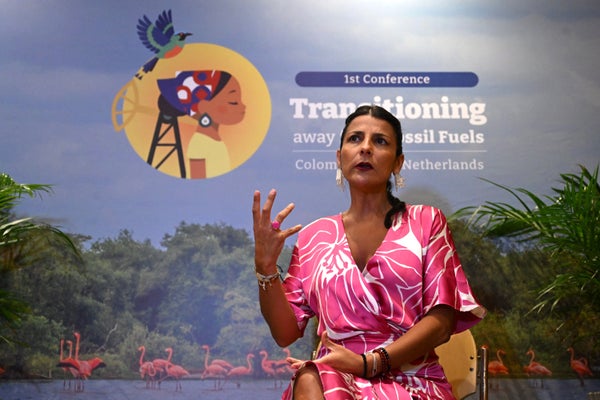
Colombia’s Environment Minister Irene Velez speaks during an interview with AFP in Santa Marta, Colombia, on April 26, 2026, on the sidelines of the International Conference on the Just Transition Away from Fossil Fuels.
Raul ARBOLEDA / AFP via Getty Images
Climate scientists, who have warned of the dangers of global warming for decades, have found some countries to listen. This week, representatives of more than 50 nations gathered in Santa Marta, Colombia, at what was billed as the first global summit on phasing out fossil fuels. One of the first orders of business was to launch a panel of scientists that will advise those countries on how to shift to clean energy.
“Here, you have a coalition of governments that decided they actually want to be informed by the science,” says Margaretha Wewerinke-Singh, an international climate-change law specialist at the University of Amsterdam.
The landmark meeting, which began on 24 April and concluded yesterday, was proposed during last year’s United Nations COP30 climate summit in Belém, Brazil. Oil-producing nations such as Saudi Arabia reportedly opposed attempts at that gathering to create a road map to cut the use of fossil fuels, which are the main source of global greenhouse-gas emissions and the largest contributor to climate change.
On supporting science journalism
If you’re enjoying this article, consider supporting our award-winning journalism by subscribing. By purchasing a subscription you are helping to ensure the future of impactful stories about the discoveries and ideas shaping our world today.
Frustrated, the governments of Colombia and the Netherlands announced that they would host the First Conference on Transitioning Away from Fossil Fuels this year, independent of the UN’s COP climate summits. Countries that have expressed an openness to creating a road map — including Australia, Cambodia and Mexico — were invited. Oil-producing nations that have opposed such efforts were not.
In Santa Marta, not only was the new panel — called the Science Panel for the Global Energy Transition (SPGET) — launched, but a separate group of researchers also took centre stage on 24 April to release a report listing 12 high-level actions that nations can take to support a fossil-fuel phaseout.
Researchers say it’s refreshing to have an international forum where they are free to make ambitious recommendations. What happens at the UN climate summits is that, “because the governments are the final decision makers on what goes out to the public, there is a lot of filtering” of science advice, says Gilberto Jannuzzi, an energy-transition specialist at the State University of Campinas in São Paulo, Brazil. “At the end, I think we found a smaller audience, but an audience that considers that we have something relevant to them.”
Practical solutions
The report, crafted by 24 researchers in consultation with hundreds of other scientists from several countries over the three months leading up to the meeting, does not attempt to systematically synthesize all of the scientific knowledge on transitioning to clean energy, says Frank Jotzo, a climate-change economist at the Australian National University in Canberra, who was part of the editorial team. That’s the role of the UN Intergovernmental Panel on Climate Change (IPCC), which produces reports that are meant to be neutral and inform policy without directly making recommendations. “We’re not trying to replicate the IPCC here. We’re trying to give some practical policy insights” based on science, Jotzo says.
For example, the report recommends that countries ban new fossil fuel infrastructure and phase out fossil-fuel subsidies, such as tax breaks or funding that lower the cost of producing oil, gas and coal. At the same time, it calls for financial incentives to put clean-energy sources in place.
Jotzo acknowledges that the guidelines are very ambitious and that some countries might perceive them as “impossibly difficult” to implement. “But they are the kinds of thing that need to be done in order to get away from fossil fuels quickly enough to be within the long-term goals of the Paris agreement,” he says. Governments that signed that agreement in 2015 pledged to cut emissions to prevent global temperatures rising to 2 ºC above pre-industrial levels, a threshold intended to avoid catastrophic damage from sea-level rise and extreme weather. “The role of the scientists involved in this process is to speak truth about the urgency of the issue and to point to practical solutions that governments can embrace,” Jotzo adds.
Science start-up
Talking about the SPGET, Januzzi says: “We have about 30 top scientists that have already been consulted and are willing to participate voluntarily in this effort.” Among them are economists, social scientists and other researchers studying the transition to clean energy, according to Jannuzzi. The group is just starting up, he says, but its goal is to be able to deliver a comprehensive set of recommendations at COP31, which will be held in Antalya, Turkey, in November.
The gathering comes amid the global energy crisis set off by the United States and Israel’s war with Iran — which has caused some nations to rethink their dependence on imported fossil fuels.In Santa Marta, the countries in attendance were asked to start work on road maps to phase out fossil fuels. France issued its plan on 28 April during the summit. How the plans should be structured and when countries should deliver them haven’t been determined yet, said Irene Velez Torres, Colombia’s environment minister, during the meeting. “What we know is that we are going to have a concentrated workstream dedicated to making these pathways and that every country that needs any support in order to design and implement the pathways is going to be supported,” she said.Jotzo told Nature that the summit will have “done its job” if it sets the stage for results and cooperation in the coming years. Organizers have agreed to continue the gathering annually. The next summit will be held in the island nation of Tuvalu and co-hosted by Ireland.
It’s Time to Stand Up for Science
If you enjoyed this article, I’d like to ask for your support. Scientific American has served as an advocate for science and industry for 180 years, and right now may be the most critical moment in that two-century history.
I’ve been a Scientific American subscriber since I was 12 years old, and it helped shape the way I look at the world. SciAm always educates and delights me, and inspires a sense of awe for our vast, beautiful universe. I hope it does that for you, too.
If you subscribe to Scientific American, you help ensure that our coverage is centered on meaningful research and discovery; that we have the resources to report on the decisions that threaten labs across the U.S.; and that we support both budding and working scientists at a time when the value of science itself too often goes unrecognized.
In return, you get essential news, captivating podcasts, brilliant infographics, can’t-miss newsletters, must-watch videos, challenging games, and the science world’s best writing and reporting. You can even gift someone a subscription.
There has never been a more important time for us to stand up and show why science matters. I hope you’ll support us in that mission.