

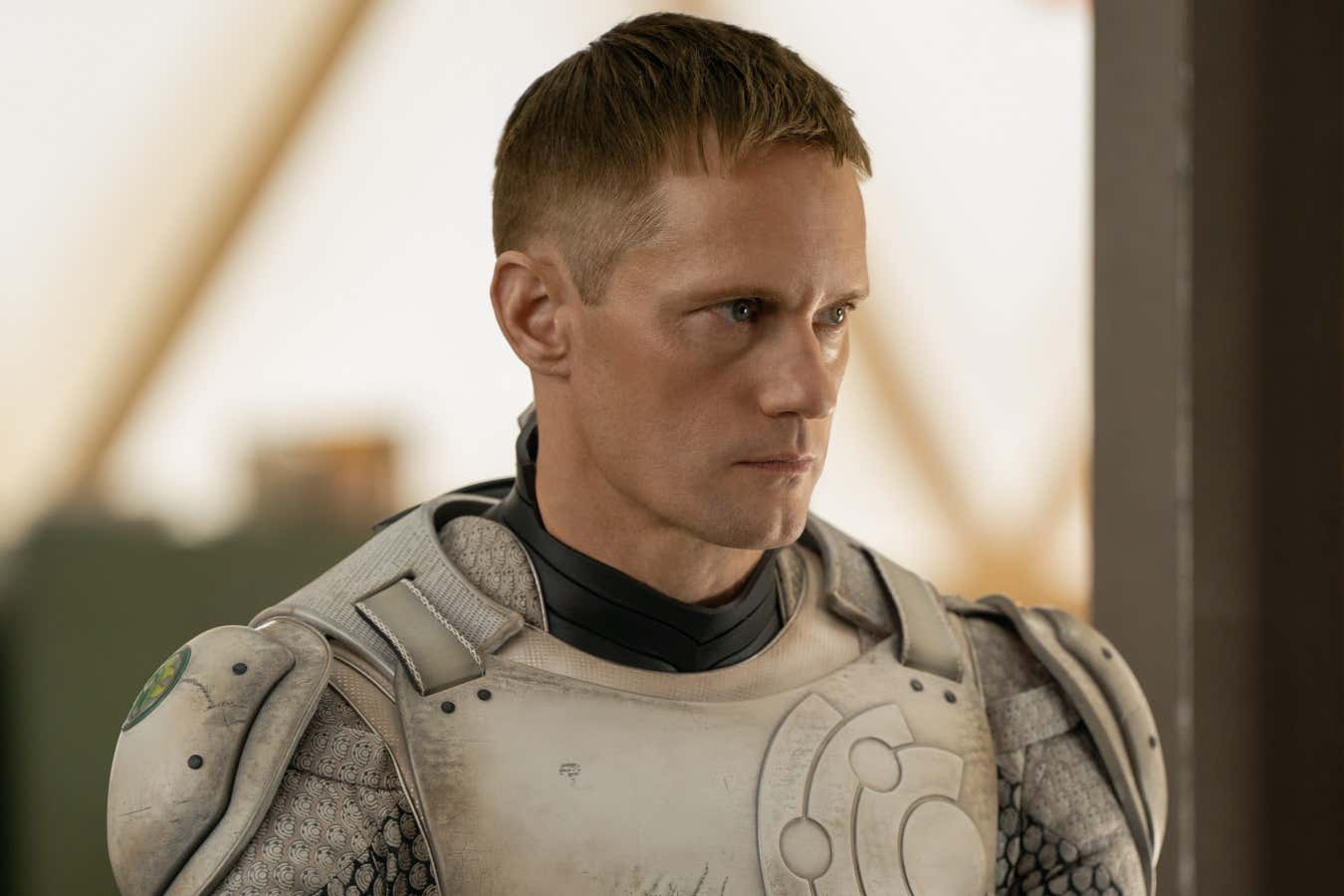
Alexander Skarsgård in Murderbot, adapted from Martha Wells’s novels
Steve Wilkie / Apple TV+
Some months, I end up scraping the bottom of the barrel to find enough interesting science fiction to tell you about. This May that wasn’t a problem – there’s tons to look forward to, whether you’re after time-travelling romance from Matt Haig (yes please), extinction events in London from Temi Oh (I’ve already read this and it’s a lot of fun), the latest Murderbot novel (hurrah) or a generation-ship story that comes garlanded with praise. There are also new titles from big names Ann Leckie and Alan Moore. If that’s not enough, then you can join the New Scientist Book Club here, and our lively Discord channel here, where we’re discussing all things sci-fi and popular science.
I got into the Murderbot books a few years back, when we read the first in the series, All Systems Red, with the New Scientist Book Club. I’m a proper fan now, including of the new television series starring Alexander Skarsgård as the eponymous cyborg security unit, so I’m delighted the eighth in the series is out this month, in which Murderbot volunteers to run a rescue mission only to discover it means spending time with some human children…
There’s nothing better than a good generation-ship story and this one, by the winner of the 2023 Future Worlds Prize, sounds really exciting. Dubbed “Arabfuturism” by its publisher Gollancz, it takes place on the city ship Safina, which is 200 years into its trip from Earth to a new habitable world. The crew keep the ship going while protecting their “ancestors” from Earth in cryostasis, but, as is often the case on these ships, they’re starting to ask questions about why they should be working for people from a world they don’t remember. Then the blackouts start, and a reckoning is on the horizon. Sci-fi author and New Scientist columnist Annalee Newitz called it “utterly original, full of thrilling plot twists, deeply wise and politically nuanced”. It’s top of my list this May.
Across 600 years and five lives, this story opens in 1983 as Becks is left a half-finished computer game by her late programmer uncle. The game will outlast her by centuries, and shape the lives of a scientist, an astronaut and a pirate captain, connecting them across time and space. It’s hotly tipped by The Ministry of Time author Kaliane Bradley (another New Scientist Book Club author), who called it “a work of joyous and serious invention”.
This is the sequel to the mighty Alan Moore’s time-travelling epic The Great When. It continues the story of Dennis Knuckleyard as he tries to forget about the shadow version of London he discovered – fortunately for us readers, without much success.

The great Alan Moore has a new novel out this month
Kazam Media/Shutterstock
This time-travel story is a follow-up to Haig’s bestselling The Midnight Library, telling the story of Wilbur, who threw away the promise of a future with the love of his life, Maggie, years earlier. Then a train arrives when he is on the brink of death – a train that can take him back in time to relive his most important moments.

Radiant Star by Ann Leckie is out in May
Will Ireland/SFX Magazine/Future via Getty Images
This is a standalone science fiction novel set in Leck’s Imperial Radch universe, and it comes recommended by our sci-fi columnist Emily H. Wilson, a big Leckie fan. Taking place on a planet that has lost its star and where the population is forced to live underground, it follows the fallout when the rulers of Radch space decide to annex this world. Check out Emily’s review for more.
I enjoyed this story of an extinction-level event from Temi Oh, author of Do You Dream of Terra-Two? It’s told through the eyes of the Mintons, an ordinary London family, each of them troubled in different ways. For example, father Marcus has lost his job and become a prepper, convinced (correctly, as it turns out) that doomsday is on the horizon, while daughter Briar is hunting for a missing classmate when she is drawn into the world of a UFO cult. There are the dramatic scenes you’d expect from the cataclysm that hits Earth (no spoilers here), and the Mintons’ attempts to find each other again in a devastated London are evocatively recounted by Oh.
Absence by Andrew Dana Hudson
This intriguing-sounding debut novel is set in a world beset by an epidemic of human vanishing, in which people keep disappearing into thin air. This is known as Spontaneous Human Absence, and it has (unsurprisingly) sent the world’s population into paroxysms of hopelessness. Harvey Ellis, who works for the Bureau of Depopulation Affairs, is given an unexpected assignment: to investigate the claims of a woman long thought to be Absent, who says she has been to the other side and back.
Abyss by Nicholas Binge
This piece of tech-themed horror sounds pleasingly disturbing. It tells of Joe Rice, who takes a new job as an admin assistant at the Ponos corporation. But things seem deeply wrong at the vast Canary Wharf office, where his work is monitored by an AI wellness chatbot that tracks his every move and demands total honesty.

Ray Nayler’s new novel features some surprisingly intelligent corvids
Jannik Wissemann/Alamy
The award-winning sci-fi author’s speculative novel is set in 1941, as four teenagers are driven into the primeval Lithuanian forest in winter. They are aided by a flock of intelligent crows, who have a secret of their own and are no ordinary corvids.
This is the second in Asher’s Time’s Shadow trilogy, following Dark Diamond. This slice of military space opera sees the return of the malevolent AI Straeger, out to plunge the galaxy into war.
Legendary samurai Isako is offered one final mission, which will see her travelling to a merciless planet where the elite can extend life or end it, and where death is always just around the corner.
Topics: