
Close Menu
    Trending
    • How Britney Spears Can Avoid Jail Time Amid DUI Charge
    • Commentary: Washington courts Manila, but the rest of Southeast Asia is watching
    • Palestine FA chief hits out at Israel federation VP at FIFA Congress | World Cup 2026 News
    • Kirill Kaprizov, Quinn Hughes are reason Wild have real chance at Stanley Cup
    • Good American CEO Emma Grede says working from home is ‘career suicide’
    • Weird ‘transdimensional’ state of matter is neither 2D nor 3D
    • GPU Performance Comparison Shows Surprising Variability
    • Emily Blunt Has Fans Seeing Red With Her ‘Terrible Advice’
    Benjamin Franklin Institute
    Friday, May 1
    • Home
    • Politics
    • Business
    • Science
    • Technology
    • Arts & Entertainment
    • International
    Benjamin Franklin Institute
    Home»Science»Weird ‘transdimensional’ state of matter is neither 2D nor 3D
    Science

    Weird ‘transdimensional’ state of matter is neither 2D nor 3D

    Team_Benjamin Franklin InstituteBy Team_Benjamin Franklin InstituteMay 1, 2026No Comments3 Mins Read
    Share Facebook Twitter Pinterest Copy Link LinkedIn Tumblr Email VKontakte Telegram
    Share
    Facebook Twitter Pinterest Email Copy Link


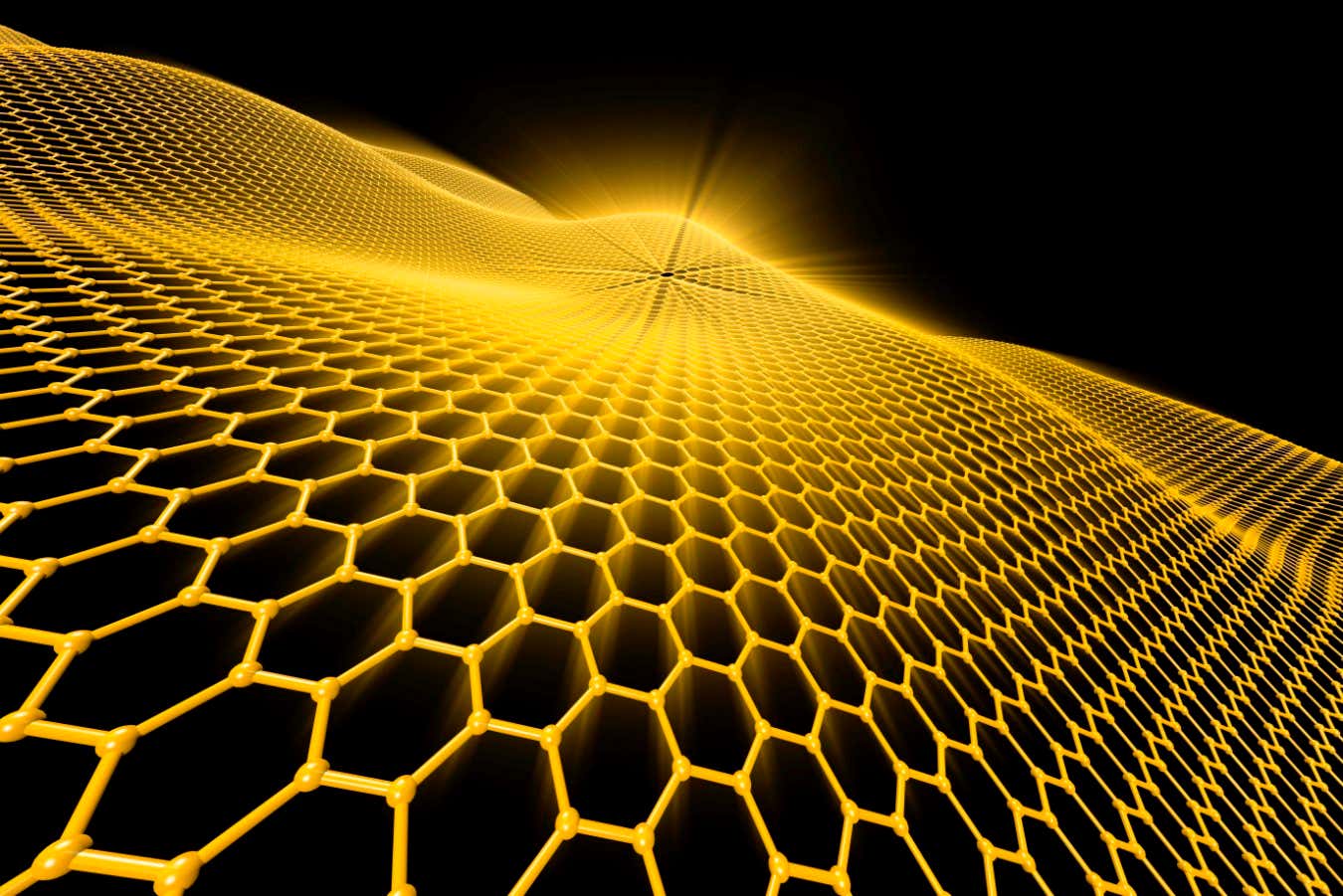
    A graphene sheet is 2D – but some thin materials may not fit neatly into that category

    ALFRED PASIEKA/SCIENCE PHOTO LIBRARY

    A new quantum state of matter behaves as if it doesn’t fully belong to a world with two or three dimensions of space, revealing a previously unobserved way for electrons to move.

    Physicists categorise states of matter based on how electrons move within a material. This motion depends on many factors, such as the arrangement of the material’s atoms.

    When a thin material is immersed in a magnetic field, its electrons trace tiny circles, and any stream of them is pushed to the material’s side. This is known as the Hall effect. For materials that are magnetic, electron choreographies become more complex, giving rise to different versions of this effect.

    Lei Wang at Nanjing University in China and his colleagues unexpectedly discovered a new version of this phenomenon, which they call the transdimensional anomalous Hall effect (TDAHE).

    The team was studying electrons in a thin material made from carbon atoms arranged in a pattern of rhombuses in hopes of seeing them form perfectly efficient currents. But when they immersed the material in a magnetic field, the electrons reacted oddly.

    “TDAHE came about as a complete surprise, a phenomenon never seen in any other material before, nor does any theory predict that,” says Wang. “After we measured the raw data, we spent about one year [trying] to understand it.”

    Specifically, what stumped the researchers was that their material exhibited a type of Hall effect when they applied two different, mutually perpendicular magnetic fields. This means the electrons could execute looping motions both horizontally and vertically, even though the material was supposed to be too thin to accommodate both.

    Wang says he and his colleagues initially thought some experimental error was to blame, but several follow-up experiments kept confirming that their measurements were correct. Making and testing more samples of the materials showed the same. They had to conclude that for pieces of their carbon material between 2 and 5 nanometres thick, the electrons were simply doing something new.

    Because these thicknesses don’t make the material fully two- or three-dimensional, the team named the new electronic state accordingly. It doesn’t somehow bridge two- and three-dimensional realms, says Wang. “It is also not a little bit of 2D and another little bit of 3D. By using ‘transdimensional’, we want to express that there exists a new regime, which does not belong to previously well-studied 2D or 3D cases,” he says.

    Andrea Young at the University of California, Santa Barbara, says that what sets the new state apart is that the mathematical representation of the electrons’ states lacks symmetry in three different ways, which is novel compared with similar states. In his view, this is more of a defining feature than the dimensionality of the material – its thickness is just a means to an end, he says.

    Young says the new state can be thought of as a type of “quarter-metal”, or a metal where the lack of symmetry limits what the electrons can do compared with more conventional metals.

    Wang’s team now wants to look for what they term transdimensional physics in other materials and to use more instruments, such as diamond-based magnetic field sensors, to learn more about the new state.

    Topics:


    Source link

    Share. Facebook Twitter Pinterest LinkedIn Tumblr Email Telegram Copy Link

    Related Posts

    Science

    ‘Green’ cryptocurrency uses 18 times more energy than makers claim

    April 30, 2026
    Science

    The rich but complicated legacy of genome pioneer Craig Venter

    April 30, 2026
    Science

    Doubts cast over ‘wild’ claim that magnetic control can turn on genes

    April 30, 2026
    Science

    Is an AI version of Mark Zuckerberg – or any boss – a good plan?

    April 30, 2026
    Science

    What happened after the fall of Rome? Ancient genomes offer new clues

    April 30, 2026
    Science

    A giant hailstorm just killed an emu at a Missouri zoo

    April 30, 2026
    Editors Picks

    Hearing Aids Will Use Biosignals to Ease Mental Strain

    January 7, 2026

    Australia to halve fuel tax as global energy crisis deepens | Oil and Gas News

    March 30, 2026

    Iran war: What’s happening on day 24 of US-Israel attacks? | US-Israel war on Iran News

    March 23, 2026

    Minnesota GOP gubernatorial candidate drops out, blaming Trump’s immigration policy

    January 27, 2026

    Meghan Markle’s Alleged Demands Before Her Big UK Return Revealed

    January 14, 2026
    About Us
    About Us

    Welcome to Benjamin Franklin Institute, your premier destination for insightful, engaging, and diverse Political News and Opinions.

    The Benjamin Franklin Institute supports free speech, the U.S. Constitution and political candidates and organizations that promote and protect both of these important features of the American Experiment.

    We are passionate about delivering high-quality, accurate, and engaging content that resonates with our readers. Sign up for our text alerts and email newsletter to stay informed.

    Latest Posts

    How Britney Spears Can Avoid Jail Time Amid DUI Charge

    May 1, 2026

    Commentary: Washington courts Manila, but the rest of Southeast Asia is watching

    May 1, 2026

    Palestine FA chief hits out at Israel federation VP at FIFA Congress | World Cup 2026 News

    May 1, 2026

    Subscribe for Updates

    Stay informed by signing up for our free news alerts.

    Paid for by the Benjamin Franklin Institute. Not authorized by any candidate or candidate’s committee.
    • Privacy Policy
    • About us
    • Contact us

    Type above and press Enter to search. Press Esc to cancel.