
Close Menu
    Trending
    • Is an AI version of Mark Zuckerberg – or any boss – a good plan?
    • Portugal’s Defense Sector Rising | Armstrong Economics
    • Timothée Chalamet’s Love Life Sparks Shock Fan Exit
    • UK boosts security for Jews after London stabbings
    • Press freedom worldwide falls to its lowest level in 25 years | Freedom of the Press News
    • Concerning update emerges on Broncos QB Bo Nix
    • The analog edge: 8 old-fashioned habits to stay sharp and fit at work
    • What happened after the fall of Rome? Ancient genomes offer new clues
    Benjamin Franklin Institute
    Thursday, April 30
    • Home
    • Politics
    • Business
    • Science
    • Technology
    • Arts & Entertainment
    • International
    Benjamin Franklin Institute
    Home»Latest News»Press freedom worldwide falls to its lowest level in 25 years | Freedom of the Press News
    Latest News

    Press freedom worldwide falls to its lowest level in 25 years | Freedom of the Press News

    Team_Benjamin Franklin InstituteBy Team_Benjamin Franklin InstituteApril 30, 2026No Comments3 Mins Read
    Share Facebook Twitter Pinterest Copy Link LinkedIn Tumblr Email VKontakte Telegram
    Share
    Facebook Twitter Pinterest Email Copy Link


    Freedom of the press around the world has fallen to its lowest level in a quarter of a century, according to the leading Paris-based press freedom NGO, Reporters Sans Frontieres (RSF), or Reporters Without Borders.

    Every year, RSF publishes a World Press Freedom Index used to compare the level of freedom enjoyed by journalists and media outlets in 180 countries. Its ranking uses a five-point scale to assess a country’s level of press freedom, ranging from “very serious” to “good”.

    Recommended Stories

    list of 3 itemsend of list

    For the first time since RSF started producing the index in 2002, more than half of the world’s countries fall into the “difficult” or “very serious” categories for press freedom – “a clear sign that journalism is increasingly criminalised worldwide”.

    Only seven mostly Nordic countries are ranked with “good” press freedom, with Norway, the Netherlands and Estonia in the top three. France ranks 25th with a “satisfactory” score, while the United States ranks 64th with a “problematic” score, falling seven places since President Donald Trump took office.

    RSF reports that Trump “has turned his repeated attacks on the press and journalists into a systematic policy”, citing the detention of Salvadoran journalist Mario Guevara, who was later deported, while he was documenting a protest against immigration raids, as well as the suspension of several notable public media institutions.

    In Latin America, RSF highlighted the dramatic fall of Javier Milei’s Argentina (98th, -11) and of El Salvador (143rd), which has dropped 105 places since 2014 following the launch of a war against the Maras criminal gangs.

    The press freedom NGO said that “Eastern Europe and the Middle East are the two most dangerous regions for journalists in the world, as they have been for 25 years”, notably putting Russia (172nd) and Iran (177th) in the bottom 10.

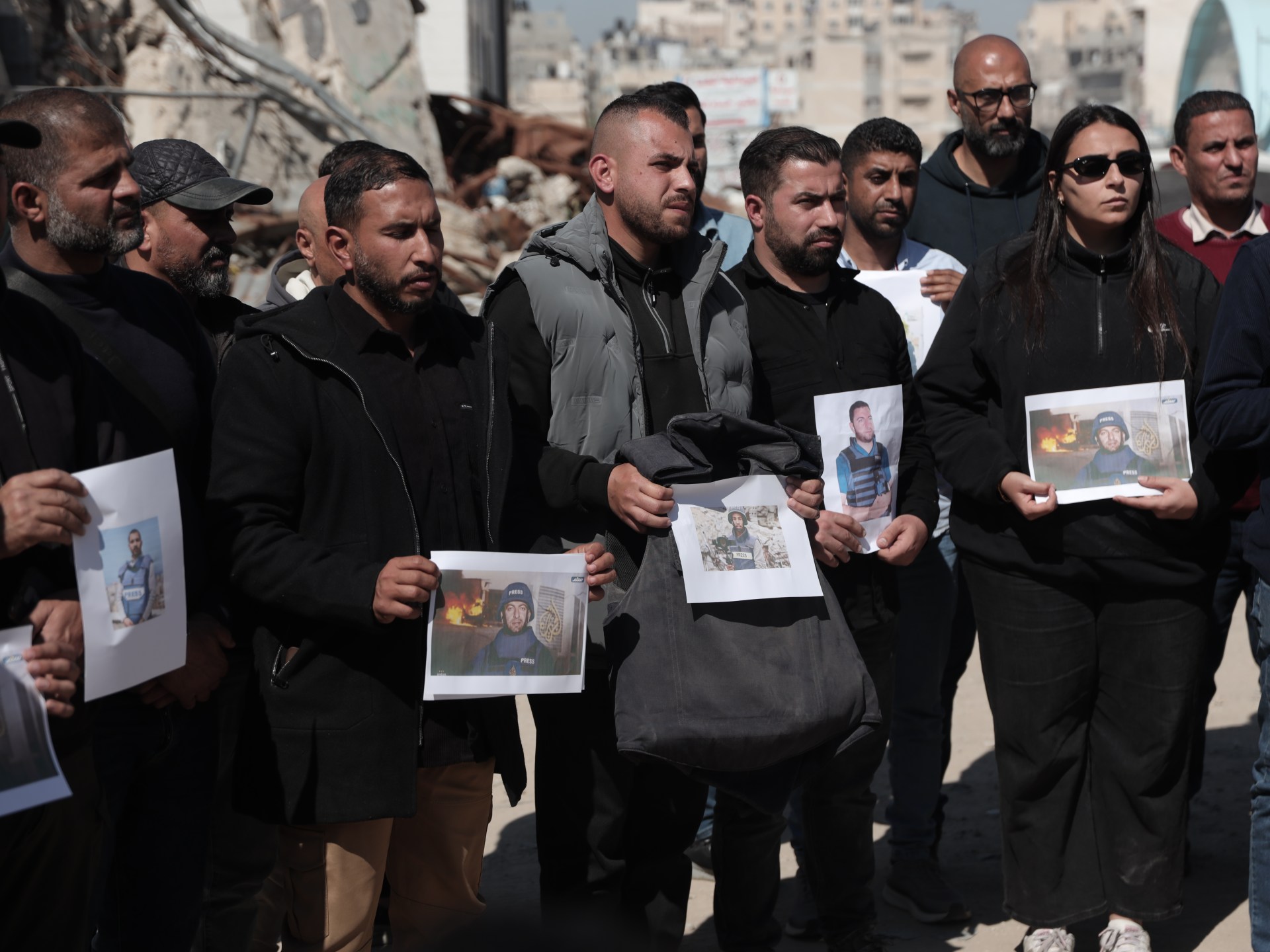
    It added that wars and restrictions on access to information are some of the driving factors for the decline in press freedom. It cited Israel’s attacks on journalists in Gaza, the occupied West Bank and Lebanon as an example of this, ranking Israel 116th.

    “Since October 2023, more than 220 journalists have been killed in Gaza by the Israeli army, including at least 70 who were slain while carrying out their work,” it said.

    Broadly speaking, RSF reported that “the criminalisation of journalism, which is rooted in circumventing press law and misusing emergency legislation and common law, is proving to be a global phenomenon”.

    It reported that more than 60 percent of countries – 110 out of 180 – have criminalised media workers in various ways, notably citing India (157th), Egypt (169th), Georgia (135th), Turkiye (163rd) and Hong Kong (140th) as prime examples of state-imposed crackdowns.

    “Although attacks on the right to information are more diverse and sophisticated, their perpetrators are now operating in plain sight,” Anne Bocande, RSF’s Editorial Director said.

    She cited “authoritarian states, complicit or incompetent political powers, predatory economic actors and under-regulated online platforms” as the main causes “for the global decline in press freedom”.

    Bocande called on democratic governments and citizens to do more to end this global criminalisation of journalists, particularly through “firm guarantees and meaningful sanctions”.

    “Current protection mechanisms are not strong enough; international law is being undermined and impunity is rife,” she said. “Inaction is a form of endorsement,” while concluding that “the spread of authoritarianism isn’t inevitable”.


    Source link

    Share. Facebook Twitter Pinterest LinkedIn Tumblr Email Telegram Copy Link

    Related Posts

    Latest News

    Europe’s little-known mutual defence clause: Is it a NATO substitute? | NATO News

    April 30, 2026
    Latest News

    Israeli forces raid Global Sumud Flotilla boats in international waters | Israel-Palestine conflict News

    April 30, 2026
    Latest News

    Carney ‘strong’ in year one, now must deliver on promises in Canada | Donald Trump News

    April 29, 2026
    Latest News

    South Africa to deport Robert Mugabe’s son over firearm offence | Courts News

    April 29, 2026
    Latest News

    ‘We saw terrible things’: Mali refugees tell of atrocities amid attacks | Armed Groups News

    April 29, 2026
    Latest News

    How US and Iran are playing a crypto cat-and-mouse game over sanctions | US-Israel war on Iran News

    April 29, 2026
    Editors Picks

    Iran’s closure of the Strait of Hormuz is an international crisis | US-Israel war on Iran

    March 25, 2026

    Early humans may have begun butchering elephants 1.8 million years ago

    January 7, 2026

    China says Irish PM to visit Beijing, Shanghai

    January 3, 2026

    Daunting Ohio State schedule could be toughest in Buckeyes history

    March 1, 2026

    Gulf leaders to meet in Saudi Arabia to discuss response to Iranian strikes

    April 28, 2026
    About Us
    About Us

    Welcome to Benjamin Franklin Institute, your premier destination for insightful, engaging, and diverse Political News and Opinions.

    The Benjamin Franklin Institute supports free speech, the U.S. Constitution and political candidates and organizations that promote and protect both of these important features of the American Experiment.

    We are passionate about delivering high-quality, accurate, and engaging content that resonates with our readers. Sign up for our text alerts and email newsletter to stay informed.

    Latest Posts

    Is an AI version of Mark Zuckerberg – or any boss – a good plan?

    April 30, 2026

    Portugal’s Defense Sector Rising | Armstrong Economics

    April 30, 2026

    Timothée Chalamet’s Love Life Sparks Shock Fan Exit

    April 30, 2026

    Subscribe for Updates

    Stay informed by signing up for our free news alerts.

    Paid for by the Benjamin Franklin Institute. Not authorized by any candidate or candidate’s committee.
    • Privacy Policy
    • About us
    • Contact us

    Type above and press Enter to search. Press Esc to cancel.