

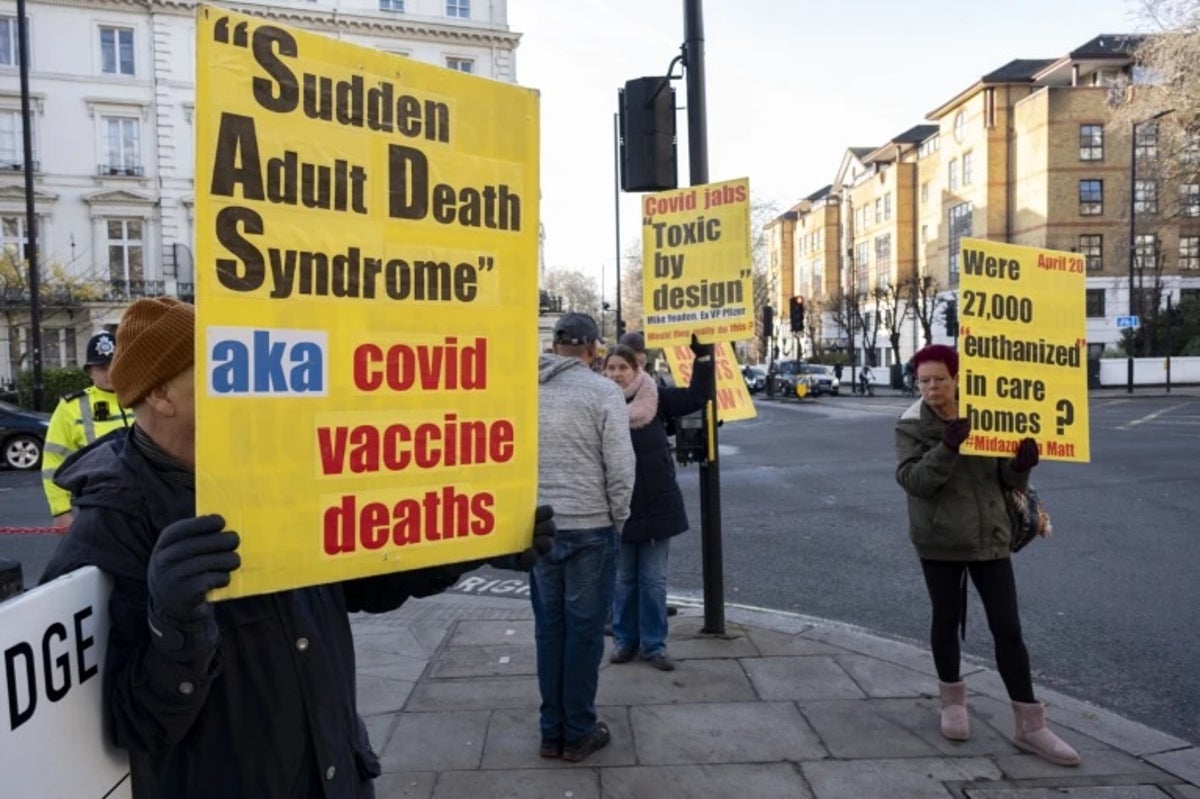
More than two-thirds of the public believe at least one false or unproven health claim — such as the idea that taking paracetamol during pregnancy causes autism — a new survey finds. The results hint that a large, and potentially growing, number of people are questioning scientific evidence.
The survey, of more than 16,000 people across 16 countries, asked whether they believed claims that are not supported by research, including that the ‘risk of childhood vaccinations outweighs benefits’, ‘fluoride in water is harmful’ and ‘raw milk is healthier than pasteurized.’
For each statement, between 25% and 32% of respondents said they believed it, and another sizeable percentage (17–39%) said they didn’t know whether it was true. In total, 70% of respondents believed at least one of the claims. The findings, which have not been peer reviewed and were published today by the Edelman Trust Institute in New York City, were described as ‘staggering’ in an accompanying article by the think tank’s chief executive, Richard Edelman.
On supporting science journalism
If you’re enjoying this article, consider supporting our award-winning journalism by subscribing. By purchasing a subscription you are helping to ensure the future of impactful stories about the discoveries and ideas shaping our world today.
The result “blows the lid off of this idea” that such beliefs are held by only a fringe population of individuals who are uninformed or ideologically driven, says David Bersoff, head of research at the Edelman Trust Institute. “This is not like a small problematic group.”
“There has definitely been a growing number of people who question widely accepted scientific evidence,” agrees Heidi Larson, who studies confidence in vaccines at the London School of Hygiene & Tropical Medicine. “It’s important to pay attention to.”
Controversial claims
Other recent studies have highlighted how commonly people question scientific consensus or evidence-based medical practices, at least in certain contentious areas, such as vaccines. One global 2023 study found that during the COVID-19 pandemic, people’s confidence that vaccines are important for children fell in 52 of 55 countries.
This year, a survey from KFF, a non-profit health-policy research organization in San Francisco, California, found that 34% of adults in the United States thought it was definitely or probably true that taking Tylenol (paracetamol) during pregnancy increases the risk of the child developing autism, even though scientific evidence does not support the link.
That claim, and some others mentioned in the Edelman survey, have been supported by US health secretary Robert F. Kennedy Jr and the wider Make America Healthy Again movement. But the study results suggest that such beliefs extend well beyond the United States. In most countries surveyed — including Brazil, South Africa, India, Germany and the United Kingdom — at least 50% of people believed one or more of the “divisive” health statements.
People who believed three or more of the claims were as likely to have attended university and more likely to consume health news than were those who believed fewer of them. This challenges the assumption that people who hold such views are ill-informed, Bersoff says.
The real problem, he argues, is an overabundance of conflicting information, from social media, news and peers in real life. In a UK survey published last week, nearly 40% of respondents agreed that there is “now too much information available to know what is true about science.”
Redistribution of trust
Research suggests that, broadly speaking, public trust in science and scientists remains relatively high. In the United States, 77% of adults in 2025 said that they had confidence in scientists to act in the public’s interests, according to a survey by the Pew Research Center, a think tank in Washington DC. This is much higher than the proportion that said they had confidence in business leaders (37%) or elected officials (27%), although a drop from 86% in 2019, before the COVID-19 pandemic.
But people increasingly trust information from other sources too, say researchers. “I think that what we’re seeing is perhaps a redistributing of that trust” away from scientific institutions, says Colin Strong, who leads behavioural science at market-research firm Ipsos in London. The Edelman survey showed that a high proportion of people value personal recommendations and social-media influencers as sources of health expertise, as well as people with academic training.
“There’s been a proliferation of ‘experts’ and a proliferation of trusted voices, and as a result, the expertise of scientists has been sort of diluted,” Bersoff says. “The more experts there are in your world, the more likely it is that on one or more occasions, you’re going to wander off from what traditional science may want you to believe.”
It’s important not to patronize or dismiss people who might be challenging established perspectives for a wide variety of legitimate reasons, adds Strong. If scientists and scientific institutions don’t communicate in a way that’s accessible and helpful — on social media, for example, “then people will seek out other sources of information and evidence.”
This article is reproduced with permission and was first published on April 22, 2026.