

Did AI just solve the mystery of one of El Greco’s most enigmatic paintings?
For years, art historians believed The Baptism of Christ was likely painted by El Greco with assistance from other artists. But new research suggests otherwise
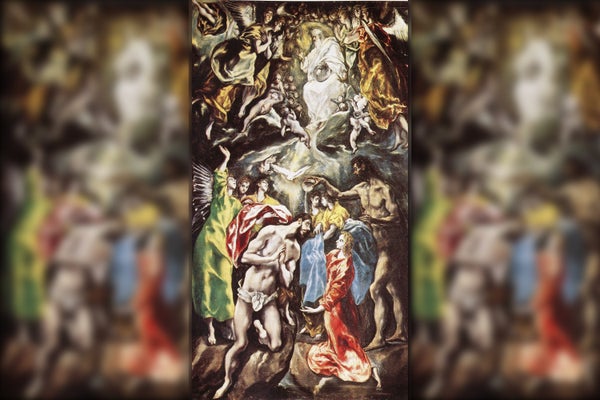
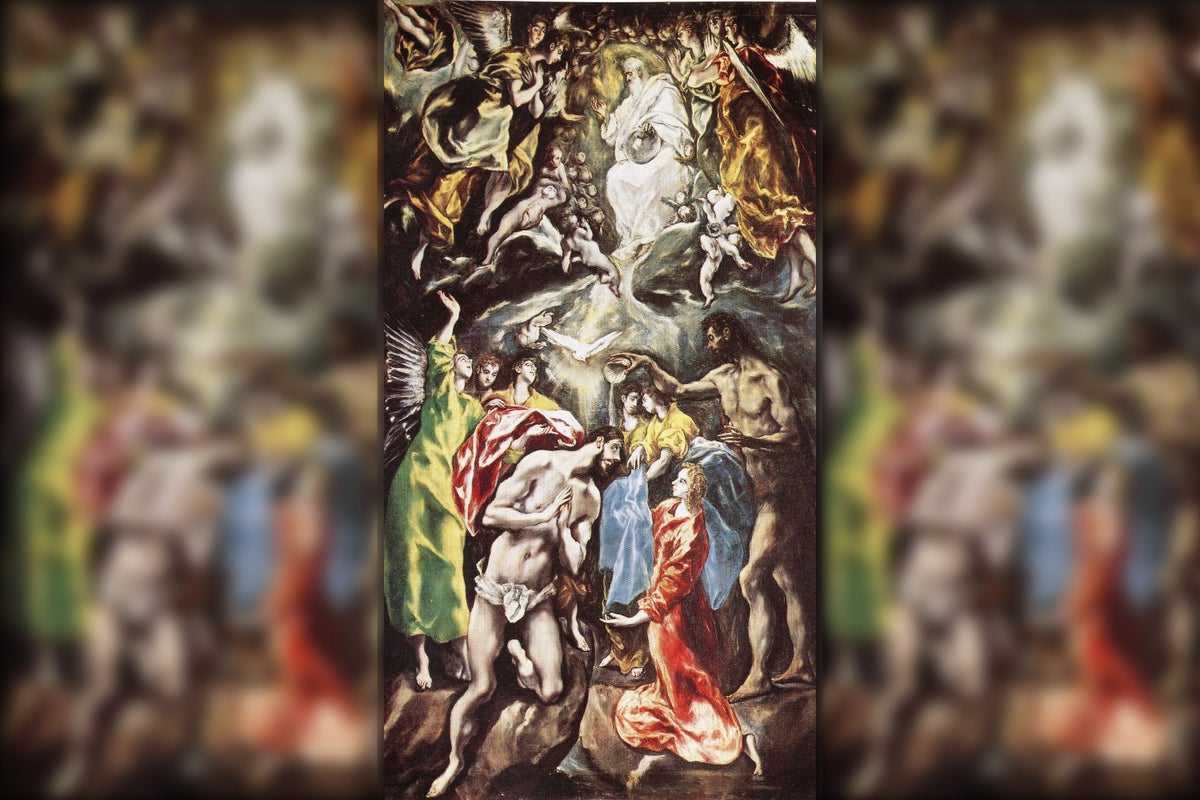
The Baptism of Christ is one of Spanish Renaissance painter El Greco’s most mysterious artworks. The oil painting depicts a towering John the Baptist pouring water on the head of an even larger, almost shimmering Jesus; in the background, God, angels and cherubs look down from heaven in an ecstatic frenzy. It’s a vital and arresting image. Art historians believe it was unfinished at the time El Greco died in 1614 and that it was completed by the painter’s son, Jorge Manuel, with help from other apprentices in El Greco’s workshop.
But new research suggests otherwise. Using artificial intelligence, researchers analyzed The Baptism of Christ at the microscopic level, looking for trends in the texture of the paint at the resolution of a single paintbrush bristle. The results suggest El Greco painted the majority of The Baptism himself—but some experts caution more research is needed.
While not definitive, the study has “muddied the waters” on the multipainter hypothesis and raises questions about The Baptism that warrant more investigation, says Andrew Van Horn, the paper’s lead author and a postdoctoral fellow in the department of anthropology at Purdue University.
On supporting science journalism
If you’re enjoying this article, consider supporting our award-winning journalism by subscribing. By purchasing a subscription you are helping to ensure the future of impactful stories about the discoveries and ideas shaping our world today.
During the Renaissance, master painters typically employed apprentices to work alongside them as the apprentices learned their craft. These assistants might mix paint pigments, stretch canvases and even help fill in certain details on paintings. Without detailed records of work, determining exactly who painted what in any given artwork from a master’s workshop can be challenging, Van Horn says.
For decades, art historians have relied on brushstroke styles and other visual and textural tells to identify whether a painting can be fully attributed to a single artist or if it should be attributed to his workshop more generally. But this detective work is sometimes fraught, and it can lead to some priceless artwork being misattributed, overlooked or disputed.
That’s where artificial intelligence could help make a difference: Van Horn and his colleagues developed a machine-learning model that was trained on 25 paintings by nine student artists. Then the researchers showed the model two paintings by El Greco: The Baptism of Christ and Christ on the Cross with Landscape, which, unlike the former painting, was thought to have been solely El Greco’s work.
As expected, the AI determined that Christ on the Cross was the work of a single artist. But when it analyzed The Baptism, the AI detected an underlying connection between segments of the painting that were thought to have been done by different painters, Van Horn says. In other words, on the micro level, the painting was more uniform than previously determined.
“What helps us is that we can look at a really fine scale, and so we’re able to see some things that maybe you can’t see with the naked eye,” Van Horn says.
The findings, which were made in collaboration with art historians, suggest that The Baptism could have been largely created by El Greco, perhaps while using different brushes than usual—or with hands that were affected by aging. The findings were published on Friday in Science Advances.
“Creating an AI system that can detect the authorship of a painting is an incredibly challenging problem,” says Mark Hamilton, a visiting researcher at the Massachusetts Institute of Technology’s Computer Science & Artificial Intelligence Laboratory, who was not involved in the study. “Artists may change their styles as they paint, collaborating artists may attempt to mimic the style of a master painter, and conservation and physical damage can affect measurements.”
“Any AI system needs to be robustly tested on real unseen data where art historians already know the ‘answer’ so that we can establish the quality of the system before trusting it,” he says. “Although this work takes steps in this direction, it both trains and evaluates its algorithm on a small dataset of 25 student paintings [of the same photograph of lilies] and does not validate their system on real paintings from antiquity. I would be cautious of trusting any predictions this system makes on real paintings from antiquity without more validation.”
“The work represents a good first step at establishing El Greco’s authorship, but more work remains to be done,” says Richard Taylor, a professor of physics, psychology and art at the University of Oregon, who also was not involved with the study. “While [the researchers’] analysis shows a strong interconnected set of communities within the painting, it cannot definitely rule one way or the other,” he adds, noting that the artwork of students may be more varied than that of artists who are trained at the same workshop and that the study has a small sample size. “A more thorough and complete analysis of many more paintings would be necessary to say anything definitive.”
If confirmed, however, the results could change how art historians view the end of El Greco’s life, as well as the value of the work he created at that time. Van Horn also hopes to use the AI tool to analyze different paintings by the same workshop to look for lesser-known individuals’ signature styles as a way to identify and track these artists. But he emphasizes the AI tool is not designed to replace art historians.
“To be able to trace people, or some phantom person, through different workshops into their own workshop would be amazing,” he says.
It’s Time to Stand Up for Science
If you enjoyed this article, I’d like to ask for your support. Scientific American has served as an advocate for science and industry for 180 years, and right now may be the most critical moment in that two-century history.
I’ve been a Scientific American subscriber since I was 12 years old, and it helped shape the way I look at the world. SciAm always educates and delights me, and inspires a sense of awe for our vast, beautiful universe. I hope it does that for you, too.
If you subscribe to Scientific American, you help ensure that our coverage is centered on meaningful research and discovery; that we have the resources to report on the decisions that threaten labs across the U.S.; and that we support both budding and working scientists at a time when the value of science itself too often goes unrecognized.
In return, you get essential news, captivating podcasts, brilliant infographics, can’t-miss newsletters, must-watch videos, challenging games, and the science world’s best writing and reporting. You can even gift someone a subscription.
There has never been a more important time for us to stand up and show why science matters. I hope you’ll support us in that mission.