
Close Menu
    Trending
    • India denounces ‘hellhole’ remark shared by Trump | Donald Trump News
    • New photos of Mike Vrabel and Dianna Russini emerge
    • AI search demands a new audience playbook
    • How do earthquakes end? A seismic ‘stop sign’ could help predict earthquake risk
    • Trump Announces Cease-Fire Between Israel and Lebanon
    • Google Is Tracking Your Life – Photo Cloud Feeding AI System
    • Rachel Zoe Confronts Amanda Frances In ‘RHOBH’ Reunion Clip
    • China’s DeepSeek says it released long-awaited new AI model
    Benjamin Franklin Institute
    Friday, April 24
    • Home
    • Politics
    • Business
    • Science
    • Technology
    • Arts & Entertainment
    • International
    Benjamin Franklin Institute
    Home»Science»Largest ever map of universe captures 47 million galaxies and quasars
    Science

    Largest ever map of universe captures 47 million galaxies and quasars

    Team_Benjamin Franklin InstituteBy Team_Benjamin Franklin InstituteApril 16, 2026No Comments4 Mins Read
    Share Facebook Twitter Pinterest Copy Link LinkedIn Tumblr Email VKontakte Telegram
    Share
    Facebook Twitter Pinterest Email Copy Link


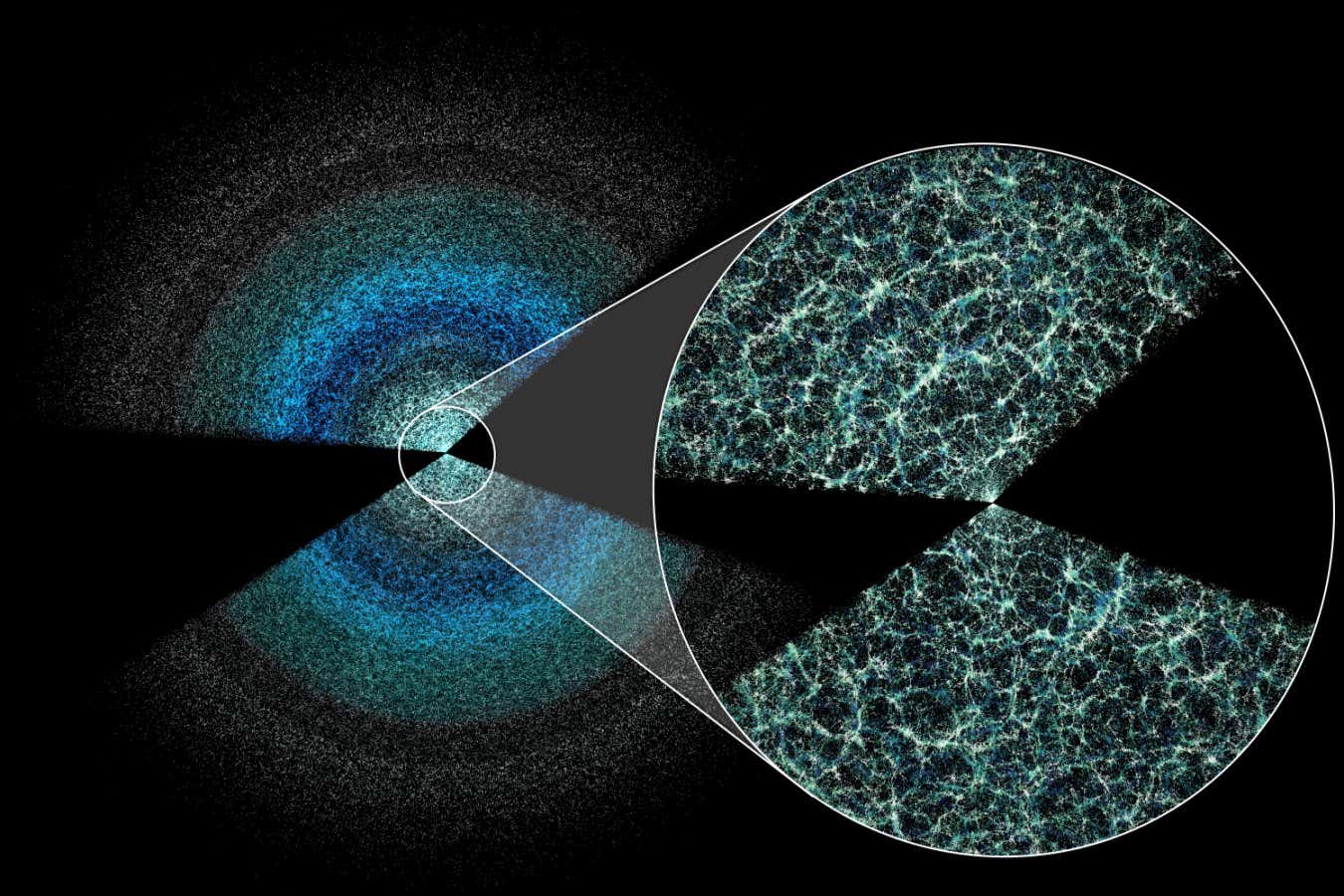
    A thin slice of the map produced by the DESI five-year survey shows galaxies and quasars above and below the plane of the Milky Way, with Earth at the centre

    Claire Lamman/DESI collaboration

    A five-year survey of the sky that has captured more than 47 million galaxies and quasars is now complete, enabling researchers to put the finishing touches on the most detailed map of the universe ever made. The data could help solve the mystery of an apparent weakening of dark energy, which threatens to upend our standard model of the cosmos.

    The Dark Energy Spectroscopic Instrument (DESI) at Kitt Peak National Observatory in Arizona has been scanning the sky since 2021. Researchers originally expected its survey to gather data on 34 million galaxies and quasars, but DESI surprised researchers with its efficiency. Because of the vast distances involved, some of these extremely faint galaxies have been observed from just 100 or 200 photons.

    David Schlegel at the Lawrence Berkeley National Laboratory in California says our previous maps of the cosmos include a total of 5 million galaxies, so the DESI data increases our knowledge of the universe by a factor of almost 10.

    “We’ve actually been on this curve now for my whole career where, every 10 years, we’re making 10-times-larger maps,” he says. “You can ask the question, at what point have you mapped every observable galaxy within 10 billion light years… and if we stayed on the curve, we would do that by 2061.”

    The main survey is now complete, but the data will take another year to analyse before it is made available to researchers. The project will continue to collect data for at least another two and a half years, and Schlegel says there are hopes that DESI can be upgraded and kept running well into the 2030s. “This is still the leading instrument like it in the world,” he says.

    DESI’s map now covers 14,000 square degrees of the sky, but the team hopes to expand this to 17,000 square degrees. The full sky has over 41,000 square degrees, but much of that is hard to observe because of relatively close and bright objects, such as our own galaxy, the Milky Way.

    The data will allow scientists to compare how galaxies were distributed in the distant past and today. This could lead to insights into the power of dark energy, which makes up about 70 per cent of the universe. An earlier dataset from DESI in 2024 suggested that, rather than remaining constant as expected, dark energy is weakening over time.

    If dark energy is indeed weakening, it would have profound implications for the standard model of cosmology, known as lambda-CDM. The full set of DESI data will allow that phenomenon to be investigated further.

    Ofer Lahav at University College London says having access to the latest map from DESI would have seemed like science fiction at the start of his career. “When I was a PhD student in Cambridge, 40 years ago, we had a sample of thousands of galaxies. The community was starving for data,” he says. “I think my students [today] may have the opposite problem; to have been flooded with data, and it’s very challenging to analyse it.”

    With so much data, there will be scientific breakthroughs about the nature of the universe, says Lahav, but we have also probably caught unusual one-off cosmological incidents that lead to exciting research.

    New Scientist. Science news and long reads from expert journalists, covering developments in science, technology, health and the environment on the website and the magazine.

    The world capital of astronomy: Chile

    Experience the astronomical highlights of Chile. Visit some of the world’s most technologically advanced observatories and stargaze beneath some of the clearest skies on earth.

    Topics:


    Source link

    Share. Facebook Twitter Pinterest LinkedIn Tumblr Email Telegram Copy Link

    Related Posts

    Science

    How do earthquakes end? A seismic ‘stop sign’ could help predict earthquake risk

    April 24, 2026
    Science

    ‘Kraken’ fossils show enormous, intelligent octopuses were top predators in Cretaceous seas

    April 24, 2026
    Science

    Largest ever octopus was great white shark of invertebrate predators

    April 24, 2026
    Science

    Do you need to worry about Mythos, Anthropic’s computer-hacking AI?

    April 23, 2026
    Science

    How many dachshunds would it take to get to the moon?

    April 23, 2026
    Science

    The Age Code review: Can you slow ageing with your diet? A new book gives it a go

    April 23, 2026
    Editors Picks

    Kyle Richards Says Deleting This Scene From ‘RHOBH’ Would Be A ‘No-Brainer’

    February 4, 2026

    Whitney Thompson Exposes The ‘ANTM’ Reality That Cameras Never Showed

    February 13, 2026

    Hyundai says it will deploy humanoid robots at US factory

    January 6, 2026

    Ex-minister Gamboa targeted in Costa Rica’s first extradition to the US | Crime News

    March 21, 2026

    Schitt’s Creek star Catherine O’Hara dead at 71

    January 30, 2026
    About Us
    About Us

    Welcome to Benjamin Franklin Institute, your premier destination for insightful, engaging, and diverse Political News and Opinions.

    The Benjamin Franklin Institute supports free speech, the U.S. Constitution and political candidates and organizations that promote and protect both of these important features of the American Experiment.

    We are passionate about delivering high-quality, accurate, and engaging content that resonates with our readers. Sign up for our text alerts and email newsletter to stay informed.

    Latest Posts

    India denounces ‘hellhole’ remark shared by Trump | Donald Trump News

    April 24, 2026

    New photos of Mike Vrabel and Dianna Russini emerge

    April 24, 2026

    AI search demands a new audience playbook

    April 24, 2026

    Subscribe for Updates

    Stay informed by signing up for our free news alerts.

    Paid for by the Benjamin Franklin Institute. Not authorized by any candidate or candidate’s committee.
    • Privacy Policy
    • About us
    • Contact us

    Type above and press Enter to search. Press Esc to cancel.