

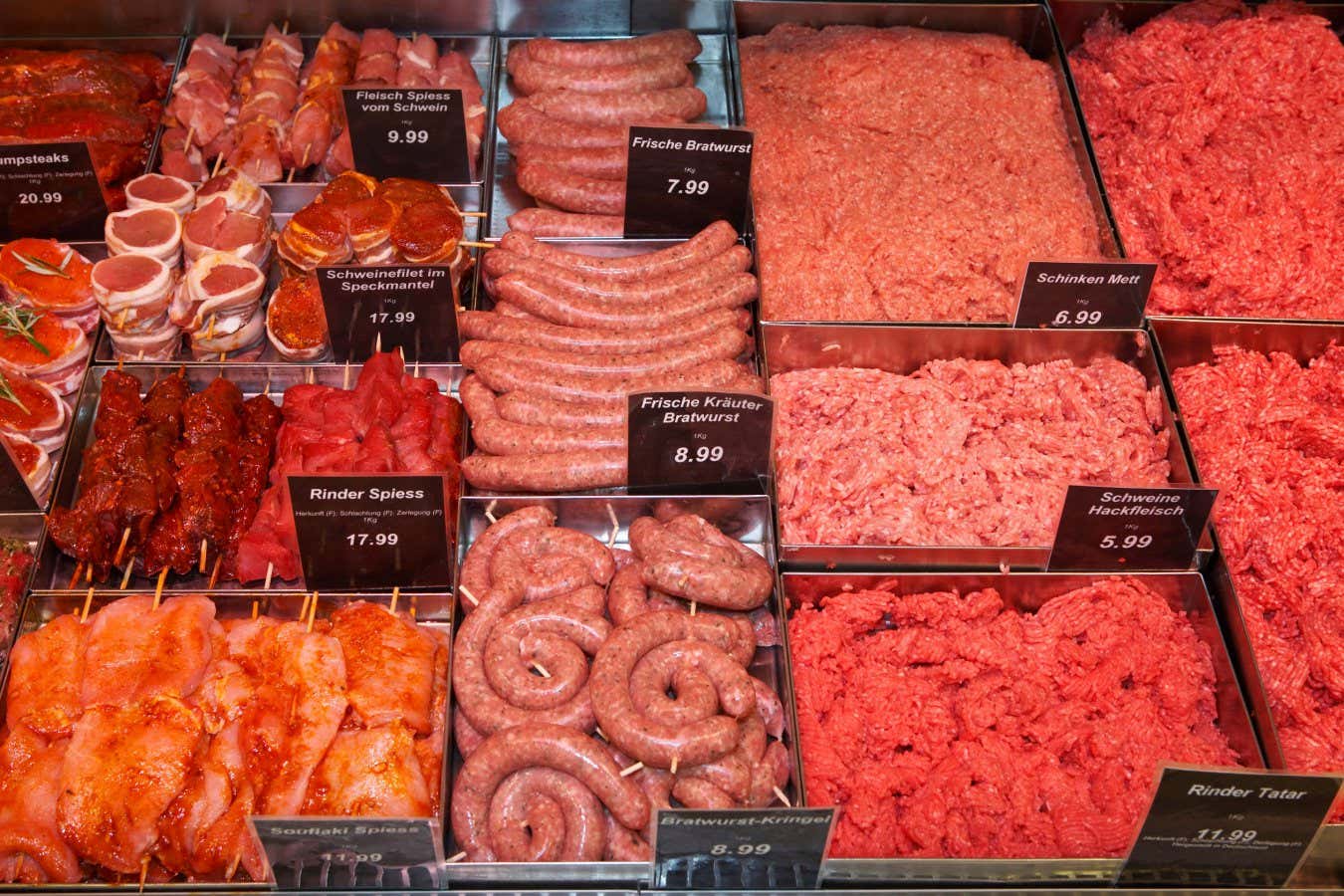
Beef consumption is on the rise in the US, but is there any amount that fits into a healthy diet?
Westend61 GmbH/Alamy
The US government caused quite a stir earlier this year when it unveiled its new dietary guidelines. A hunk of red meat now gets top billing, sitting at the widest section of the food pyramid, implying beef and other animal-based proteins should form a substantial part of a healthy diet.
The guidance is a sharp departure from public health messaging of the past few decades, which had advised limiting red meat consumption. “It’s very confusing for consumers,” says Sara Bleich at Harvard University, who previously worked at the US Department of Agriculture (USDA) under former President Joe Biden. “You look at that image – which has a huge piece of steak on it – and naturally you’re going to say, ‘Oh! I can eat as much steak as I want,’” she says.
Beef’s comeback didn’t come out of nowhere – it has been brewing for years. Social media is filled with posts about the carnivore diet. Influencers hawk beef tallow for use in the kitchen and out. Even Robert F. Kennedy Jr – the leading public health official in the US – boasted online about frying his Thanksgiving turkey in a vat of beef fat. “This is how we cook the MAHA way – beef tallow,” he said in a social media video, referring to his Make America Healthy Again policy initiative, which has encouraged people to “eat real food”. But not all so-called real food is made equal.
The scientific picture of red meat has largely stayed the same over the past few decades. It remains one of the most climate-intensive foods on the menu, and study after study links its consumption with poorer health outcomes, such as heart disease and cancer. In March, the American Heart Association published its own dietary guidance, encouraging people to limit red meat consumption and opt for plant-based proteins.
Beef’s resurgence, then, is better viewed through a cultural lens, reflecting a wider obsession with protein and a return to traditional values. The powerful beef and dairy industry probably also played a part.
The rise and fall of red meat
In past centuries, Western countries saw meat as more of a supporting actor on plates than a main character. That began to change around the 19th century, as industrialisation, refrigeration and rising incomes made meat more accessible, with the rest of the world gradually following suit.
In the US, annual beef consumption peaked in 1976 at nearly 43 kilograms (around 94 pounds) per person a year. About a decade later, the European Union hit its high point of 25 kilograms per person annually. Consumption then started to wane amid growing concern about saturated fats and their potential link with heart disease. Around the same time, white-meat products, such as chicken and turkey sausage, hit supermarket shelves and were marketed as a healthier, leaner alternative to red meat. Whereas one serving of ground beef contains almost 7 grams of saturated fat, a serving of ground chicken contains less than 2 grams. It got to the point that even the US National Pork Board launched a campaign in 1987 to brand pork as “the other white meat”, though it contains nearly the same amount of saturated fat as beef and is unequivocally a red meat.
Beef’s reputation took another hit in 2015, when the World Health Organization (WHO) convened 22 researchers from 10 countries to assess the link between red meat and cancer. After evaluating more than 800 studies, the group labelled processed meats such as bacon and ham as carcinogens, meaning they cause cancer. The analysis suggested that every 50 grams of processed meat eaten daily – about one sausage – increases the risk of colorectal cancer by about 18 per cent. “It is about the same amount of risk increase as second-hand smoke,” says Kurt Straif at Boston College, who was part of the WHO research group.

The recently updated US food pyramid gives red meat top billing
U.S. Department of Agriculture/U.S. Department of Health and Human Services
The team also classified red meat as a probable carcinogen, based on studies showing a positive association between its consumption and colorectal cancer. “But overall, the evidence was not as consistent [as it was for processed meat],” says Straif, noting that they couldn’t rule out other explanations for the rise in colorectal cancer among red meat eaters. Still, eating 100 grams of red meat daily – roughly the size of a deck of cards – was associated with a 17 per cent higher risk of colorectal cancer.
While these risks may seem small, they have a substantial impact at the population level. The WHO estimates that worldwide, about 34,000 cancer deaths a year are attributable to processed meat. If the association with red meat proves causal, it could account for roughly 50,000 cancer deaths annually.
Also in 2015, an advisory committee to the USDA recommended updating US dietary guidelines to encourage more plant-based diets, partly due to concerns about the environmental impact of meat production. It cited a 2012 study that found doubling the number of vegetarians in the UK would reduce greenhouse gas emissions by nearly 28 million tonnes per year, or about 3 per cent of total emissions. Given that climate change contributes to heart disease, respiratory illnesses and premature death, the move would have also benefited public health. Yet the USDA declined the recommendation.
Still, around a decade ago, annual beef consumption had bottomed out in the US at about 25 kilograms (54 pounds) per person – roughly the same amount recorded in 1909, the first year the government began collecting data.
Health harms of red meat
Since then, evidence that red meat can harm our health has only grown. For instance, a 2024 study of nearly 149,000 adults found that those who ate two or more servings of processed red meat a day had a 29 per cent higher risk of heart disease than those who ate less than a serving a week. Meanwhile, people who ate two or more servings of unprocessed red meat daily still had a 14 per cent higher risk than those who ate less than a serving a week. Participants were followed for an average of four years, and all of them were free of heart disease, cancer and diabetes at the study’s start.
While saturated fats in red meat were once thought to drive this association, that no longer seems to be the case. A 2022 study of nearly 4000 US adults aged 65 and older found that higher intake of unprocessed red meat was associated with a 15 per cent greater risk of a condition called atherosclerosis, which hardens arteries and raises the risk of heart attack and stroke. Crucially, it also showed that a substance called trimethylamine N-oxide (TMAO) significantly mediated this association.
Gut bacteria produce TMAO when breaking down compounds prevalent in red meat, such as choline and L-carnitine. TMAO inflames blood vessels and interferes with processes that prevent cholesterol from accumulating in arteries. It is also implicated in the development of colorectal cancer, which could explain why a 2025 analysis of 60 studies found that eating red meat and processed meat was associated with a 15 per cent and 21 per cent greater risk of colorectal cancer, respectively.
“All these pathways are totally unrelated to saturated fat,” says Dariush Mozaffarian at Tufts University in Massachusetts, who helped conduct the 2022 study. “So we have been mistakenly telling people to eat lean red meat, when it is really other things in red meat that are the problem.”
Beef’s comeback
Even though red meat’s health risks are clearer than ever, it is finding its way back onto plates. Between 2015 and 2021, the most recent year for which data is available, US beef consumption rose almost 9 per cent – and it will probably climb even higher given the country’s updated dietary guidelines. Meanwhile, about 25 per cent of Australians reported increasing their red meat consumption in 2025, whereas less than 10 per cent did so in 2013. Red meat consumption has steadily declined in the UK since 1980, although some groups, such as young men, have recently reported upping their intake. The drivers behind this shift aren’t entirely clear, but a changing cultural and political landscape is almost certainly part of the equation. Take, for instance, the rise of the so-called manosphere, a countermovement to feminism that stresses traditional ideas of masculinity.
“In some circles, red meat is seen as a way to assert strength and dominance and independence – these are all features that are coded as masculine,” says Elina Vrijsen at the University of Antwerp in Belgium.
She and her colleagues have found that young men often use meat as a way to communicate and reinforce their masculinity, which may explain why red meat consumption is rising among Gen Z men. A 2024 survey from the UK environmental non-profit Hubbub found that men aged 16 to 24 were nearly three times as likely as the general population to have increased their meat consumption in the past year.
There is also the cultural obsession with protein, as exemplified by the US government’s updated dietary guidelines that nearly doubled the recommended daily intake: instead of 0.8 grams of protein per kilogram of body weight, the guidelines suggest up 1.6 grams. “This near doubling does not have a scientific basis,” says Bleich. “We are meeting or exceeding what we actually need from a health perspective when it comes to protein, so it doesn’t make sense.”

US Secretary of Health and Human Services Robert F Kennedy Jr revealed new dietary guidelines in February 2026
Michael M. Santiago/Getty Images
The USDA’s updated guidance came after the government rejected recommendations from an independent advisory committee tasked with reviewing scientific evidence on nutrition. The committee, which underwent vetting for conflicts of interest, had pushed for a more plant-based diet. Yet President Donald Trump’s administration broke with norms and convened its own committee, partly over concerns about the promotion of plant-based diets. At least four of its nine members had financial ties to the beef and dairy industry.
“At long last, we are realigning our food system to support American farmers, ranchers, and companies that grow and produce real food,” said US Secretary of Agriculture Brooke Rollins in a statement. “Farmers and ranchers are at the forefront of the solution, and that means more protein, dairy, vegetables, fruits, healthy fats, and whole grains on American dinner tables.”
It also means overlooking the abundance of evidence linking red meat to heart disease and cancer, not to mention its outsized carbon footprint.
So, what should people trying to follow a healthy diet do about beef? Given the evidence, Straif says there really is no safe amount of processed red meat to consume, and the same is probably true for unprocessed red meat. That might sound shocking to some, but the numbers don’t lie. At the same time, red meat offers other nutrients, such as iron, vitamin B12 and zinc, which is why context matters. “Highly processed foods rich in starch, sugar and salt – you would be better off eating red meat compared to those,” says Mozaffarian. “On the other hand, there are so many other healthier choices than red meat, but that doesn’t mean red meat is the worst choice.”
It is safe to say most people are getting plenty of protein without increasing their red meat intake. The average person could certainly benefit from eating fewer burgers and steaks than they do now – and no one needs to be deep-frying turkey in beef tallow.
Topics: