
Close Menu
    Trending
    • Negotiations that enable Israel’s land-grabs | Israel-Palestine conflict
    • True-or-false for Round 1 of 2026 NFL Draft: Will Cowboys regret their trade?
    • Opinion | Stewart Brand, Silicon Valley’s Favorite Prophet, on Life’s Most Important Principle
    • Struggling to scale your company? Here are five things that could be holding you back
    • What happens if you’re hit by a primordial black hole?
    • When is London Marathon 2026? Start time and how to watch race for FREE
    • Pentagon Requests $54 Billion For AI War
    • Clavicular Hit With New YouTube Crackdown
    Benjamin Franklin Institute
    Friday, April 24
    • Home
    • Politics
    • Business
    • Science
    • Technology
    • Arts & Entertainment
    • International
    Benjamin Franklin Institute
    Home»Science»We’ve caught a comet switching its spin direction for the first time
    Science

    We’ve caught a comet switching its spin direction for the first time

    Team_Benjamin Franklin InstituteBy Team_Benjamin Franklin InstituteApril 14, 2026No Comments3 Mins Read
    Share Facebook Twitter Pinterest Copy Link LinkedIn Tumblr Email VKontakte Telegram
    Share
    Facebook Twitter Pinterest Email Copy Link


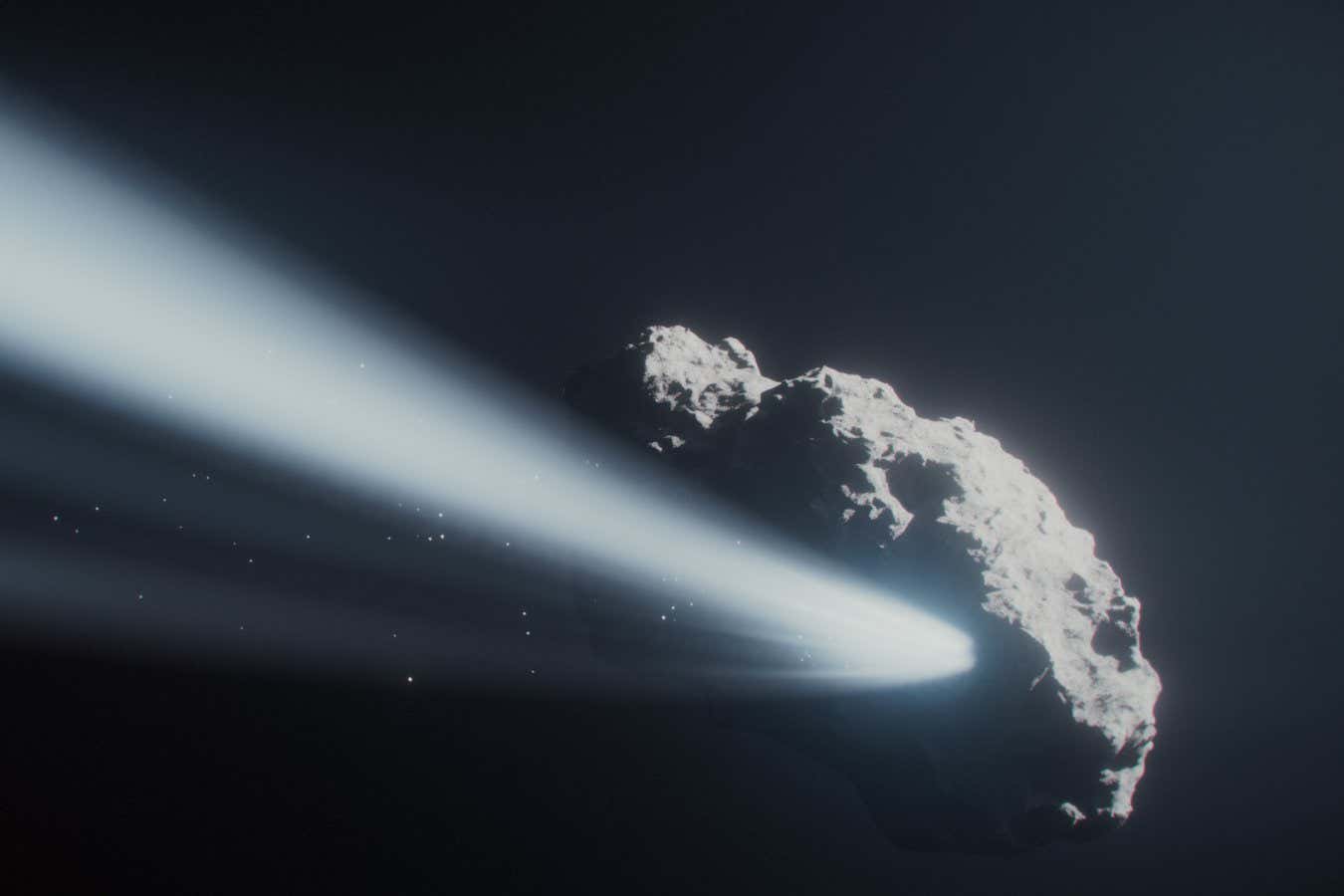
    An artist’s impression of comet 41P as it approached the sun and shot material off into space

    NASA, ESA, CSA, Ralf Crawford (STScI)

    A small comet seems to have switched the direction in which it is rotating – the first time astronomers have seen evidence of such behaviour. Changes like this may help us learn about the insides of comets, which could reveal information about the composition of the early solar system.

    Comet 41P/Tuttle-Giacobini-Kresák, or simply 41P, measures about 1 kilometre across and takes around 5.4 years to orbit the sun. We can only see it when it visits the inner solar system and its trajectory happens to take it relatively close to Earth. It was last seen in 2017.

    In March that year, it was rotating at a rate of about one full spin every 20 hours. When astronomers observed it just two months later, it had slowed down dramatically to one spin every 46 to 60 hours. Now, David Jewitt at the University of California, Los Angeles, has reanalysed observations from the Hubble Space Telescope taken in December 2017 and found that the comet had sped up again to one spin every 14 hours or so.

    The simplest explanation is that the comet’s rotational speed slowed until it eventually reached zero, at which point the comet began to rotate in the opposite direction, picking up rotational speed as it did so. This may be because sunlight caused ice on the comet’s surface to sublimate away into gas that then acted like a jet. If this jet fired in the opposite direction from the comet’s original rotational direction, it would slow down the comet’s rotational speed and eventually send it spinning in the opposite direction.

    “It is the first detected ‘fast’ change of the rotation direction for a celestial body,” says Dmitrii Vavilov at the University of Washington in Seattle. Most of the time, significant changes in any celestial body, even such a small comet, take decades or centuries.

    “Following 41P during its next apparition in late 2027/early 2028 will be quite interesting,” says John Noonan at Auburn University in Alabama. “I’d be keen to see if these comets are more likely to fracture as well, due to the stress.” If 41P spins too fast, its main body, or nucleus, will simply fall apart.

    “I expect this nucleus will very quickly self-destruct,” said Jewitt in a statement. In fact, it may have already happened. If so, it could present an excellent opportunity to observe the insides of a comet that froze while the solar system was forming. Studying the composition of such ancient ice could not only give us precious insights into the chemical make-up of the early solar system, but also act as a benchmark to work out how that chemistry changed as the solar system matured.

    Topics:


    Source link

    Share. Facebook Twitter Pinterest LinkedIn Tumblr Email Telegram Copy Link

    Related Posts

    Science

    What happens if you’re hit by a primordial black hole?

    April 24, 2026
    Science

    How do earthquakes end? A seismic ‘stop sign’ could help predict earthquake risk

    April 24, 2026
    Science

    ‘Kraken’ fossils show enormous, intelligent octopuses were top predators in Cretaceous seas

    April 24, 2026
    Science

    Largest ever octopus was great white shark of invertebrate predators

    April 24, 2026
    Science

    Do you need to worry about Mythos, Anthropic’s computer-hacking AI?

    April 23, 2026
    Science

    How many dachshunds would it take to get to the moon?

    April 23, 2026
    Editors Picks

    Fury after Trump posts video of Obamas as monkeys

    February 6, 2026

    India vs United States: T20 World Cup – teams, start time, lineups | ICC Men’s T20 World Cup News

    February 6, 2026

    Was 2025 the year we found signs of past life on Mars?

    December 26, 2025

    Kings fire HC Mike Brown after disappointing start

    December 27, 2024

    How 2026 tax changes could leave more money in your paycheck

    January 5, 2026
    About Us
    About Us

    Welcome to Benjamin Franklin Institute, your premier destination for insightful, engaging, and diverse Political News and Opinions.

    The Benjamin Franklin Institute supports free speech, the U.S. Constitution and political candidates and organizations that promote and protect both of these important features of the American Experiment.

    We are passionate about delivering high-quality, accurate, and engaging content that resonates with our readers. Sign up for our text alerts and email newsletter to stay informed.

    Latest Posts

    Negotiations that enable Israel’s land-grabs | Israel-Palestine conflict

    April 24, 2026

    True-or-false for Round 1 of 2026 NFL Draft: Will Cowboys regret their trade?

    April 24, 2026

    Opinion | Stewart Brand, Silicon Valley’s Favorite Prophet, on Life’s Most Important Principle

    April 24, 2026

    Subscribe for Updates

    Stay informed by signing up for our free news alerts.

    Paid for by the Benjamin Franklin Institute. Not authorized by any candidate or candidate’s committee.
    • Privacy Policy
    • About us
    • Contact us

    Type above and press Enter to search. Press Esc to cancel.