

‘Moon joy’ and the overview effect—how views from space change us
Artemis II’s views from space trigger a special type of awe. Psychologists suggest holding onto it
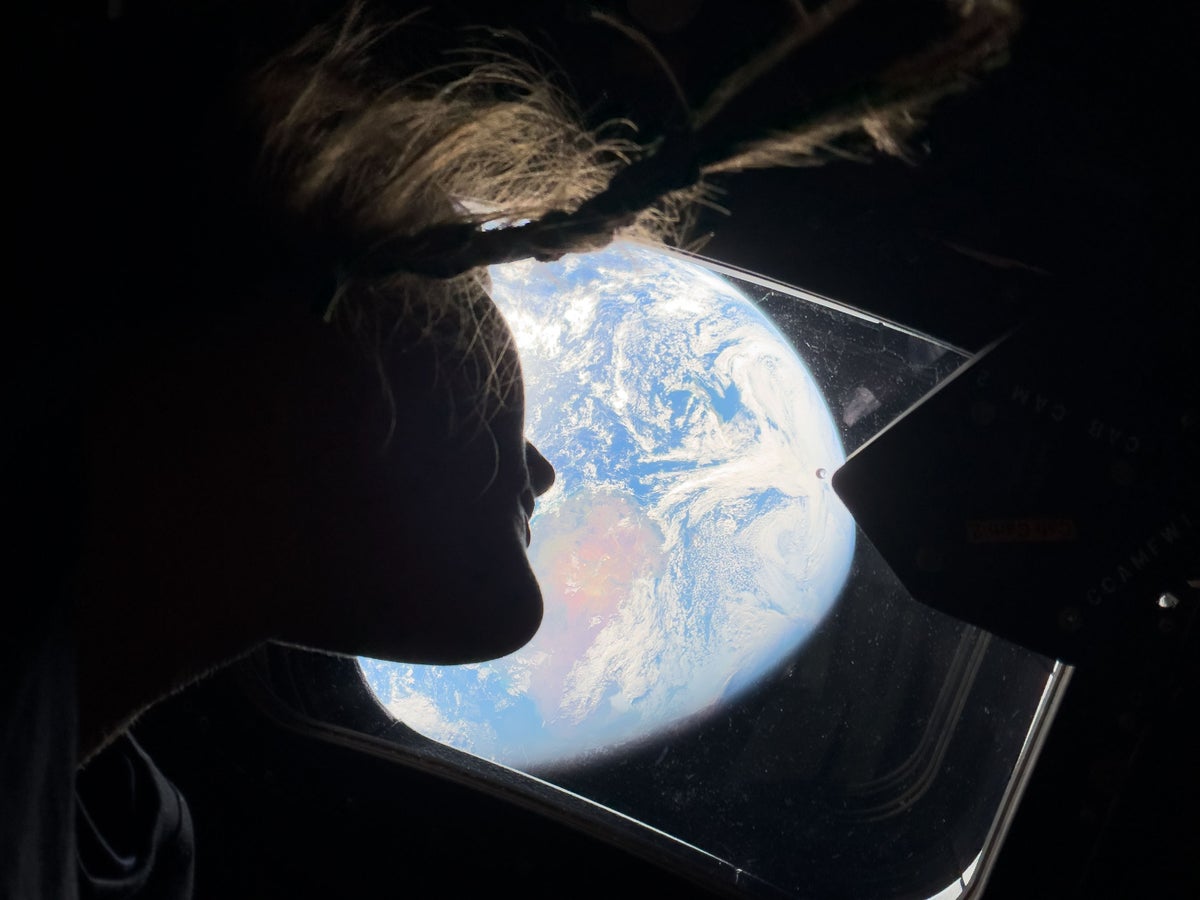
Astronaut Christina Koch gazes on her receding home planet out the window of Orion as the spacecraft continues its journey toward the moon.
“The moon we are looking at is not the moon you see from Earth whatsoever.” That’s how Artemis II astronaut Christina Koch described our natural satellite as the mission’s spacecraft drew closer to the moon on April 4.
What Koch and her crew mates experienced—what NASA’s mission control in Houston called “moon joy”—is infectious, it seems. The Artemis II mission, which splashed down into the Pacific Ocean on Friday, marks the first time that most people alive today have witnessed humans travel to the moon; the last occasion was in 1972, when Apollo 17 landed astronauts on the lunar surface. And it’s definitely the first time we’ve seen such a mission in high-resolution, nearly continuous live video.
It has also been a mission of superlatives. With Artemis II, humans have now traveled farther from Earth than ever before, captured images of a total solar eclipse from space, seen parts of the far side of the moon that were never seen previously, and witnessed our own planet setting and rising behind the craggy lunar surface.
On supporting science journalism
If you’re enjoying this article, consider supporting our award-winning journalism by subscribing. By purchasing a subscription you are helping to ensure the future of impactful stories about the discoveries and ideas shaping our world today.
There’s a term for the awe of spaceflight: the overview effect. It describes the profound mental shift that many astronauts report having experienced after seeing Earth from a distance. Writer Frank Write, who coined the term in 1987, said that not only astronauts might feel the effect—people on Earth could, too. Certainly, photographs of Earth taken from space such as the original “Earthrise” or the “Pale Blue Dot” have become symbols of the environmental movement. These images show Earth as a vast oasis in the void. But even as the overview effect has become part of the mythos of human space exploration, it doesn’t fully capture the psychology at play.
Astronauts go to space knowing that many of their predecessors reported profoundly perspective shifts. Apollo 11 astronaut Michael Collins wrote in his autobiography that “I really believe that if the political leaders of the world could see their planet from a distance of … 100,000 miles, their outlook would be fundamentally changed.”
In many ways, soundbites like this have become expected from astronauts—how could you not be amazed? University of Chicago space historian Jordan Bimm argues that the overview effect is a product of culture and not an inherent human response. It’s “a story that’s really convenient and really nice and very positive,” Bimm says, adding that it is also handy marketing for private space companies. “But I worry that it’s one cultural interpretation that we’re mistaking for a natural phenomenon that would work the same for everyone,” he says.
Notably, Artemis II astronaut Jeremy Hansen said in a press event on April 8 that being in space hadn’t changed his perspective about Earth. “The perspective I launched with was that we live on a fragile planet in the vacuum, in the void, of space,” Hansen said. “Our purpose on the planet as humans is to find … the joy in lifting each other up by creating solutions together instead of destroying. When you see it from out here, it doesn’t change it; it just absolutely reaffirms that. It’s almost like seeing living proof of it.”
Ultimately, the overview effect may be best understood as a special type of awe. It’s a feeling we get when we encounter “something so complex, so vast, that it transcends [our] understanding of the world,” says Paul Piff, a psychologist who studies awe at the University of California, Irvine.
During these experiences, our perspective of the world seems to zoom out or to flip to a different angle, adds Michelle Shiota, a social psychologist at Arizona State University. This feeling tends to make us feel small and to put our daily problems in perspective. The “zoom out” of going to space is probably “the greatest version of that experience that humans are capable of,” Shiota says.
But awe isn’t inherently positive. The term comes from an Old English word meaning terror or dread. William Shatner wept upon returning to Earth after his Blue Origins spaceflight in 2021. “It was among the strongest feelings of grief I have ever encountered,” he later wrote.
Some critics of the overview effect argue that you don’t need to go to space to feel connected with Earth. Research seems to bear this out. In a study published last December, psychologists interviewed “aquanauts,” deep-sea saturation divers who live for weeks at a time in habitats near the ocean floor. They reported experiencing a similar profound effect, which the researchers dubbed the “underview effect.”
“Even though they’re not seeing the Earth from space or from this sort of panoramic perspective, they’re getting a unique immersive experience that can shift them out of their normal, habitual ways of viewing the world,” says the study’s lead author Kristen Kilgallen, who researches psychology at Northeastern University.
Everyday experiences of awe, such as watching patterns of light on the sidewalk or marveling at insect wings, can be transformative, too, Piff says. And seeking out the emotion on a daily basis seems to improve emotional well-being. Research published in 2022 found that older adults instructed to tap into their inner “sense of wonder” before taking 15-minute walks every day for eight weeks reported decreases in daily distress and an increase in positive, prosocial emotions (though measures of anxiety, depression and life satisfaction didn’t change).
Now that the crew of Artemis II has splashed down in the Pacific, the high of this collective joy will fade. But Shiota says we can continue to look for little moments of awe throughout our daily lives.
“Sit with it and let that ‘extraordinary’ wash over you,” she says.
It’s Time to Stand Up for Science
If you enjoyed this article, I’d like to ask for your support. Scientific American has served as an advocate for science and industry for 180 years, and right now may be the most critical moment in that two-century history.
I’ve been a Scientific American subscriber since I was 12 years old, and it helped shape the way I look at the world. SciAm always educates and delights me, and inspires a sense of awe for our vast, beautiful universe. I hope it does that for you, too.
If you subscribe to Scientific American, you help ensure that our coverage is centered on meaningful research and discovery; that we have the resources to report on the decisions that threaten labs across the U.S.; and that we support both budding and working scientists at a time when the value of science itself too often goes unrecognized.
In return, you get essential news, captivating podcasts, brilliant infographics, can’t-miss newsletters, must-watch videos, challenging games, and the science world’s best writing and reporting. You can even gift someone a subscription.
There has never been a more important time for us to stand up and show why science matters. I hope you’ll support us in that mission.