

“WE DON’T KNOW MUCH ABOUT HIS WORLD VIEW”
In Iran’s theocratic system of rule, ultimate power is meant to be wielded by the supreme leader, a venerable Shi’ite Muslim cleric appointed by an assembly of 88 ayatollahs. The leader oversees the elected president while directly commanding parallel institutions including the Revolutionary Guards, a powerful political and military force.
Iran’s first supreme leader, Ayatollah Ruhollah Khomeini, enjoyed unquestioned authority as the charismatic leader of the revolution and the most learned cleric of his day.
His successor, Ali Khamenei, was a less revered cleric but had served as Iran’s president. He spent decades cementing his authority after his appointment in 1989, partly through promoting the power of the Revolutionary Guards.
His son Mojtaba does not command absolute power in the same way, senior Iranian sources have previously told Reuters. The Revolutionary Guards, who helped steer him into the top job after his father’s assassination, have emerged as the dominant voice on strategic decisions during the war. Iran’s UN mission didn’t respond to questions about the power wielded by the Guards and the new supreme leader.
As an influential figure in his father’s office, Khamenei had previously spent years involved in exercising power at the top levels of the Islamic Republic, officials and insiders have said, building ties with senior Guards figures.
While he is widely seen as likely to continue his father’s hardline approach due to his links to the Guards, we don’t know much about his world view, said Vatanka at the Middle East Institute.
Khamenei’s first communication with Iranians as supreme leader came on Mar 12, saying in a written statement read out by a television news presenter that the Strait of Hormuz should stay closed and warning regional countries to shut US bases.
His office has since issued a few other brief written statements from him, including on Mar 20 when he welcomed in the Persian new year, which he named the “year of resistance”. Public statements of policy on Iran’s war stance, its approach towards diplomacy, neighbours, ceasefire negotiations and domestic unrest, have been made by other senior officials.
“WHERE IS MOJTABA?” MEMES CIRCULATE ONLINE
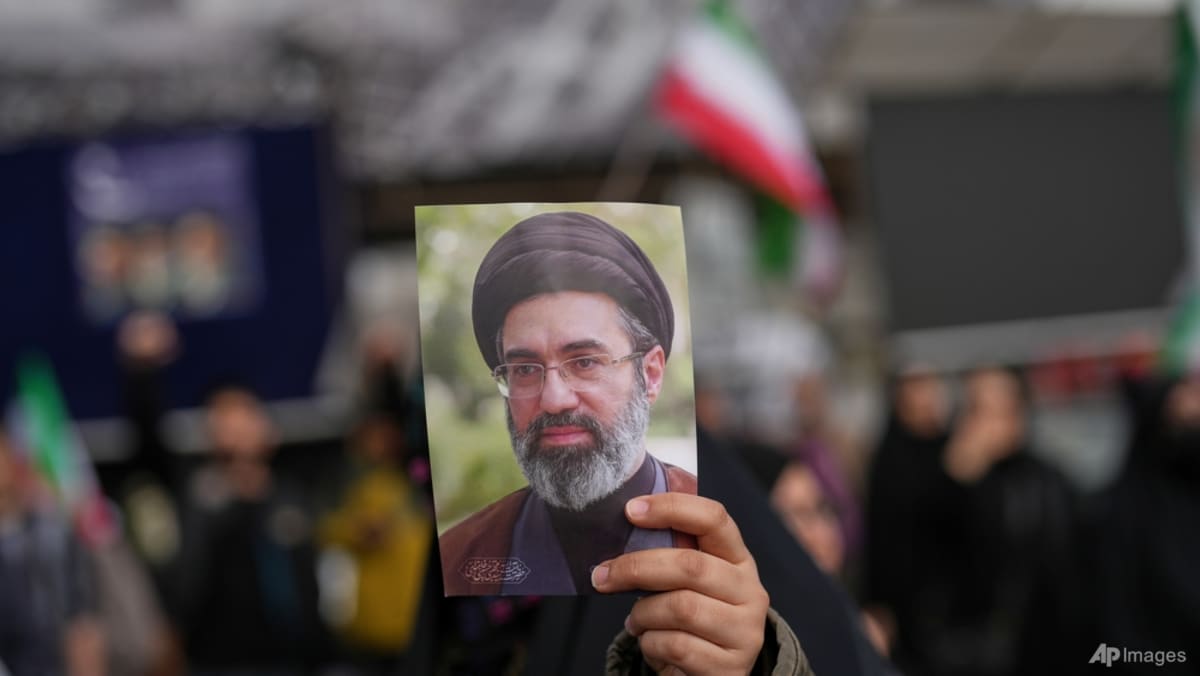
Khamenei’s absence is widely discussed on Iranian social media and in messaging app groups, when the country’s patchy internet allows, with conspiracy theories widespread about his condition and who is running the country.
One popular meme circulating online is a picture of an empty chair under a spotlight with the slogan “Where is Mojtaba?”
However, some government supporters, including a senior member of the Basij militia, a volunteer paramilitary group run by the Revolutionary Guards, said that it was important for Khamenei to keep a low profile, given the threat posed by waves of US and Israeli airstrikes that have already wiped out much of the country’s leadership.
A lower-ranking Basij member agreed.
“Why should he appear in public? To become a target for these criminals?” Mohammad Hosseini, from the city of Qom, said in a text message.