

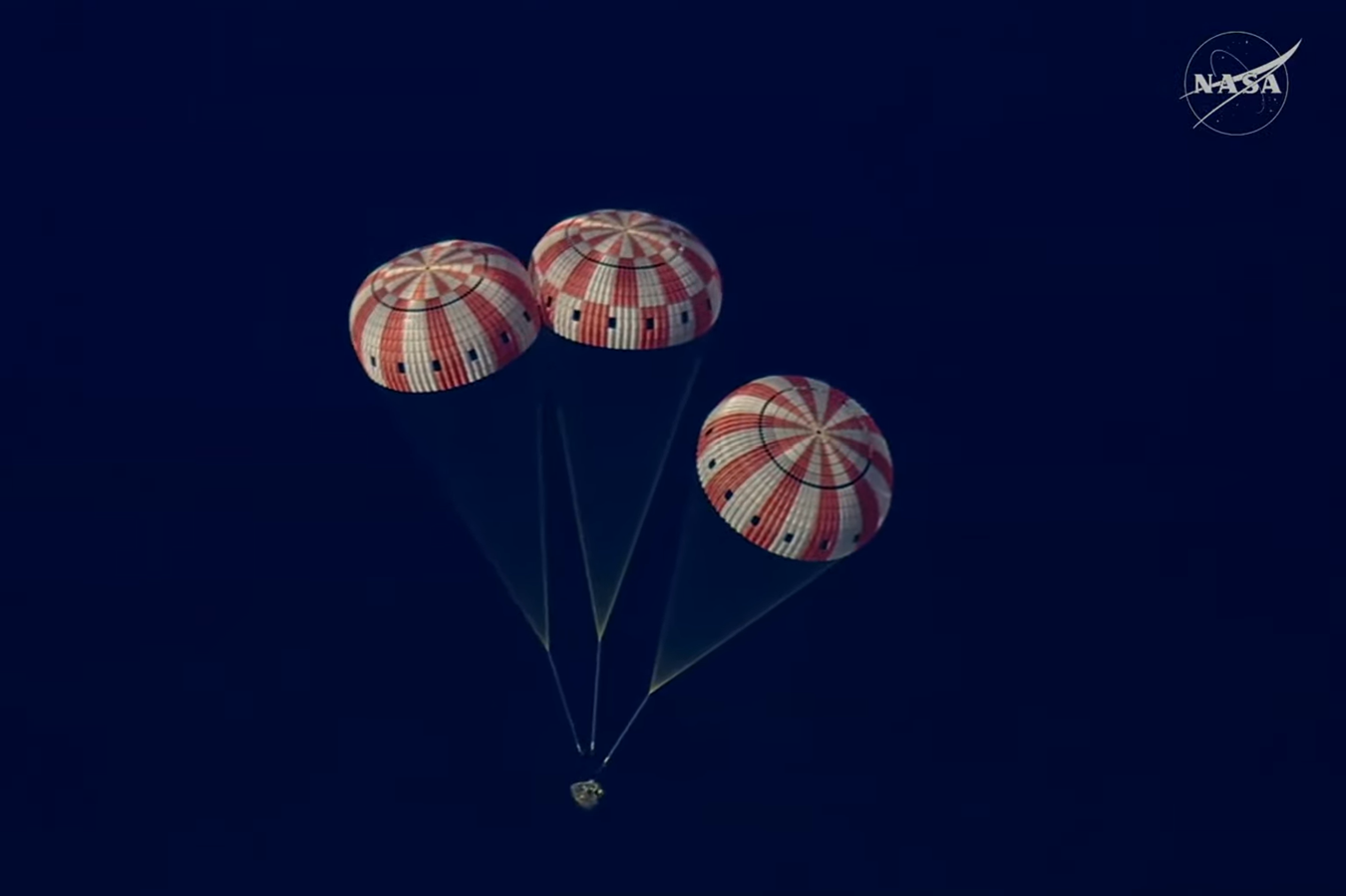
The astronauts of the Artemis II mission have made it home. Their journey, which began in Cape Canaveral, Florida, on 1 April, took them around the moon and further from Earth than any human has travelled before. On 10 April, they splashed down in their capsule off the coast of California. On landing, mission commander Reid Wiseman reported “four green crew members”, indicating that he, his NASA crewmates Victor Glover and Christina Koch and Canadian astronaut Jeremy Hansen were all feeling good after re-entering Earth’s atmosphere. “What a journey,” he said.
This historic flight marked the first time humans have been to the moon since the Apollo 18 mission in 1972. At its most distant, the Orion capsule was 406,771 kilometres from Earth, beating the distance record set by the crew of the Apollo 13 mission in 1970.
The main purpose of Artemis II was to act as a test flight for future lunar missions, a test it passed with flying colours, but there were several science goals as well. Several of them were tied to the hues of the lunar surface – it appears simply grey from afar, but up close the astronauts noted green, brown and even orange hues. These observations can help scientists unravel the composition and history of the lunar surface, particularly on its far side, where the astronauts observed some areas that have never been directly seen by human eyes before.
When Earth and the moon were both visible at once, though, the brightness of sunlight reflected off the planet in a phenomenon called earthshine drowned out these subtle variations. “The moon turned into a sponge of light,” said Koch. “As soon as the Earth got close enough to be in my field of view to take them both in at the same time, [the moon] dulled, it turned into a sponge, it’s almost like it went matte.” In fact, the earthshine through one of the windows throughout the flight was so bright that the crew covered the window with a spare shirt, prompting calls for future missions to include dedicated window shades.
The astronauts also took pictures and made voice recordings as they watched the moon go by, including detailed descriptions of the terrain below them. “It’s those kind of nuanced observations that could ultimately inform future landed missions, future crewed missions, to understand where [we can] go to maximise the scientific value,” said NASA’s Artemis science lead, Kelsey Young, in a 7 April press conference. “These ultimately get at chronology of the solar system, at how the inner solar system has evolved over time, which connects to the moon being the witness plate for our planet and for the inner solar system.”
While their spacecraft was behind the moon, the Artemis crew also got to witness a solar eclipse unlike any visible from Earth, in which the sun appeared smaller than the moon in the sky as it disappeared behind the lunar horizon. “The eclipse occurred, and then we had 5 minutes of human emotional reaction to staring at that orb floating in the vastness of space,” said Wiseman. “Then right after that, somebody in the cabin said, ‘Let’s look for impact flashes,’ and immediately we saw one or two or three.”
Spotting impact flashes, which are momentary sparks of light caused by meteorites hitting the darkened surface of the moon, was one of the mission’s science goals, because observing them can help us figure out how concerned future missions to the surface should be about meteorite impacts.
The next mission in the Artemis programme, Artemis III, won’t include a landing or even a visit to the moon, after a series of recent changes aimed at making the programme nimbler and more practical. Instead, it will primarily be about testing the Orion capsule’s ability to dock with lunar landers in orbit around Earth. It is planned for 2027; the next lunar landing is scheduled for the Artemis IV mission in 2028.
All of these flights are part of a larger goal to build a sustained human presence on the moon. NASA recently announced a pivot in its plans, from a space station in lunar orbit to a base on the ground, and China’s space programme has similar aspirations. The hope is that within a few decades, going to the moon will be as relatively routine as visiting the International Space Station is now – and eventually, maybe as routine as a transcontinental flight. Whether or not that happens, the images from Artemis II have been emblazoned on the public consciousness, injecting new life into our view of the moon.
Topics: