

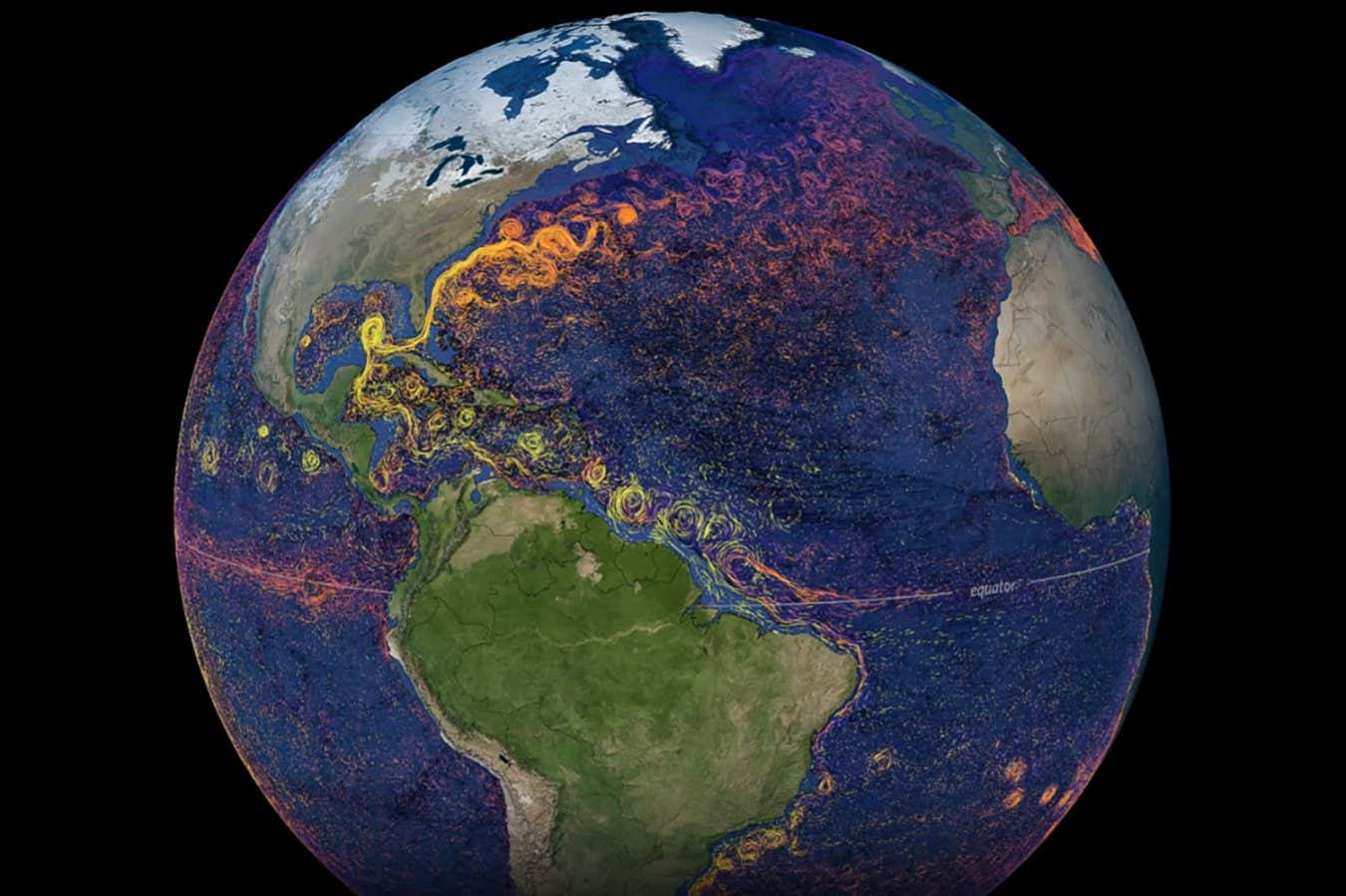
Visualisation showing the western boundary currents that form part of the Atlantic Meridional Overturning Circulation
NASA’s Scientific Visualization Studio
Buoy measurements show the Atlantic Meridional Overturning Circulation, which moderates Europe’s climate, is weakening at four different latitudes, the strongest evidence so far that this system of ocean currents is slowing and could be heading toward collapse.
Part of the ocean conveyor belt of currents circling the globe, the AMOC brings warm, salty water from the Gulf of Mexico to the north Atlantic, keeping temperatures in western Europe milder than in Canada or Russia. The dense water then cools and sinks, moving south on the seafloor along the western side of the Atlantic.
Analysis of old ocean temperature readings suggests the AMOC has weakened 15 per cent since 1950, and some computer modelling has warned it could shut down within decades. But scientists have been measuring it directly for only about two decades, not long enough to draw firm conclusions.
Now, a study in the western Atlantic has shown more convincingly that the AMOC is slowing.
“The Atlantic circulation is weakening at the western boundary, and we use multiple latitudes of the basin array data to confirm such a signal from the western boundary is consistent across the wider north Atlantic,” says Qianjiang Xing at the University of Miami, Florida, who led the study.
In 2004, the University of Miami and other institutions installed a line of anchored moorings from the Bahamas to the Canary Islands called RAPID-MOCHA. With this array’s measurements of temperature, salinity and velocity, scientists estimate pressure, or “how much water is effectively stacked up” on either side of the Atlantic, according to team member Shane Elipot, also at the University of Miami.
Water flows from areas of high pressure to areas of low pressure, but is deflected to the right by the counterclockwise rotation of Earth, driving the overturning circulation. Changes in pressure, therefore, can indicate changes in AMOC strength.
The study’s analysis of the latest RAPID-MOCHA data shows that the flow of the AMOC is declining by about 90,000 cubic metres of water per second each year, a faster rate than what has previously been observed. That means between 2004 and 2023, the AMOC weakened by about 10 per cent.
But the uncertainty range of this change in flow is almost as large as the change itself. For this reason, Xin’s study also analyses pressure changes at three mooring arrays that have been installed since 2004 in the western Atlantic off the West Indies, the US east coast and Nova Scotia, Canada. There, it finds an even greater weakening of the AMOC, with much less uncertainty.
“It is the strongest direct observational evidence so far” that the AMOC is weakening, as models have long shown, says Stefan Rahmstorf at the University of Potsdam, Germany, who wasn’t involved in the research.
Scientists think freshwater from the melting of the Greenland ice sheet is diluting the dense, salty water of the AMOC, so it sinks more slowly, weakening the southward flow along the bottom of the western Atlantic. The declining trend observed by the study at four latitudes in the western Atlantic suggests this is indeed happening.
“We expect to see that in the deep western boundary,” says team member David Smeed at the UK’s National Oceanography Centre. “It’s giving us confidence that that interpretation is correct.”
“They show for the first time I’m aware of that there is this very coherent picture of deep western overturning weakening for all different kinds of latitudes,” says René van Westen at Utrecht University in the Netherlands, who wasn’t part of the research.
The findings underscore the need for more observations to try to understand whether the AMOC is heading for collapse, according to Elipot. A collapse would cause dramatically colder winters in Europe and could disrupt Asian and African monsoons.
“The trend would be consistent with going towards the tipping point,” he says.
Topics: