
Close Menu
    Trending
    • True-or-false for Round 1 of 2026 NFL Draft: Will Cowboys regret their trade?
    • Opinion | Stewart Brand, Silicon Valley’s Favorite Prophet, on Life’s Most Important Principle
    • Struggling to scale your company? Here are five things that could be holding you back
    • What happens if you’re hit by a primordial black hole?
    • When is London Marathon 2026? Start time and how to watch race for FREE
    • Pentagon Requests $54 Billion For AI War
    • Clavicular Hit With New YouTube Crackdown
    • Beijing’s new supply chain rules deepen concerns for US firms in China
    Benjamin Franklin Institute
    Friday, April 24
    • Home
    • Politics
    • Business
    • Science
    • Technology
    • Arts & Entertainment
    • International
    Benjamin Franklin Institute
    Home»Science»Particles seen emerging from empty space for first time
    Science

    Particles seen emerging from empty space for first time

    Team_Benjamin Franklin InstituteBy Team_Benjamin Franklin InstituteApril 8, 2026No Comments3 Mins Read
    Share Facebook Twitter Pinterest Copy Link LinkedIn Tumblr Email VKontakte Telegram
    Share
    Facebook Twitter Pinterest Email Copy Link


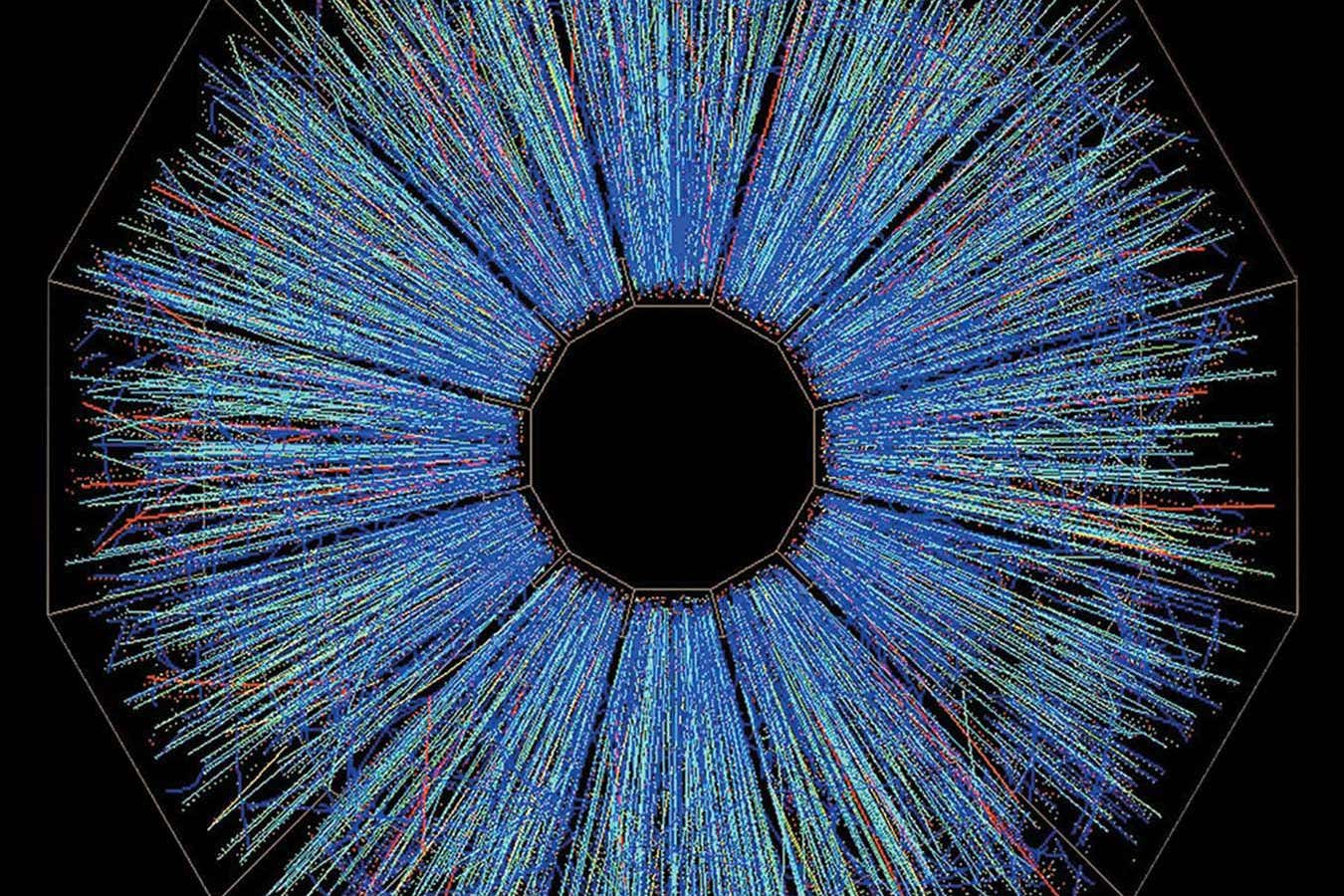
    Particle collisions inside the STAR detector at the Solenoidal Tracker at RHIC, known as STAR

    Brookhaven National Laboratory

    A pair of rare particles produced in high-energy proton collisions may be the clearest evidence yet that mass can emerge from empty space. The finding could shed light on one of the biggest puzzles in physics: how particles acquire their mass.

    According to quantum chromodynamics (QCD) – widely considered to be our best theory for describing the strong force, which binds quarks inside protons and neutrons – even a perfect vacuum isn’t truly empty. Instead, it is filled with short-lived disturbances in the underlying energy of space that flicker in and out of existence, known as virtual particles. Among them are quark-antiquark pairs.

    Under normal conditions, these fleeting pairs vanish almost as soon as they appear. But if enough energy is injected into a vacuum, QCD predicts they can be promoted into real, detectable particles with measurable mass.

    Now, the STAR collaboration – an international team of physicists working at the Relativistic Heavy Ion Collider in Brookhaven National Laboratory in New York state – has observed this process for the first time.

    The team smashed together high-energy protons in a vacuum, producing a spray of particles. Some of these particles should be quark-antiquark pairs pulled directly from the vacuum itself, but quarks can never exist alone and immediately combine into composite particles.

    Luckily for the team, these particular particles hold a clue as to their origins. Quarks and antiquarks are born with their spins correlated — a shared quantum alignment inherited from the vacuum.

    The researchers found that this link persists even after the quarks and antiquarks become part of larger particles called hyperons, which decay in less than a tenth of a billionth of a second. Spotting these spin-aligned hyperons in the aftermath of the proton collisions allowed the researchers to confirm that the quarks within them came from the vacuum.

    “This is the first time we’ve seen the entire process,” says Zhoudunming Tu, a member of the STAR collaboration.

    “I’m very happy to see this measurement,” says Daniel Boer at the University of Groningen in the Netherlands, who wasn’t involved with the work. He says there are still many mysteries about quarks, such as why they can’t exist alone. “This is what makes this experiment especially interesting.”

    Tu thinks that the work opens a new way to examine the properties of the vacuum directly, hopefully allowing scientists to study how particles acquire mass. The theory of QCD predicts that quarks gain more of their heft by interacting with the vacuum itself, but how they do so is unclear.

    Alessandro Bacchetta at the University of Pavia in Italy says the result isn’t yet definitive, as reconstructing events from particle collisions can be complex. Researchers must first exhaustively exclude other possibilities that could have led to the same signal, he says.

    Topics:


    Source link

    Share. Facebook Twitter Pinterest LinkedIn Tumblr Email Telegram Copy Link

    Related Posts

    Science

    What happens if you’re hit by a primordial black hole?

    April 24, 2026
    Science

    How do earthquakes end? A seismic ‘stop sign’ could help predict earthquake risk

    April 24, 2026
    Science

    ‘Kraken’ fossils show enormous, intelligent octopuses were top predators in Cretaceous seas

    April 24, 2026
    Science

    Largest ever octopus was great white shark of invertebrate predators

    April 24, 2026
    Science

    Do you need to worry about Mythos, Anthropic’s computer-hacking AI?

    April 23, 2026
    Science

    How many dachshunds would it take to get to the moon?

    April 23, 2026
    Editors Picks

    Opinion | ICE Is Losing the Political Battle

    January 16, 2026

    US ‘not concerned’ by reports Russia aiding Iran’s targeting

    March 7, 2026

    Iran Their Proxy War Against USA

    March 8, 2026

    What will the Fed’s minutes say about the path for interest rates?

    October 5, 2025

    Micah Parsons calls out Jerry Jones, Cowboys for slander

    January 1, 2026
    About Us
    About Us

    Welcome to Benjamin Franklin Institute, your premier destination for insightful, engaging, and diverse Political News and Opinions.

    The Benjamin Franklin Institute supports free speech, the U.S. Constitution and political candidates and organizations that promote and protect both of these important features of the American Experiment.

    We are passionate about delivering high-quality, accurate, and engaging content that resonates with our readers. Sign up for our text alerts and email newsletter to stay informed.

    Latest Posts

    True-or-false for Round 1 of 2026 NFL Draft: Will Cowboys regret their trade?

    April 24, 2026

    Opinion | Stewart Brand, Silicon Valley’s Favorite Prophet, on Life’s Most Important Principle

    April 24, 2026

    Struggling to scale your company? Here are five things that could be holding you back

    April 24, 2026

    Subscribe for Updates

    Stay informed by signing up for our free news alerts.

    Paid for by the Benjamin Franklin Institute. Not authorized by any candidate or candidate’s committee.
    • Privacy Policy
    • About us
    • Contact us

    Type above and press Enter to search. Press Esc to cancel.