
Close Menu
    Trending
    • India denounces ‘hellhole’ remark shared by Trump | Donald Trump News
    • New photos of Mike Vrabel and Dianna Russini emerge
    • AI search demands a new audience playbook
    • How do earthquakes end? A seismic ‘stop sign’ could help predict earthquake risk
    • Trump Announces Cease-Fire Between Israel and Lebanon
    • Google Is Tracking Your Life – Photo Cloud Feeding AI System
    • Rachel Zoe Confronts Amanda Frances In ‘RHOBH’ Reunion Clip
    • China’s DeepSeek says it released long-awaited new AI model
    Benjamin Franklin Institute
    Friday, April 24
    • Home
    • Politics
    • Business
    • Science
    • Technology
    • Arts & Entertainment
    • International
    Benjamin Franklin Institute
    Home»Science»We may have seen a ‘dirty fireball’ star explosion for the first time
    Science

    We may have seen a ‘dirty fireball’ star explosion for the first time

    Team_Benjamin Franklin InstituteBy Team_Benjamin Franklin InstituteApril 3, 2026No Comments3 Mins Read
    Share Facebook Twitter Pinterest Copy Link LinkedIn Tumblr Email VKontakte Telegram
    Share
    Facebook Twitter Pinterest Email Copy Link


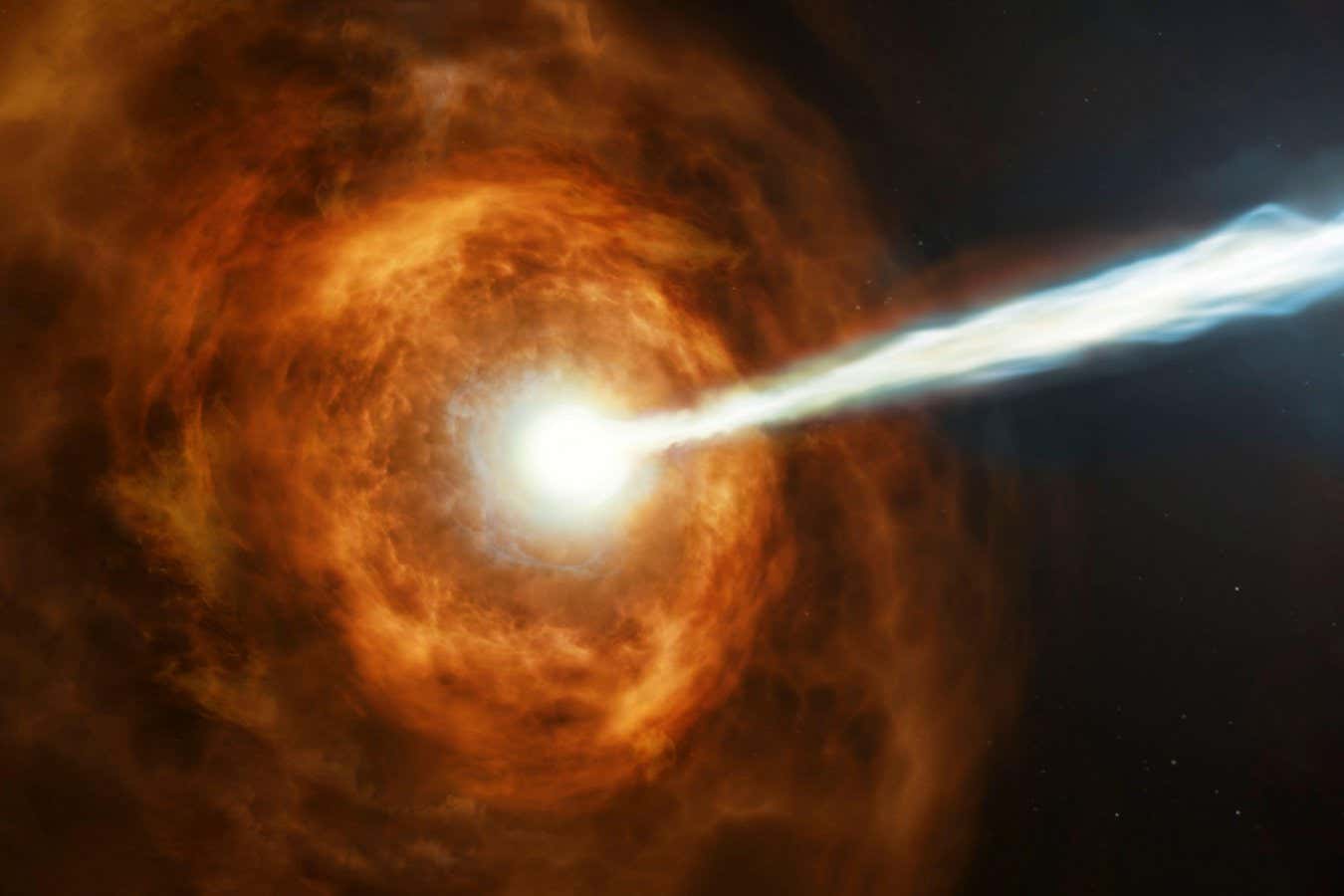
    Dying stars can emit a powerful jet of radiation, as seen in an artist’s impression

    Stocktrek Images, Inc./Alamy

    Astronomers think they have seen a type of explosion produced by a dying star called a dirty fireball for the first time, and it could help us understand how massive stars die.

    When a massive star runs out of fuel, it can collapse and explode in several ways. If a black hole is produced in the collapse, an extremely powerful jet of radiation can burst through the star, producing a flash of high-energy light called a gamma ray burst.

    These bursts are among the most powerful explosions in the universe and can emit energy equivalent to the total lifetime output of smaller stars, such as the sun, in a single beam. But astronomers still don’t know exactly how this process works or how variations between different massive stars affect the jet.

    Physicists have hypothesised that we might see something different if the jet somehow gets contaminated with heavier matter from the star, such as protons and neutrons. These particles would act as a sponge, slowing the jet down and causing it to emit X-rays, rather than gamma rays. But until now, this “dirty fireball” scenario hadn’t been observed.

    Xiang-Yu Wang at Nanjing University in China and his colleagues have now picked up a flash of X-rays called EP241113a that fits the picture of a dirty fireball, using a new space telescope called the Einstein Probe.

    Wang and his team detected a flash of light from a galaxy around 9 billion light years away, containing as much energy as a gamma ray burst, but in X-ray frequencies instead. The initial explosion faded to a glow that lasted several hours, before dying out gradually, similar to a typical gamma ray burst.

    “It’s a very exciting prospect,” says Rhaana Starling at the University of Leicester, UK. “[Dirty fireballs] have been theorised to exist since the 90s, but there hasn’t really been any compelling evidence for them.”

    While we know of thousands of gamma ray bursts, the event producing this blast is likely to be different from others, says Starling. It might be a black hole or neutron star that is interacting with the jet in an interesting physical way, for example. “If it’s a black hole, then we are able to then get a more complete picture of black hole formation across the universe,” she says.

    It also shows us that the gamma ray bursts we typically see could be an observational bias, and there could be many more like this or weaker, says Gavin Lamb at Liverpool John Moores University, UK. “There could well be a continuum that goes right the way down to no jets.”

    However, we can’t yet be certain that this is a dirty fireball, says Om Sharan Salafia at Brera Astronomical Observatory in Italy. First, we have to establish whether the explosion really did come from a galaxy as distant as Wang and his team claim. “If all of this holds, then indeed, this transient is a bit puzzling,” he says.

    Topics:


    Source link

    Share. Facebook Twitter Pinterest LinkedIn Tumblr Email Telegram Copy Link

    Related Posts

    Science

    How do earthquakes end? A seismic ‘stop sign’ could help predict earthquake risk

    April 24, 2026
    Science

    ‘Kraken’ fossils show enormous, intelligent octopuses were top predators in Cretaceous seas

    April 24, 2026
    Science

    Largest ever octopus was great white shark of invertebrate predators

    April 24, 2026
    Science

    Do you need to worry about Mythos, Anthropic’s computer-hacking AI?

    April 23, 2026
    Science

    How many dachshunds would it take to get to the moon?

    April 23, 2026
    Science

    The Age Code review: Can you slow ageing with your diet? A new book gives it a go

    April 23, 2026
    Editors Picks

    Jerry Jones sends clear message to players about 18-game schedule

    April 1, 2026

    Billie Eilish Gets Ridiculed By Bill Maher Over ‘Stolen Land’ Remark

    February 8, 2026

    Why 1.5°C failed and setting a new limit would make things worse

    February 11, 2026

    Teenage hackers are on the rise, and they’re more dangerous than you think

    March 2, 2026

    Our big brains may have evolved because of placental sex hormones

    June 20, 2025
    About Us
    About Us

    Welcome to Benjamin Franklin Institute, your premier destination for insightful, engaging, and diverse Political News and Opinions.

    The Benjamin Franklin Institute supports free speech, the U.S. Constitution and political candidates and organizations that promote and protect both of these important features of the American Experiment.

    We are passionate about delivering high-quality, accurate, and engaging content that resonates with our readers. Sign up for our text alerts and email newsletter to stay informed.

    Latest Posts

    India denounces ‘hellhole’ remark shared by Trump | Donald Trump News

    April 24, 2026

    New photos of Mike Vrabel and Dianna Russini emerge

    April 24, 2026

    AI search demands a new audience playbook

    April 24, 2026

    Subscribe for Updates

    Stay informed by signing up for our free news alerts.

    Paid for by the Benjamin Franklin Institute. Not authorized by any candidate or candidate’s committee.
    • Privacy Policy
    • About us
    • Contact us

    Type above and press Enter to search. Press Esc to cancel.