

Can you survive inside a tornado? This scientist did by accident—he’s lucky to be alive
Atmospheric scientist Perry Samson was doing fieldwork when he was unexpectedly caught inside a tornado—making him one of the few such people who have lived to tell the tale
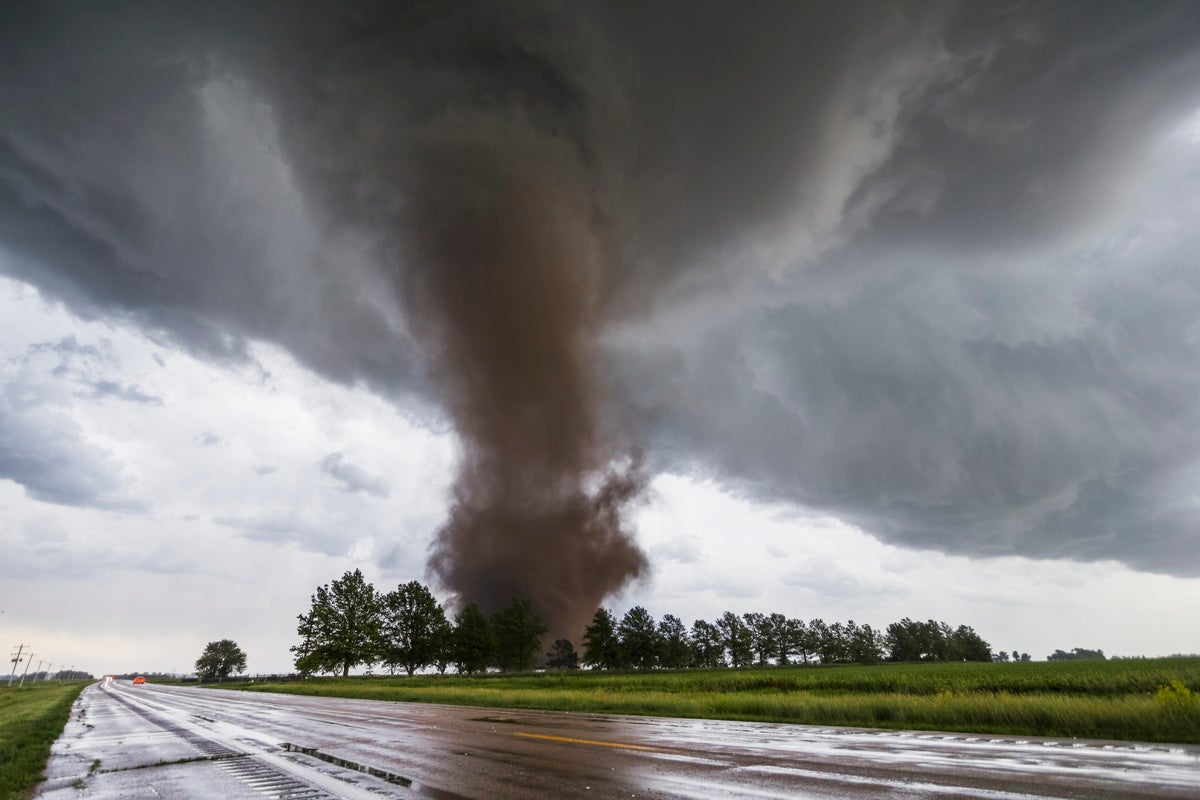
A tornado seen in Nebraska in 2011.
Mike Hollingshead/Getty Images
The following essay is reprinted with permission from  The Conversation, an online publication covering the latest research.
Can a person survive inside a tornado? – Sophia, age 14, Greencastle, Indiana
I have seen the center of a monster. Most people describe the sound of a tornado as like a freight train, but up close, it’s more like a thousand screaming jet engines. I am one of the few people on Earth who has driven into a tornado and lived to tell the tale.
On supporting science journalism
If you’re enjoying this article, consider supporting our award-winning journalism by subscribing. By purchasing a subscription you are helping to ensure the future of impactful stories about the discoveries and ideas shaping our world today.
While it might sound like a scene from a Hollywood blockbuster involving a high-tech armored truck, my experience was much more dangerous and terrifying.
I am an atmospheric scientist who studies tornadoes, but I am only alive today because of split-second decisions and a massive amount of dumb luck. Believe me, I do not want to ever be in that situation again.
The day the sky broke
It started in northwest Kansas, where I was studying supercell thunderstorms – the kind that produce tornadoes – with a team of students from the University of Michigan.
We were positioned under a thunderstorm that was so dark, we had to turn on our vehicles’ headlights in the middle of the day. Suddenly, a tornado formed and began charging directly toward us.
The students were in other vehicles and got away, but my car was quickly swallowed by a cloud of flying debris so thick that I couldn’t even see my own hood.
With my options disappearing, I made a desperate move: I turned the car directly into the wind, hoping the vehicle’s aerodynamics would keep us pinned to the ground rather than being flipped like a toy.
The physics of fear
When you’re inside a tornado’s vortex, your body experiences things the news cameras can’t capture:
-
The pressure change: A tornado is a localized area of rapidly changing pressure. Your ears don’t just “pop” – they ache, as if your head is being squeezed by giant hands.
-
The solid wind: We measured wind speeds of almost 150 mph (241 kph) nearby, but inside the vortex, they were likely much higher. At those speeds, air hits you with the force of a solid object.
-
The soup of darkness: In movies, the “eye” is a clear space. In reality, it’s a debris ball – a brownish-black soup of pulverized soil, trees and buildings. It was so dark that my camera couldn’t even register a picture.
As debris slammed into my windshield, I was terrified I’d be crushed by flying materials – tornadoes can pick up fences, wood and metal from buildings, tree branches, even cows. Textbook advice says to get into a ditch so you’re lying flat and might be more protected from flying debris. But the wind was so violent, I couldn’t even open the car door. I just stayed low and prayed.
The making of a monster
How does this severe of a storm even happen? It takes a perfect, violent recipe of atmospheric ingredients:
-
Fuel: A tornado needs warm, muggy air (water vapor) near the ground with dry air above it. This creates the potential for rising air, but only if the atmosphere is unstable enough to overcome “the cap.”
-
The cap: A thin “inversion” layer of stable air acts like a lid on that warm moist air, bottling it up until the moist air punches through.
-
The dry line: The dry line is where warm, moist air from the Gulf of Mexico and dry air from the west meet. The advancing hot, dry air is actually heavier than muggy air, and this dry air pushes the moist air upward, disrupting the cap.
-
Wind shear: Surface winds from the south and upper winds from the west create a horizontal rolling motion in the atmosphere. When the air is pushed upward, that rotation becomes vertical, creating what’s known as a mesocyclone.
-
The jet stream: About 5 to 7 miles (8 to 11 kilometers) up, the jet stream is a fast-moving river of air. Disturbances within it can create areas that pull air upward from below and lower surface pressure.
Together, these ingredients can create the powerful, rotating vortex that you know as a tornado.
These storms can have winds up to 300 mph (482 kph) and leave a long path of destruction, sometimes more than a mile (1.6 kilometers) wide. They can stay on the ground for seconds or many minutes, tearing apart buildings and trees in their path. Where they will travel is hard to predict, so getting to safety should be a priority.
The monster’s lesson
When the storm passed, the silence was jarring. My rental car was mired in mud, the antenna was bent in half, and bits of straw were embedded in every single seam of the car’s body.
Tornadoes are extremely dangerous. Sixty-one people were killed by tornadoes in the U.S. in 2025, and many more were injured by flying debris. Make sure you know what to do when a tornado alert sounds – follow the alert’s advice and get to safety immediately.
When scientists chase storms, they are not trying to experience tornadoes – they are trying to measure the small-scale processes inside storms that cannot be observed in other ways. Many of the key processes that produce tornadoes occur within a few hundred meters of the ground and evolve over minutes, which means radars, satellites and weather stations often miss them.
Seeing a tornado and the damage it causes is a powerful reminder that people are not in control of everything. It serves as a warning to be wise and ready for anything. Sophisticated research using drones and radar is the smart way to study these monsters – seeing them from the inside is definitely not.
Willa Connolly, a student at Tappan Middle School in Ann Arbor, Michigan, contributed to this article.
Curious Kids is a series for children of all ages. If you have a question you’d like an expert to answer, send it to curiouskidsus@theconversation.com.
This article was originally published on The Conversation. Read the original article.
It’s Time to Stand Up for Science
If you enjoyed this article, I’d like to ask for your support. Scientific American has served as an advocate for science and industry for 180 years, and right now may be the most critical moment in that two-century history.
I’ve been a Scientific American subscriber since I was 12 years old, and it helped shape the way I look at the world. SciAm always educates and delights me, and inspires a sense of awe for our vast, beautiful universe. I hope it does that for you, too.
If you subscribe to Scientific American, you help ensure that our coverage is centered on meaningful research and discovery; that we have the resources to report on the decisions that threaten labs across the U.S.; and that we support both budding and working scientists at a time when the value of science itself too often goes unrecognized.
In return, you get essential news, captivating podcasts, brilliant infographics, can’t-miss newsletters, must-watch videos, challenging games, and the science world’s best writing and reporting. You can even gift someone a subscription.
There has never been a more important time for us to stand up and show why science matters. I hope you’ll support us in that mission.