
Close Menu
    Trending
    • Negotiations that enable Israel’s land-grabs | Israel-Palestine conflict
    • True-or-false for Round 1 of 2026 NFL Draft: Will Cowboys regret their trade?
    • Opinion | Stewart Brand, Silicon Valley’s Favorite Prophet, on Life’s Most Important Principle
    • Struggling to scale your company? Here are five things that could be holding you back
    • What happens if you’re hit by a primordial black hole?
    • When is London Marathon 2026? Start time and how to watch race for FREE
    • Pentagon Requests $54 Billion For AI War
    • Clavicular Hit With New YouTube Crackdown
    Benjamin Franklin Institute
    Friday, April 24
    • Home
    • Politics
    • Business
    • Science
    • Technology
    • Arts & Entertainment
    • International
    Benjamin Franklin Institute
    Home»Science»New Scientist Book Club: Read an extract from Kim Stanley Robinson’s sci-fi classic Red Mars
    Science

    New Scientist Book Club: Read an extract from Kim Stanley Robinson’s sci-fi classic Red Mars

    Team_Benjamin Franklin InstituteBy Team_Benjamin Franklin InstituteMarch 28, 2026No Comments3 Mins Read
    Share Facebook Twitter Pinterest Copy Link LinkedIn Tumblr Email VKontakte Telegram
    Share
    Facebook Twitter Pinterest Email Copy Link


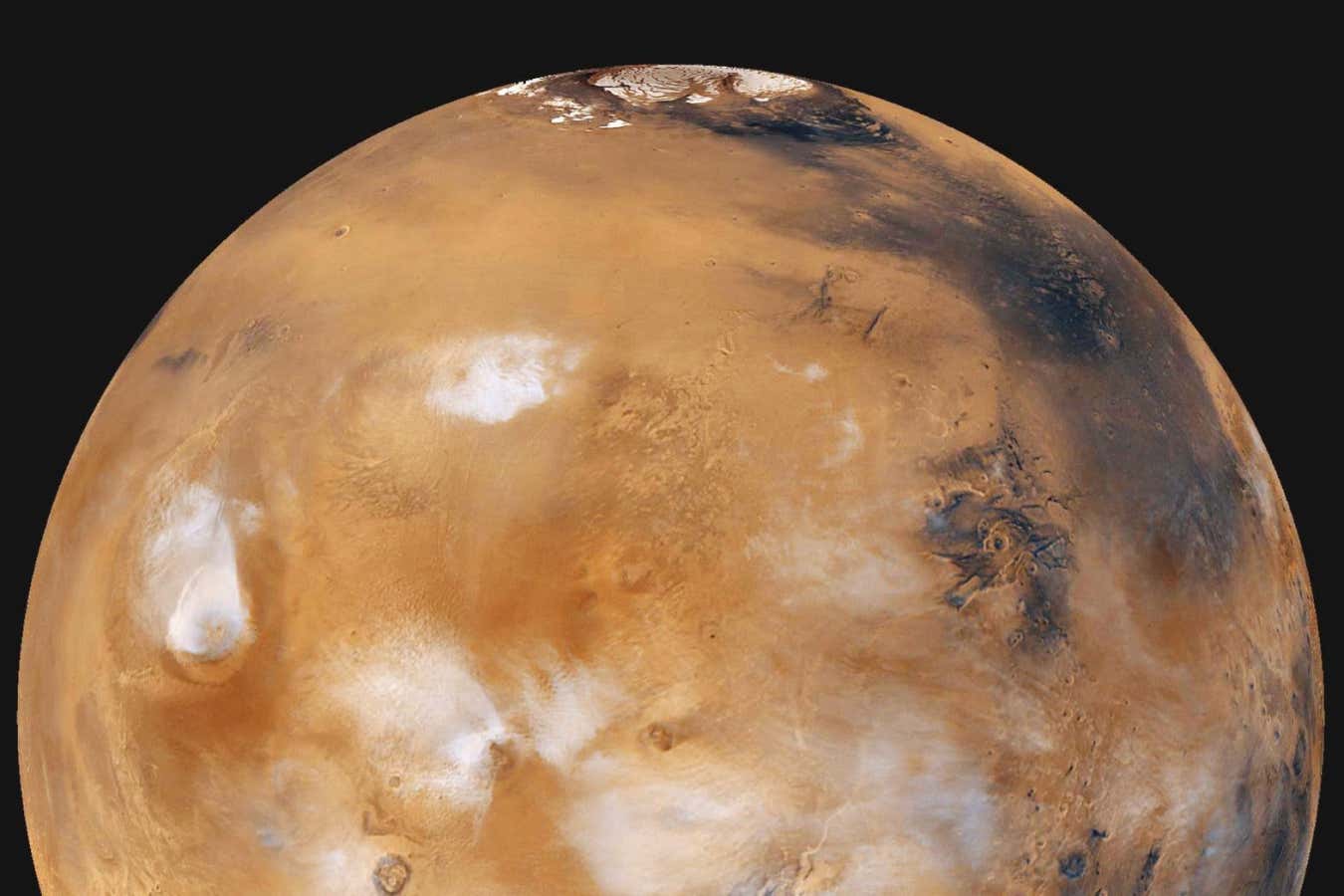
    Bluish-white water ice clouds hang above the Tharsis volcanoes on Mars

    NASA/JPL/MSSS

    Mars was empty before we came. That’s not to say that nothing had ever happened. The planet had accreted, melted, roiled and cooled, leaving a surface scarred by enormous geological features: craters, canyons, volcanoes. But all of that happened in mineral unconsciousness, and unobserved. There were no witnesses – except for us, looking from the planet next door, and that only in the last moment of its long history. We are all the consciousness that Mars has ever had.

    Now everybody knows the history of Mars in the human mind: how for all the generations of prehistory it was one of the chief lights in the sky, because of its redness and fluctuating intensity, and the way it stalled in its wandering course through the stars, and sometimes even reversed direction. It seemed to be saying something with all that. So perhaps it is not surprising that all the oldest names for Mars have a peculiar weight on the tongue – Nirgal, Mangala, Auqakuh, Harmakhis – they sound as if they were even older than the ancient languages we find them in, as if they were fossil words from the Ice Age or before. Yes, for thousands of years Mars was a sacred power in human affairs; and its color made it a dangerous power, representing blood, anger, war and the heart.

    Then the first telescopes gave us a closer look, and we saw the little orange disk, with its white poles and dark patches spreading and shrinking as the long seasons passed. No improvement in the technology of the telescope ever gave us much more than that; but the best Earthbound images gave Lowell enough blurs to inspire a story, the story we all know, of a dying world and a heroic people, desperately building canals to hold off the final deadly encroachment of the desert.

    It was a great story. But then Mariner and Viking sent back their photos, and everything changed. Our knowledge of Mars expanded by magnitudes, we literally knew millions of times more about this planet than we had before. And there before us flew a new world, a world unsuspected.

    It seemed, however, to be a world without life. People searched for signs of past or present Martian life, anything from microbes to the doomed canal-builders, or even alien visitors. As you know, no evidence for any of these has ever been found. And so stories have naturally blossomed to fill the gap, just as in Lowell’s time, or in Homer’s, or in the caves or on the savannah – stories of microfossils wrecked by our bio-organisms, of ruins found in dust storms and then lost forever, of Big Man and all his adventures, of the elusive little red people, always glimpsed out of the corner of the eye. And all of these tales are told in an attempt to give Mars life, or to bring it to life. Because we are still those animals who survived the Ice Age, and looked up at the night sky in wonder, and told stories. And Mars has never ceased to be what it was to us from our very beginning – a great sign, a great symbol, a great power.

    And so we came here. It had been a power; now it became a place.

    This is an extract from Kim Stanley Robinson’s Red Mars, the latest pick for the New Scientist Book Club. Sign up and read along with us here.

    Topics:


    Source link

    Share. Facebook Twitter Pinterest LinkedIn Tumblr Email Telegram Copy Link

    Related Posts

    Science

    What happens if you’re hit by a primordial black hole?

    April 24, 2026
    Science

    How do earthquakes end? A seismic ‘stop sign’ could help predict earthquake risk

    April 24, 2026
    Science

    ‘Kraken’ fossils show enormous, intelligent octopuses were top predators in Cretaceous seas

    April 24, 2026
    Science

    Largest ever octopus was great white shark of invertebrate predators

    April 24, 2026
    Science

    Do you need to worry about Mythos, Anthropic’s computer-hacking AI?

    April 23, 2026
    Science

    How many dachshunds would it take to get to the moon?

    April 23, 2026
    Editors Picks

    Opinion | The Failure of Donald Trump

    April 17, 2026

    Kate Middleton Allegedly Found To Be Meghan Markle ‘Abrasive’

    February 24, 2026

    Brooks Marks Breaks His Silence On Robert Cosby Jr.’s ‘Devastating’ Death

    March 8, 2026

    Claressa Shields Blasted Online After Flaunting $30,000 Louis Vuitton Haul

    December 29, 2025

    Let’s nitpick about the physics of Stranger Things, not its ending

    January 25, 2026
    About Us
    About Us

    Welcome to Benjamin Franklin Institute, your premier destination for insightful, engaging, and diverse Political News and Opinions.

    The Benjamin Franklin Institute supports free speech, the U.S. Constitution and political candidates and organizations that promote and protect both of these important features of the American Experiment.

    We are passionate about delivering high-quality, accurate, and engaging content that resonates with our readers. Sign up for our text alerts and email newsletter to stay informed.

    Latest Posts

    Negotiations that enable Israel’s land-grabs | Israel-Palestine conflict

    April 24, 2026

    True-or-false for Round 1 of 2026 NFL Draft: Will Cowboys regret their trade?

    April 24, 2026

    Opinion | Stewart Brand, Silicon Valley’s Favorite Prophet, on Life’s Most Important Principle

    April 24, 2026

    Subscribe for Updates

    Stay informed by signing up for our free news alerts.

    Paid for by the Benjamin Franklin Institute. Not authorized by any candidate or candidate’s committee.
    • Privacy Policy
    • About us
    • Contact us

    Type above and press Enter to search. Press Esc to cancel.