

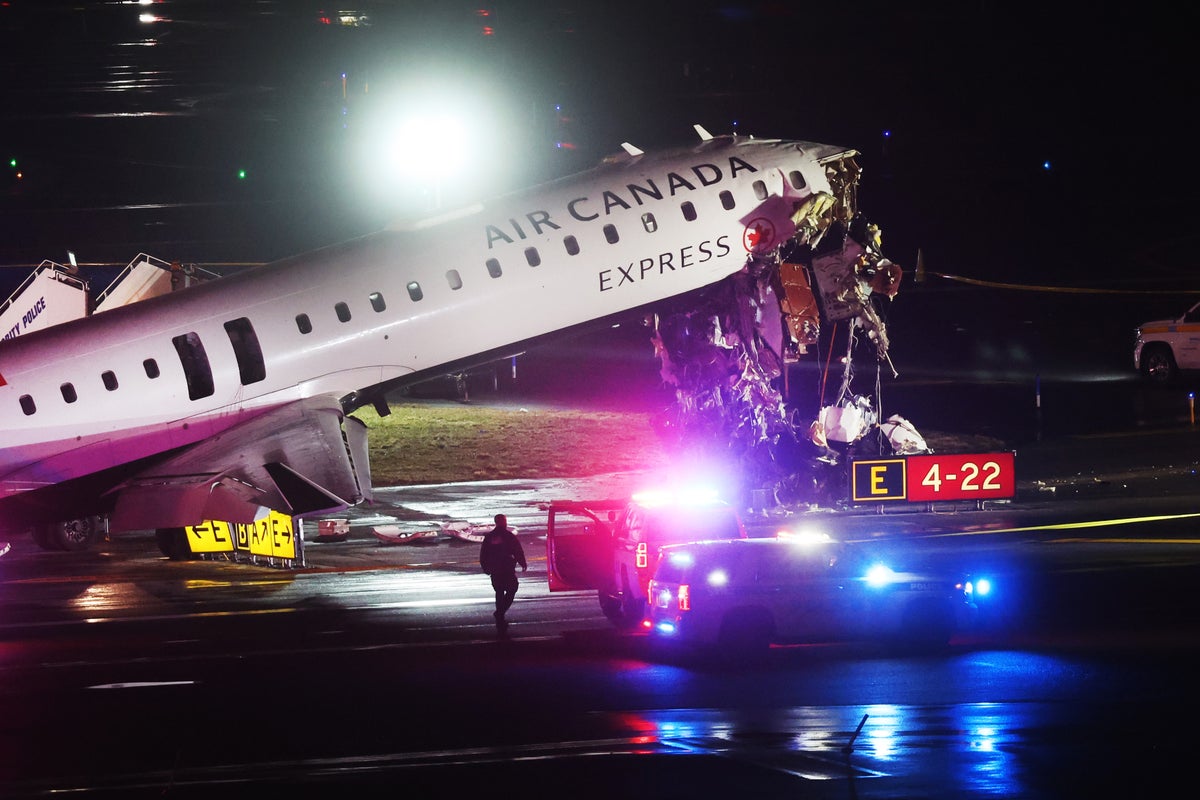
Why the LaGuardia plane crash was so destructive
Engineers explain how a collision between an Air Canada plane and a fire truck at one of New York’s busiest airports turned deadly
Spencer Platt/Getty Images
The shocking collision between an Air Canada plane arriving into LaGuardia airport and a fire truck on the runway Sunday night has left at least two people dead and many unanswered questions about how, exactly, this could have happened at one of the nation’s busiest airports.
What we know is that the Air Canada plane had just touched down in New York from Montreal and was carrying an estimated 72 passengers and four crew members. The plane was apparently traveling at more than 90 miles per hour when it was struck by a fire truck responding to a separate incident. The collision appears to have sheared off the plane’s nose cone. Both of the Air Canada pilots were killed in the collision, the airline said in a statement. Forty-one people on board and two firefighters were taken to the hospital, according to the Port Authority of New York and New Jersey; 32 had reportedly been released by Monday afternoon. It’s unclear how serious any remaining injuries may be.
In the aftermath of the incident, many questions remain, including the role of air traffic control, which apparently gave the go-ahead for the fire truck to move onto the runway before telling it to stop. But part of what made the collision so disastrous, experts say, may lie in how planes are designed.
On supporting science journalism
If you’re enjoying this article, consider supporting our award-winning journalism by subscribing. By purchasing a subscription you are helping to ensure the future of impactful stories about the discoveries and ideas shaping our world today.
Airplanes are engineered to avoid in-air collisions with other aircraft, to withstand turbulence and bird strikes, and to even survive emergency landings—including on water—but they aren’t designed for road vehicle collisions.
“They’re engineered in design, number one, for airworthiness,” says Michael McCormick, an associate professor in air traffic management at Embry-Riddle Aeronautical University. That includes the ability to withstand many departures and arrivals on the landing gear, and in the event of a “wheels-up” landing—an emergency—to withstand the force of hitting the ground on the bottom of the aircraft and to “essentially slide down the runway.”
A plane doesn’t have the same kind of crash protection as a car might, such as air bags, bumpers and a hard-frame cab designed to absorb the energy of a direct hit, McCormick says. “The automobiles are designed to take collisions and tested multiple times in multiple ways. Aircraft are not.”
Airplane cockpits are specifically designed to withstand a bird strike, and the underwing engines are designed to tear off if landing in the water, says John Hansman, a professor of aeronautics and astronautics at the Massachusetts Institute of Technology. “[Planes] are not designed to bump into things,” he says. And everything about an airplane is designed to balance weight and strength: “anything you do to make the airplane stronger adds weight to the airplane that you have to carry and becomes inefficiency,” he says.
While much of an airplane is made of aluminum, the nose tip, which houses the radar equipment, is made of plastic. “If it was metal, the radar wouldn’t be able to function,” McCormick says—making that area of the plane even more vulnerable to wrecking in the rare event of a crash.
Planes also aren’t made to swerve like a car. Although pilots are trained to make “touch-and-go” landings—in which they take off immediately after touchdown—the plane would still need to build up speed to take off.
“Once you get to a certain point, even if there’s a truck in front of you, you don’t have enough room to take off again, and you can only stop as fast as you can stop,” Hansman says. “Particularly, if it pulled out suddenly in front of you, there wouldn’t be anything you could do,” he adds.
In addition, LaGuardia is a “notoriously short” airport, McCormick says: its runways were not originally designed to accommodate commercial jets and had to be extended in the 1960s. It’s unclear, however, if the length of the airport’s runways played a role in Sunday’s incident.
Authorities closed the airport on Monday “to allow for a thorough investigation” by federal authorities. It was reopened at around 2 P.M. Eastern time.
It’s Time to Stand Up for Science
If you enjoyed this article, I’d like to ask for your support. Scientific American has served as an advocate for science and industry for 180 years, and right now may be the most critical moment in that two-century history.
I’ve been a Scientific American subscriber since I was 12 years old, and it helped shape the way I look at the world. SciAm always educates and delights me, and inspires a sense of awe for our vast, beautiful universe. I hope it does that for you, too.
If you subscribe to Scientific American, you help ensure that our coverage is centered on meaningful research and discovery; that we have the resources to report on the decisions that threaten labs across the U.S.; and that we support both budding and working scientists at a time when the value of science itself too often goes unrecognized.
In return, you get essential news, captivating podcasts, brilliant infographics, can’t-miss newsletters, must-watch videos, challenging games, and the science world’s best writing and reporting. You can even gift someone a subscription.
There has never been a more important time for us to stand up and show why science matters. I hope you’ll support us in that mission.