

Everything about this week’s record-shattering western heat wave is extreme
An astoundingly strong heat wave is not just setting records across the western U.S.—it’s pulverizing them
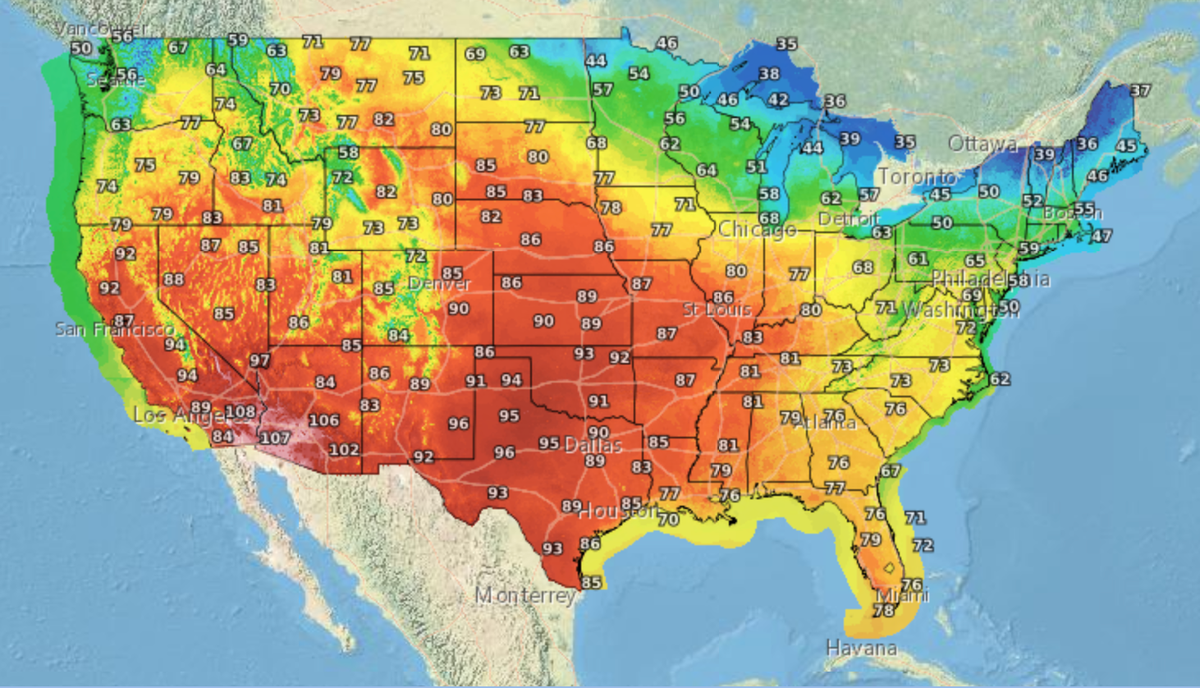
Temperatures across the western U.S. are soaring to 20 to 30 degrees Fahrenheit above normal.
Editor’s note (3/21/26): Four stations (two in Arizona and two in California) recorded temperatures of 112 degrees Fahrenheit (44.4 degrees Celsius) on Friday, March 20, besting the all-time U.S. March record set just the day before. That is 1 degree F (0.56 degree C) below the all-time April U.S. record. Eight states have set all-time high temperature records for March during this heat wave.
On Wednesday in North Shore, Calif., the temperature soared to a stunning 108 degrees Fahrenheit (42 degrees Celsius)—matching the hottest March temperature on record for the state. And then, on Thursday, Phoenix, Ariz., hit 105 degrees F (41 degrees C)—the earliest such recording by more than a month. And that same day, the temperature just outside Martinez Lake, Ariz., reached 110 degrees F (43 degrees C)—the highest March temperature ever recorded in the U.S.
The heat wave that is engulfing much of the western U.S. right now is unprecedented. A high-pressure area—the strongest ever observed over the Southwest in March—ushered in the unseasonably scorching weather. This area, also known as a ridge because of the northward humps in the jet stream that the phenomenon is associated with, covers an enormous swath of the U.S. It will persist for days and is sending temperatures 20 to 30 degrees F (11 to 17 degrees C) above normal. It is “one of the more meteorologically exceptional events that I’ve seen in recent years in the American West, and that is saying something,” said climate scientist Daniel Swain on his YouTube channel.
On supporting science journalism
If you’re enjoying this article, consider supporting our award-winning journalism by subscribing. By purchasing a subscription you are helping to ensure the future of impactful stories about the discoveries and ideas shaping our world today.
Typically, any record high temperatures in March tend to be set toward the end of the month, when it’s climatologically warmer. But this heat wave is so extreme that it has been besting some April records, never mind those for March. The event is “breaking records by … just absurd margins,” Swain said.
“This is a summerlike ridge occurring in March. It’s really genuinely shocking,” he added.
Ridges are always flanked by low-pressure areas, and the air at the surface flows from the high to low pressure. That leaves room for air in the atmosphere above to subside down to the surface. As the air subsides, it is compressed, which warms it up. The air under a ridge is also stable, preventing the formation of clouds or rainstorms—the clear skies allow sunlight to heat up the surface unimpeded.
Another, opposing weather pattern is also juicing the heat: a “Kona low” that drenched Hawaii in record-breaking rain last week. Essentially, when there’s a lot of water vapor in the atmosphere, that represents potential—or latent—heat. When that water vapor condenses and gets wrung out of the atmosphere as intense precipitation (rain), it releases that heat. That’s what happened with the Kona low, and an atmospheric river is now shunting that moisture and heat up to the Pacific Northwest, where some of it is diverging into the ridge and likely adding to the warmth.
But climate change is also playing a role. The World Weather Attribution research group, which does rapid analyses looking for the fingerprints of climate change on extreme weather, has said this heat wave would be “virtually impossible without climate change.”
In just the past decade, such an event has become about four times more likely because of the heat trapped by greenhouse gases in the atmosphere and up to 1.4 degrees F (0.8 degree C) hotter than it might otherwise have been.
Heat advisories and extreme heat alerts have been issued for many western states to warn of the health risks of heat, particularly for the very young, older individuals and people who work outside—even though summer temperatures often get much higher than this. The concern is based not just on the number on the thermometer but also on the sudden onset of the heat. Normally, humans have time to acclimate gradually to warming temperatures throughout the spring and summer. But not now.
Read more: How to Keep Your Home Cool in Extreme Heat
Some experts are also concerned that the heat could make for ideal conditions for wildfires to spread. Much of the West is in some stage of drought, and the snowpack that usually keeps soils and streams topped up with moisture in the spring is worryingly low. The heat wave is likely to melt whatever is left in “a shocking, sudden snowpack loss event,” Swain said on his YouTube channel. That will set up even worse drought conditions and wildfire risk as spring and summer wear on.
It’s Time to Stand Up for Science
If you enjoyed this article, I’d like to ask for your support. Scientific American has served as an advocate for science and industry for 180 years, and right now may be the most critical moment in that two-century history.
I’ve been a Scientific American subscriber since I was 12 years old, and it helped shape the way I look at the world. SciAm always educates and delights me, and inspires a sense of awe for our vast, beautiful universe. I hope it does that for you, too.
If you subscribe to Scientific American, you help ensure that our coverage is centered on meaningful research and discovery; that we have the resources to report on the decisions that threaten labs across the U.S.; and that we support both budding and working scientists at a time when the value of science itself too often goes unrecognized.
In return, you get essential news, captivating podcasts, brilliant infographics, can’t-miss newsletters, must-watch videos, challenging games, and the science world’s best writing and reporting. You can even gift someone a subscription.
There has never been a more important time for us to stand up and show why science matters. I hope you’ll support us in that mission.