

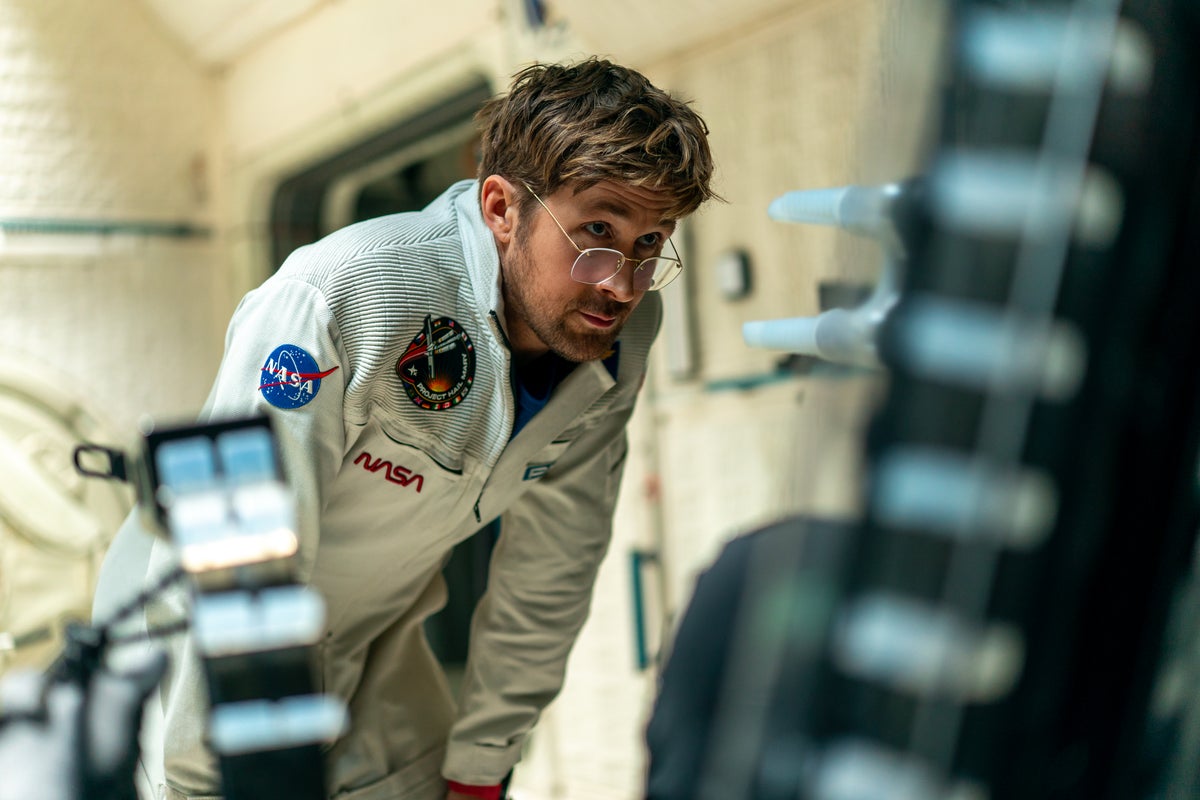
Imagine waking up, groggy and bearded, on a space ship light-years from Earth. That’s how Ryland Grace, played by Ryan Gosling, awakens in the new space drama Project Hail Mary. As the audience soon learns, Grace, a middle school science teacher, was apparently sent on a mission to save the sun from dying.
The movie is largely based in science, from the names of the stars—Tau Ceti is very much a real star—to its depictions of artificial gravity. Aside from some fuzzy quantum physics and fictional sun-eating microbes called Astrophage, “everything else just follows established physics and science,” said Andy Weir, author of the novel Project Hail Mary and a producer of its film adaptation, in a recent interview with Scientific American.
Does that include the movie’s opening scene? According to the science, yes and no.
On supporting science journalism
If you’re enjoying this article, consider supporting our award-winning journalism by subscribing. By purchasing a subscription you are helping to ensure the future of impactful stories about the discoveries and ideas shaping our world today.
In the book, Grace understands his sleep condition to be something akin to a medically induced coma, or a form of “suspended animation.” He’s hooked up to an IV and feeding tubes and receives “constant medical care” from an onboard robot. “Everything a body needs,” Weir writes in the book.
But putting someone into a pharmacological coma for long-term space travel would be tricky, says Matteo Cerri, an associate professor of physiology at the University of Bologna in Italy. For one, it wouldn’t meaningfully slow the body’s metabolism, which means it might not change the body’s demands for food or oxygen. And importantly, “at a certain point, the drugs become toxic,” Cerri says.
It would, however, be possible to slow metabolism down, he says, in a kind of induced hibernationlike state, or “synthetic torpor.” Many animals, such as bears and hamsters, suppress their metabolic rate and use less oxygen than normal during a state called torpor. And other animals, such as ground squirrels, enter an extended form of torpor known as true hibernation. Lower body temperatures and less energy demand mean they don’t need to eat or drink, sometimes for months on end, Cerri says. “Life is moving but very slowly. It’s like you slow down the clock of life, and every second lasts longer,” he explains.
In humans, “in theory, synthetic torpor would work. I strongly believe that,” Cerri says. He currently chairs a research group for the European Space Agency that studies how to induce human hibernation or torpor for space travel. Being able to enter such as state in space has advantages, such as the lower metabolic demands and potentially longer lifespans, and it can provide protection against radiation, Cerri explains, in part because lower oxygen levels in tissues may boost resistance to radiation. “Radiation is the number one problem for space exploration,” he says. “There is no solution at the moment.”
No researchers have managed to induce hibernation in a human yet, but Cerri and his colleagues have shown it is possible to induce torpor in animals that don’t naturally enter the state: rats. By injecting drugs into part of the brain stem, the researchers “tricked” part of the rat brain to induce a synthetic torpor. But for safety reasons, it’s not yet possible to replicate the experiment in humans.
Another potential strategy that is often depicted in science fiction—Alien, Avatar, Futurama, and more—is “cryosleep,” basically freezing a person’s body to thaw out later without somehow killing them in the process. Again, no one has done this in real life. But some scientists say it’s possible, at least in theory.
“I believe reversible human cryostasis will become technically possible,” says Alexander German, a molecular neurology researcher at the Friedrich-AlexanderUniversity of Erlangen-Nuremberg in Germany. “If you look at nature, it is not a completely alien concept,” he says. Tardigrades, he notes, can “vitrify,” or turn to a glasslike substance, while Siberian salamanders can survive frozen for years in permafrost, and Arctic ground squirrels can survive for weeks at body temperatures below freezing. This raises “the question of why humans should not possess a latent biological potential for this if we apply the right methods,” German says.
In a paper published in early March, German and his colleagues successfully recovered brain activity in slices of mouse brains after vitrification at –196 degrees Celsius. “This provides evidence that reversible cryostasis may be possible in principle, although we still have a long way to go in practice,” German says.
The risk with cryonics is that as water becomes ice, it expands into a crystal form like a “blade in a balloon,” Cerri explains, and can burst cells. If scientists ever solve this problem, among others (including the toxicity of vitrification chemicals), and make cryosleep viable, however, “it will be revolutionary, because it will allow for a very, very long trip” in space, he says.
Surprisingly, one detail that science-fiction movies, including Project Hail Mary, often get wrong about suspended animation is the waking up, Cerri says. “The thing that every movie gets wrong, usually, is the arousal. Waking up is too immediate,” he explains. In theory, to safely come back from induced hibernation, or even cryosleep, the body and mind would likely need hours or days to reverse the changes induced by torpor. “Every organ has to ‘go back to work,’” Cerri says.