

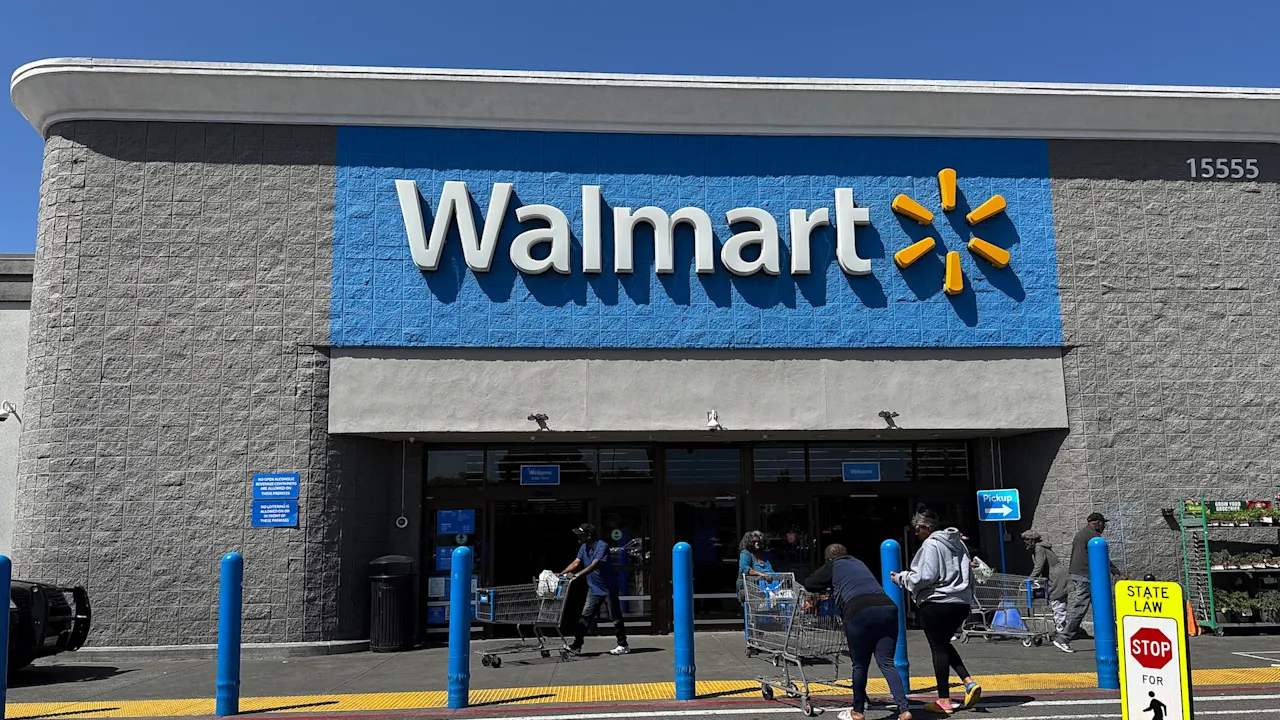
On the one hand, the fact that Walmart passed $1 trillion in market cap is notable, but not especially surprising. The company has long been the largest company in the world, measured by revenue. Almost everyone is familiar with the small five-and-dime store that started in one of the most rural towns in America and grew up to become the biggest retailer in the world.
On paper, this looks like just another milestone in a 64-year-old success story. But a closer look at how Walmart just hit a market cap reserved almost exclusively for tech giants reveals how the company has changed, even in just the past three years.
For the past six decades, Walmart was the king of bricks and mortar. No one would think of it as the underdog, but as more and more shopping moved online, the company faced intense pressure, especially from Amazon.
And so, over the past few years, Walmart rebuilt itself into something that looks a lot more like a tech company. It even moved its stock to the Nasdaq, listed next to Apple, Nvidia, Meta, and—of course—Amazon.
Here are the three most significant things that led to Walmart’s transformation into a $1 trillion giant:
The most tangible part is actually something most people won’t ever see—at least, not directly. In late 2024, Walmart used its AI to overhaul 850 million lines of product data. This is pretty boring stuff—granular details like dimensions, descriptions, and specifications, for nearly every item it sells.
In the past, that kind of cleanup would have required 100 times the head count and a decade of manual entry. By doing it with code, Walmart built a foundation in which search results actually match customer intent. It’s the difference between guessing what you’re looking for and using technology to give you exactly what you want.
The second part of this story is about where the money was actually coming from. Retailers typically live on a 3 percent margin, while tech companies typically expect much more. To get to a $1 trillion market cap, Walmart had to find a way to make more than a few cents on a gallon of milk.
They found it in Walmart Connect, the company’s advertising arm. Over the past three years, this has grown into a high-margin business that looks a lot more like something from Amazon, Google, or Meta.
In late 2025, ad sales jumped 53 percent. That’s significant, considering that advertising has margins in the 70 to 80 percent range. And, because 90 percent of Americans live within 10 miles of a Walmart, the company has a “closed-loop” data set.
They know what you see on your Vizio TV at home and what you actually put in your cart an hour later. That has turned advertising and Walmart+ membership into roughly one-third of Walmart’s operating income.
Finally, the most Amazonian move Walmart made was realizing its 4,700 stores weren’t just places people go to shop, but also conveniently located fulfillment centers. By automating warehouse tasks and investing in AI-driven logistics, Walmart can now offer same-day delivery to 95 percent of U.S. households.
The company’s e-commerce push finally became a standalone profitable unit in 2025. By keeping its global workforce steady at 2.1 million while revenue soared, Walmart proved it could scale its business without just adding more stores or employees.
This shift became real when Walmart moved its stock from the NYSE to the Nasdaq in December. It was Walmart’s way of telling the market: Value us as a technology-focused growth company, not a grocery chain.
It took Sam Walton six decades to build the physical network. But it was a three-year sprint into AI and advertising that turned that network into a trillion-dollar asset. The stores are still there, but the business model underneath them has completely changed.
—Jason Aten
This article originally appeared on Fast Company’s sister website, Inc.com.
Inc. is the voice of the American entrepreneur. We inspire, inform, and document the most fascinating people in business: the risk-takers, the innovators, and the ultra-driven go-getters that represent the most dynamic force in the American economy.